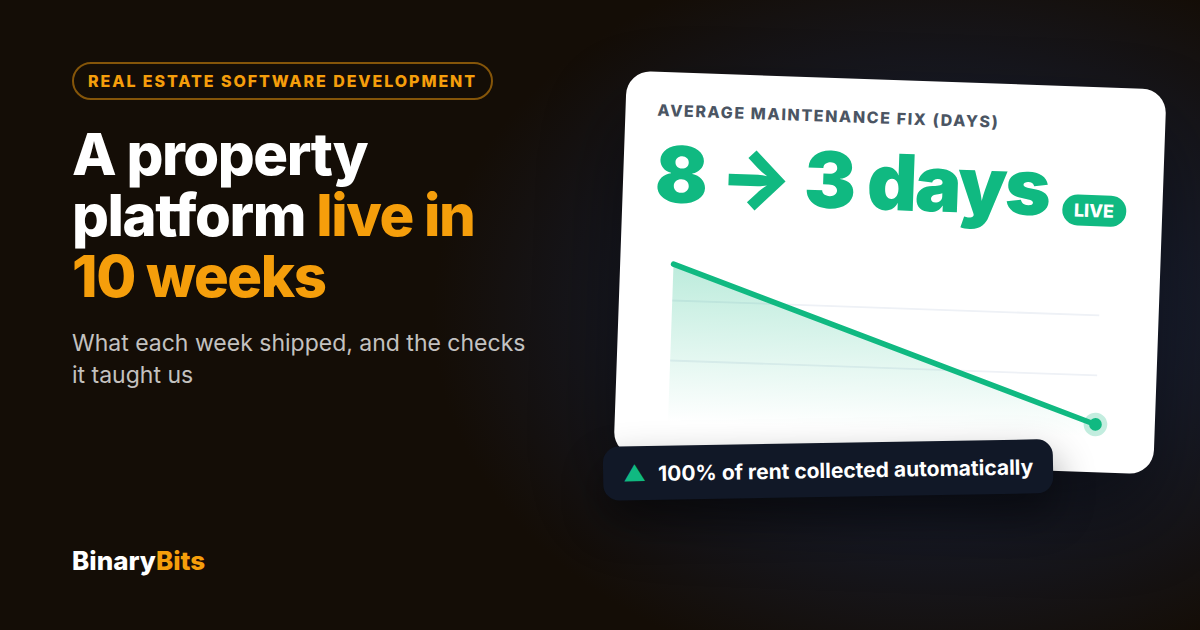
Good real estate software development services start with your data model and payments, not the screens. We built a property management platform (landlord dashboard, tenant portal, Stripe rent collection, maintenance, e-signed leases and a compliance calendar) in 10 weeks. One market guide puts a similar first version at 12-16 weeks and $70,000-$100,000. Here's what each week shipped and the checks it taught us.
The build is a live BinaryBits project for a UK property management company with 24 properties. The checks work the same for a US buyer, and there's a section on MLS and IDX listings for US teams.
💡 What you'll get from this post: a week-by-week view of a real build, 8 checks you can run on any developer, and the market price ranges with their sources.
TL;DR
- A focused property management platform can go live in about 10 weeks if the scope is fixed and the workflows are mapped in weeks 1-2.
- Ask any developer for the data model, a live payment demo and the plan for keeping each company's data separate. A good one shows you all three before you sign.
- You should own the code, the cloud account and the Stripe account from day one.
- Market guides put a first version at $30,000-$100,000 and a full platform at $70,000-$250,000+.
- US listing feeds (MLS/IDX) are licensed through the MLS and usually a broker. Plan for the paperwork, not just the code.
What real estate software do you need?
Most real estate software falls into four kinds. Pick the one that matches the job you're losing time on, because each has a different build and a different price.
| Kind | Who uses it | Core features | The hard part |
|---|---|---|---|
| Property management | Landlords, property managers | Rent collection, leases, maintenance, tenant portal | Payments, failed payments, compliance dates |
| Real estate CRM | Agents, brokerages | Leads, pipelines, follow-ups, reporting | Getting agents to use it every day |
| Listing portal or website | Brokerages, marketplaces | Search, map, saved searches, alerts | Licensed listing data (MLS/IDX in the US) |
| Transaction tools | Brokers, closing teams | Documents, e-signature, checklists, deadlines | Document workflows and audit trails |
This post follows a property management build, because that's the one we can show from start to finish. If you need a CRM, a listing portal or transaction tools, the week-by-week detail won't match yours, but the 8 checks further down still apply.
Should you buy off-the-shelf or build custom?
Buy first if a standard tool fits how you work. Building makes sense when one of these is true:
- Your workflow is the product. You want to sell the platform to other property companies, as our client now does.
- The tool's rules don't fit yours. Local compliance dates, unusual fee splits or a reporting format your owners expect.
- Per-unit fees grow faster than you do. Some subscriptions charge for every unit, every month, so a large portfolio pays more each year.
If none of these apply, a subscription is cheaper and faster. We'd tell you that on a call.
What did a 10-week property management build cover?
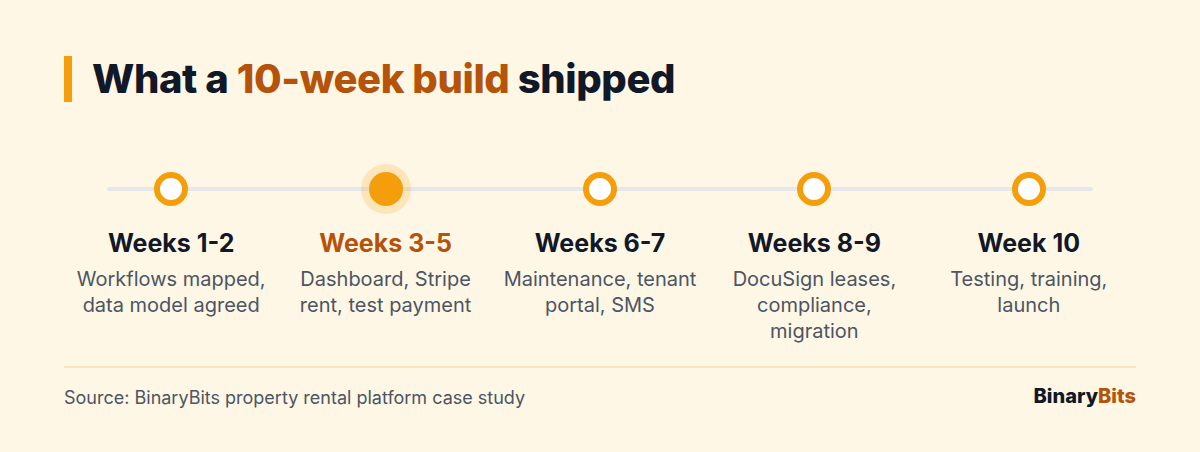
The client ran 24 rental properties on Excel, WhatsApp, email and PDF leases in Dropbox. Missed payments were noticed days late, renewals came with no warning and maintenance requests got lost. Here's what we shipped, week by week, as published on the property rental platform case study.
| Weeks | What shipped | Checkpoint |
|---|---|---|
| 1-2 | Workflow mapping and the data model: properties, tenancies, leases, payments, maintenance tickets, compliance records | Data model agreed |
| 3-5 | Landlord dashboard, Stripe recurring rent, failed-payment handling, receipts | First test payment in week 5 |
| 6-7 | Maintenance tickets with photos, tenant portal, SMS and email via Twilio and SendGrid | Tenants can raise and track issues |
| 8-9 | DocuSign lease signing, compliance calendar, migration of all 24 properties | Real data in the system |
| 10 | QA across both portals, final migration, team training, launch | First automated rent cycle |
Weeks 1-2: why does the data model come first?
The data model (the list of things the system stores and how they link) decides everything after it. A tenancy links a tenant, a property and a lease; a payment belongs to a tenancy; a gas safety certificate belongs to a property and has an expiry date. Get that wrong and every later feature fights it.
We mapped the client's spreadsheets and WhatsApp habits into that model before writing a screen. Two weeks felt slow to the client at the time. It's why weeks 3-9 didn't need rework.
Weeks 3-5: how was rent collection automated?
Rent runs on Stripe recurring payments, by card or direct debit. Tenants get reminders 7, 3 and 1 day before the due date and a receipt by email. A failed payment starts an automatic retry sequence and alerts the landlord at the same time.
We aimed for a real test payment by week 5 on purpose. Payments are where property software breaks, so they went first.
Weeks 6-9: maintenance, tenant portal, leases and compliance
- Maintenance: tenants raise a ticket with photos, it routes to the property manager, a contractor is assigned and the tenant hears when it's fixed.
- Tenant portal: lease details, payment history, receipts, maintenance requests and messages in one place.
- Leases: versioned storage, DocuSign signing, renewal reminders at 60, 30 and 7 days.
- Compliance calendar: gas safety certificates, EPCs (energy performance certificates), electrical reports and inspections, each with alerts.
The compliance items are UK rules. A US build would swap in its own state and city inspection dates; the calendar itself doesn't change.
Week 10: what changed after launch?
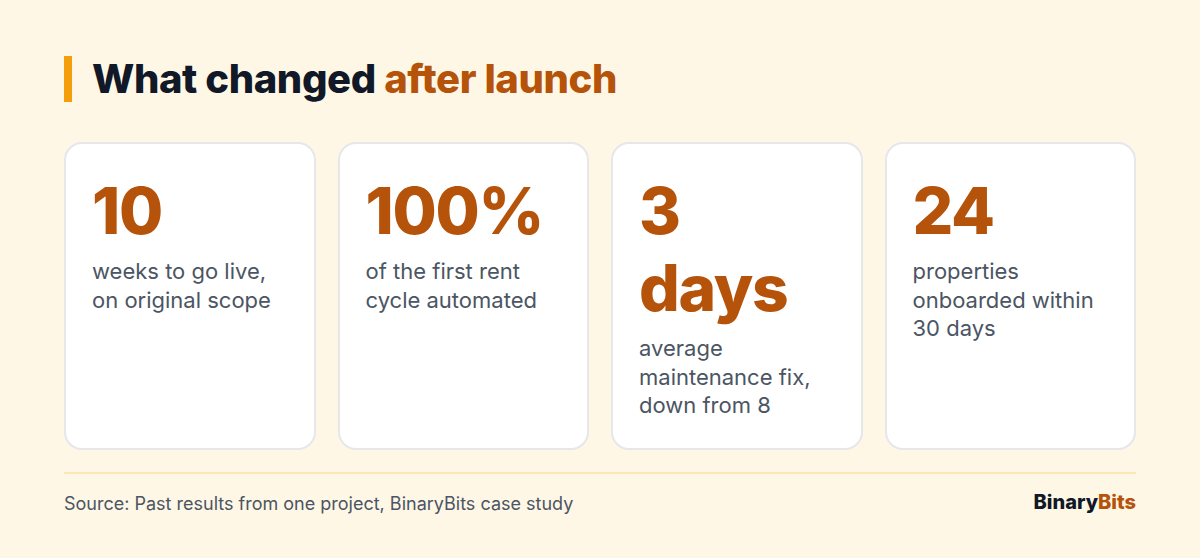
These are past results from this one project, as published on the case study, not a promise for yours:
- Live in 10 weeks, on time and to the original scope.
- Rent collection fully automated: the first automated rent cycle processed 100% of rent payments with no manual step (case study).
- Average maintenance resolution fell from 8 days to 3.
- All 24 properties and their active tenants were onboarded within 30 days of launch, and the spreadsheets were retired.
What wasn't in the 10 weeks?
Honest scope matters more than the week count. This build had no public listings, no online rental applications and no tenant screening. It was a responsive web app, not native iPhone and Android apps, which add scope of their own. It served one company with a clear way of working.
Add tenant screening (with US FCRA notices), payouts to owners or state lease templates and you're closer to the 16-22 weeks that RaftLabs gives for a second version. A developer who quotes 10 weeks for everything is guessing.
Planning a property platform and want a week-by-week plan for your scope? See how we scope web and product builds →
How do you check a real estate software development company?
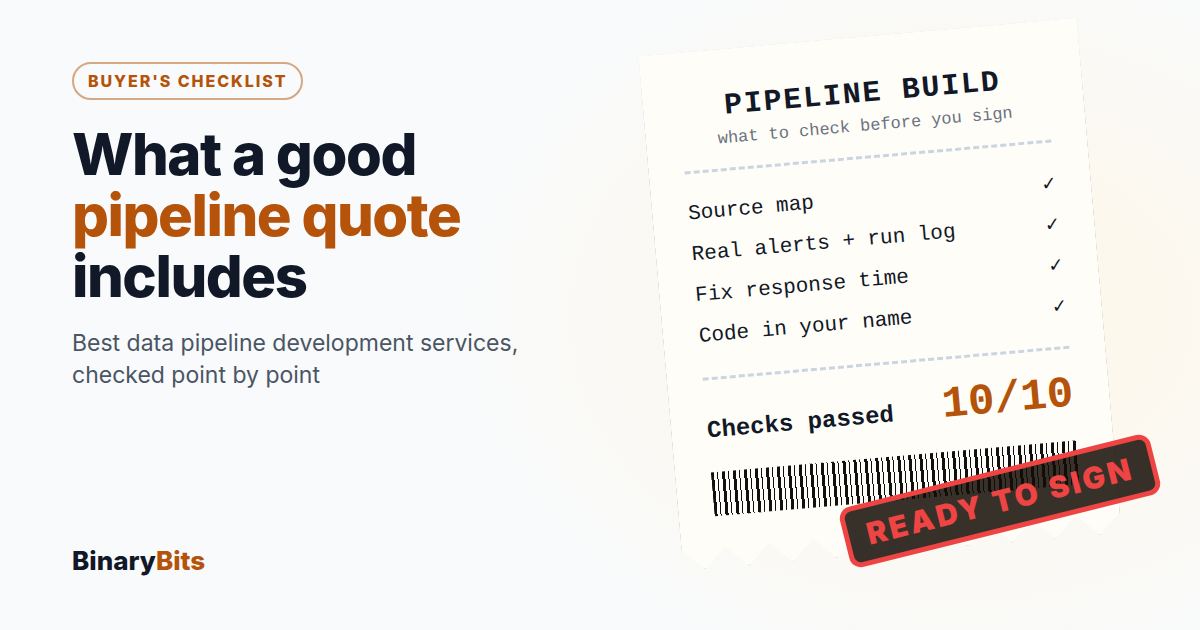
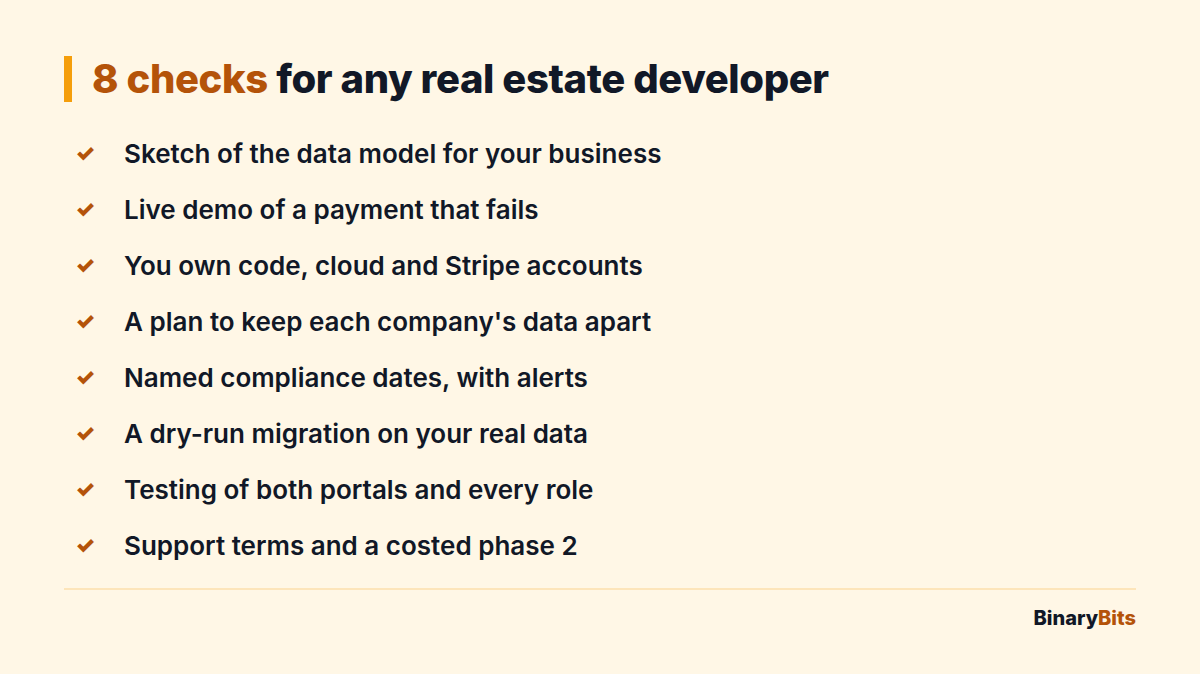
Portfolios and reviews tell you a company has built something. These 8 checks tell you whether they can build yours. Each one is something you can ask for in a first or second call.
| Check | What to ask for | A good answer |
|---|---|---|
| 1. Data model | A sketch of the main records for your business | Properties, units, tenancies, leases, payments, linked, with your edge cases |
| 2. Payments | A live demo of a payment that fails | Retry, alert, ledger update, receipt, all shown |
| 3. Ownership | Who owns code, cloud and Stripe accounts | You, from day one, in the contract |
| 4. Data separation | How one company's data stays apart from another's | A clear tenancy plan (see the next section) |
| 5. Compliance | Which dates and documents they'll track | Named rules for your state or country, with alerts |
| 6. Migration | How your spreadsheets get in | A dry run on real data before launch week |
| 7. Testing | What gets tested before launch | Both portals, payments, permissions by role |
| 8. After launch | Support terms and the next phase | Response times, a named person, a costed phase 2, and a past client you can call about deadlines and budget |
Why does owning the Stripe account matter?
If the developer opens the payment account in their name, your rent money and your payment history sit in an account you don't control. Moving later means re-collecting every tenant's payment details. Open it yourself and give the developer access.
One platform, many property companies: how does multi-tenancy work?
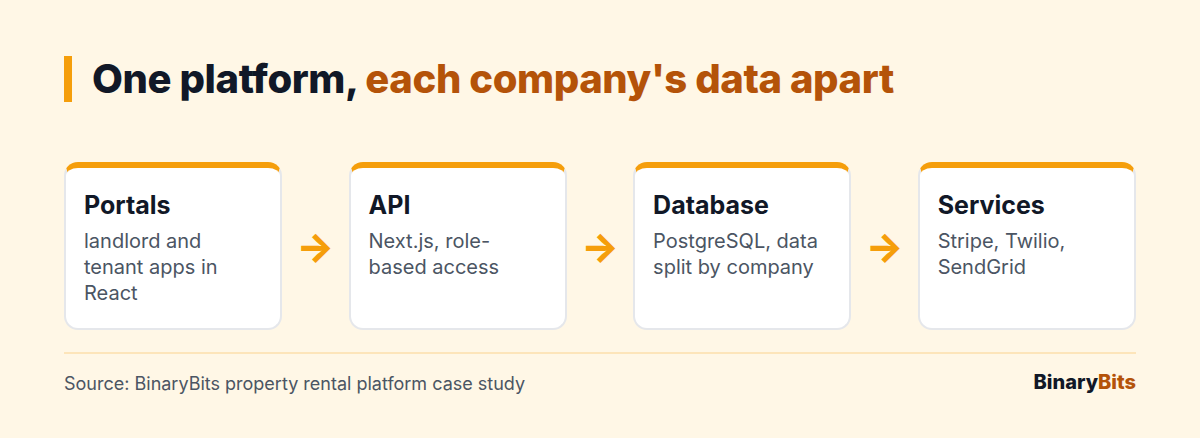
Multi-tenancy means one copy of the software serves many companies, with each company's data kept apart. It matters if you might ever sell your platform to others, which is exactly what happened here: the client is now marketing it to other management companies as a white-label product.
We designed the database for this from week 1. The platform runs as a React web app talking to a Next.js API with role-based access (each user only sees what their role allows), on a PostgreSQL database with a multi-tenant schema. The multi-company and white-label features themselves are what we're building now, in phase 2. Stripe handles payments, Twilio and SendGrid handle SMS and email.
Planning for this in week 1 is cheap. Adding it after launch means touching every table and every query. If white-label is on your roadmap, our guide to white-label software development covers the business side.
Can a developer integrate MLS or IDX listings?
Yes, but in the US the developer can't simply switch it on. An MLS (multiple listing service) licenses its listing data, and IDX (Internet Data Exchange) is the set of rules for showing it on a website. Access usually runs through a broker who is a member of that MLS.
The rules vary by MLS. North Carolina's NCRMLS asks most website vendors to sign a data access agreement with the broker and the broker's association, which typically charges a setup and annual fee. MLS PIN in New England offers a vendor agreement at $525 a month. Ask your developer which MLS you'll use and who signs.
We haven't built an MLS integration ourselves, so we won't claim one. If you only need property data rather than software, our sister company TheDataHQ covers property market data.
Which payment, e-signature and messaging services did we use?
- Stripe for recurring rent, failed-payment retries and receipts. If you'll pay out to many landlords, look at Stripe Connect, which is built for platforms.
- DocuSign for lease signing and renewals.
- Twilio for SMS reminders and SendGrid for email.
- AWS S3 for documents and maintenance photos.
Each one is a monthly cost on top of hosting, so ask for them in the running-cost estimate.
How much do real estate software development services cost?
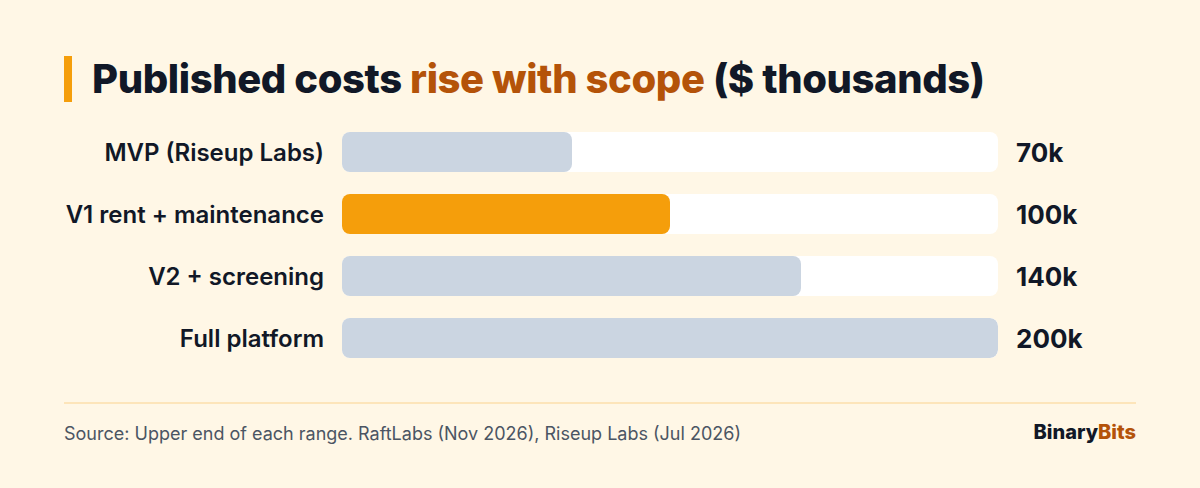
Market guides put a first version between $30,000 and $100,000 and a full platform between $70,000 and $250,000+. These are vendors' published ranges, not our prices, and they depend heavily on scope.
| Scope | Cost | Time | Source |
|---|---|---|---|
| MVP / first version | $30,000-$70,000 | Not stated | Riseup Labs |
| V1: leasing, rent, maintenance | $70,000-$100,000 | 12-16 weeks | RaftLabs |
| V2: plus screening, FCRA notices, owner payouts | $100,000-$140,000 | 16-22 weeks | RaftLabs |
| Full platform | $140,000-$200,000 | 22-30 weeks | RaftLabs |
| Full-featured app | $70,000-$250,000+ | Not stated | Riseup Labs |
For how the team's location and build type change these numbers, see our breakdown of SaaS app development cost.
What drives the cost up?
- Payments: bank transfers, split payouts to owners and late fees each add work.
- Tenant screening: background and credit checks bring a paid provider and, in the US, FCRA (Fair Credit Reporting Act) notices when you turn someone down.
- Owner money: holding and paying out owners' funds means trust accounting and state rules on leases and deposits, which RaftLabs lists among the main US cost drivers.
- Listing data: MLS/IDX licensing, display rules and refresh schedules.
- Many companies on one platform: multi-tenancy, white-label branding and per-company billing.
- Migration: years of messy spreadsheets take longer than 24 tidy properties.
Fixed price or time and materials?
A fixed price suits a first version with a tight scope, like the 10-week build above: you know the bill and the date. Time and materials (paying for hours used) or a dedicated team suits phase 2 and beyond, when priorities change month to month. Either way, ask what support after launch covers: bug fixes, security updates and how fast someone answers.
What are the red flags when hiring a real estate software developer?
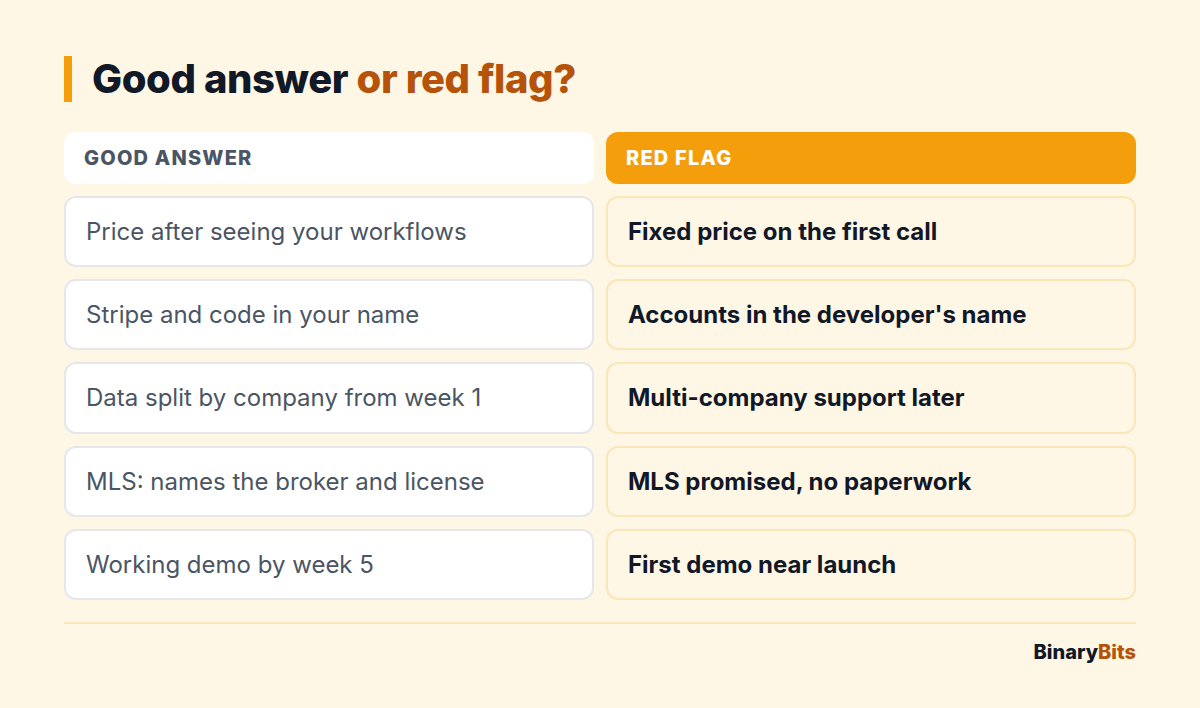
Most red flags show up as vague answers to the 8 checks above. Watch for these:
- A fixed price before anyone has seen your workflows or spreadsheets.
- The payment account or the code repository opened in the developer's name.
- "We'll add multi-company support later" when you've said you plan to sell the platform.
- An MLS integration promised with no word about the broker or the license.
- No working demo until the last weeks of the project.
For a wider view of choosing a build partner, see our guide to custom SaaS development services.
We build property platforms that go live
We'll map your workflows, sketch the data model and give you a week-by-week plan for your scope. No pitch, just a conversation.
Frequently asked questions
How much does real estate software development cost?
Published vendor ranges put a first version at $30,000-$100,000 and a full platform at $70,000-$250,000+, according to Riseup Labs and RaftLabs. The spread comes from scope: payments, tenant screening, listing data, the number of user roles and whether many companies will share the platform. Ask for a week-by-week plan before comparing quotes, so you're comparing the same scope.
How long does it take to build property management software?
Our property platform, with rent collection, maintenance, tenant portal, e-signed leases and a compliance calendar, went live in 10 weeks. RaftLabs gives 12-16 weeks for a similar first version and 22-30 weeks for a full platform. The time depends on fixed scope, fast decisions from your side and how messy your current data is.
Can a developer integrate MLS or IDX listings?
Yes, but access is licensed by each MLS, usually through a broker who is a member. Many MLSs ask the website vendor to sign a data access agreement and charge setup or monthly fees; MLS PIN, for example, charges vendors $525 a month. Confirm which MLS you'll use, who signs and the display rules before the build starts.
Should I buy off-the-shelf property management software or build custom?
Buy if a standard tool fits how you work and per-unit fees stay affordable. Build when your workflow is what makes you different, when local rules don't fit the tool, or when you plan to sell the platform to other property companies. A custom build costs more upfront but you own it and decide what comes next.
What features does a property management platform need?
Start with rent collection and failed-payment handling, a tenant portal, maintenance requests with photos, lease storage with renewal reminders and a compliance calendar. A landlord dashboard should show occupancy, rent status, open maintenance and upcoming deadlines in one view. Screening, owner portals and listings come next, once the core is used every day.
Who owns the code and the Stripe account when an agency builds it?
You should, from day one, and the contract should say so. Open the Stripe account, the cloud hosting and the code repository in your company's name and give the developer access. If the agency holds them, moving later means re-collecting every tenant's payment details and arguing over the code.