White label software development means a partner builds software that your agency sells and delivers under its own brand, and your client never deals with the partner. To choose one, check five things before price: IP assigned to you in writing on payment, code in your repositories from day one, only you talk to the client, daily overlap hours, and a named backup for every developer.
Most guides stop at "vet the developers and sign an NDA." This one covers the contract and delivery details that actually cause trouble six months in, with a real 12-week white-label build as the worked example.
💡 What you'll get from this post: a 10-point partner checklist you can paste into your next vendor call, the contract clauses to get in writing, and honest numbers on cost and timelines.
TL;DR
- White label means the partner is invisible: your brand, your client relationship, your price.
- In the US, a copyright transfer isn't valid unless it's in writing and signed, so get an IP assignment clause, not a handshake.
- Put the code in your own GitHub or GitLab account from the first commit.
- Agree who speaks to the client (you), the overlap hours, and what happens when a developer leaves.
- A focused custom product takes about 8-12 weeks; our white-label LMS shipped in 12.
What is white label software development?
It's a partnership where one company builds the software and another puts its own name on it. For agencies, the partner works behind the scenes and the agency owns the client relationship, the billing and the margin.
Are there two kinds of white label software?
Yes, and most articles mix them up:
- White-label delivery: a partner builds custom work (an app, a portal, an integration) that your agency hands over as its own. This post is mostly about this kind.
- A white-label product: software built so that each customer can put its own logo, colors and domain on it, then resell it. A rebrandable LMS or client dashboard is a typical example.
Agencies often need both: a partner who can build under your brand, and who can build products your clients can rebrand.
How does white-label delivery work for an agency?
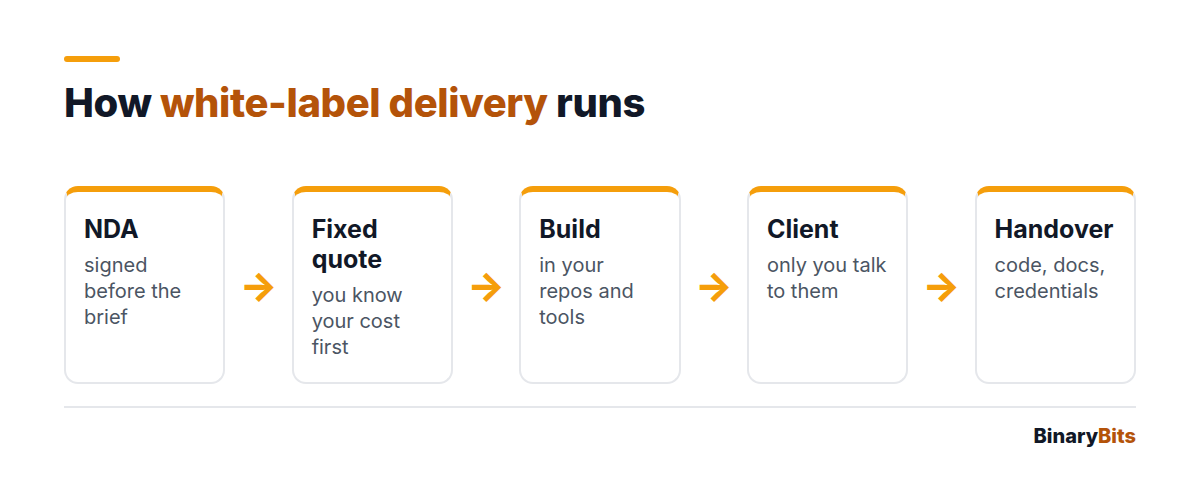
The client only ever sees your agency. The partner joins your process, not the other way round.
- NDA first: the partner signs before you share the client's name or brief.
- Scope and fixed quote: you get a cost before you price the client, so you know your margin.
- Build in your tools: your repos, your project board, your staging URLs, no partner logos anywhere.
- You run the client: demos, emails and sign-off go through your team.
- Handover: source code, docs and credentials land in your accounts, then support continues under your name.
White label vs outsourcing vs freelancers vs in-house: which fits?
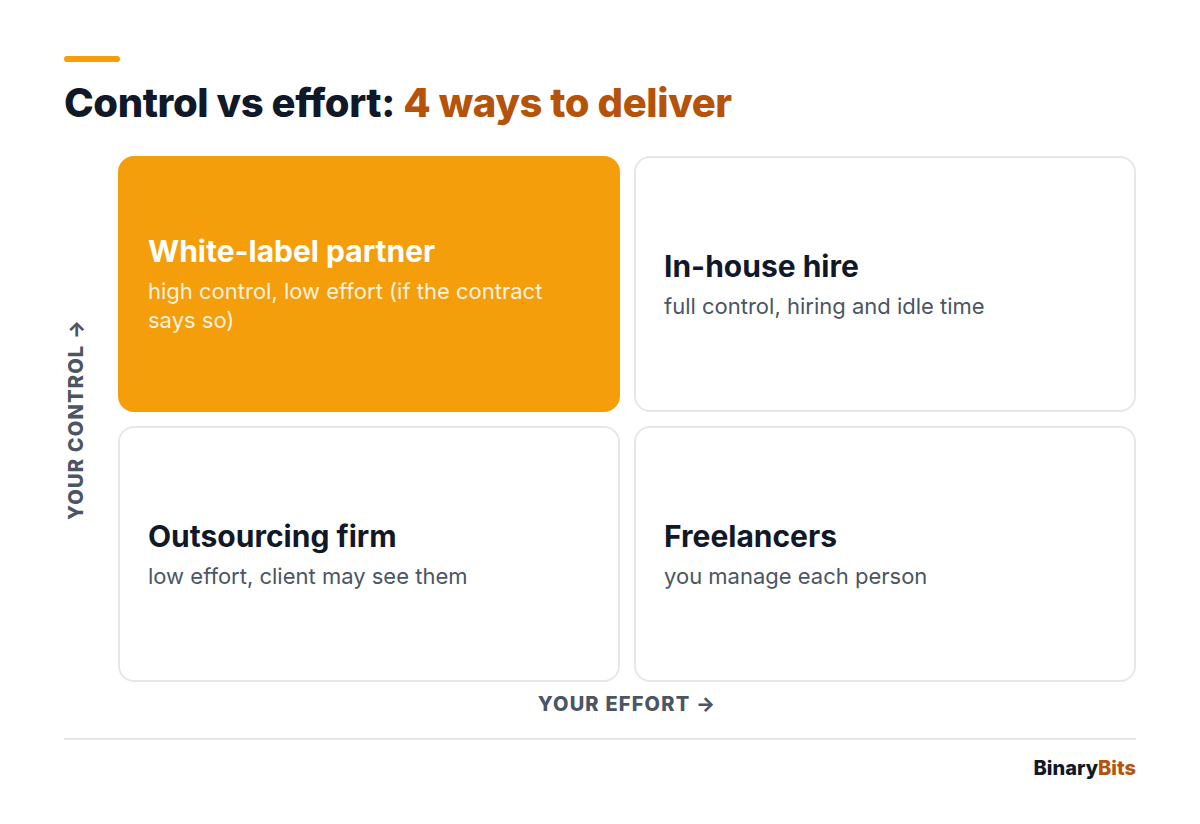
White label is a form of outsourcing with one extra promise: the partner stays invisible and never competes for your client. Here's how the four options compare for an agency.
| Option | Your control | Your effort | Best for |
|---|---|---|---|
| In-house hire | Full | High: hiring, payroll, idle time between projects | Steady work in one stack |
| Freelancers | Medium | High: you manage each person and cover gaps | Small, well-defined tasks |
| Outsourcing firm | Medium | Low | Projects where the client can know who built it |
| White-label partner | High, if the contract says so | Low to medium | Client work sold under your brand |
If you're weighing individuals against a team, our comparison of hiring a developer, a dedicated team or a freelancer goes deeper on that choice.
How do you choose a white label software development partner?
Ask these ten questions on the first call. A good partner answers each one in a sentence; hesitation on any of them is a warning sign.
| # | Question to ask | A good answer |
|---|---|---|
| 1 | Will you sign our NDA before the brief? | Yes, before any client detail is shared |
| 2 | Who owns the code, and when? | You (or your client), assigned in writing on payment |
| 3 | Where does the code live? | In your repositories from the first commit |
| 4 | Will your name appear anywhere? | No: not in code comments, emails, staging URLs or invoices to the client |
| 5 | Who talks to our client? | Only you, unless you ask them to join a call under your brand |
| 6 | How many hours overlap with our day? | A fixed daily window, stated in writing |
| 7 | What happens if a developer leaves? | A named backup who already knows the project |
| 8 | How do you price? | A fixed quote or a monthly rate you know before you price the client |
| 9 | What's the warranty after launch? | A defined bug-fix window and a support rate |
| 10 | Can we see similar work? | Case studies with timelines and results, client names removed |
Codeable makes a fair point here: agencies often target 50-70% gross margins on resold white-label work, which only works if the partner's costs are predictable (Codeable). That's why question 8 matters as much as question 2.
Who owns the code, and what should the contract say?
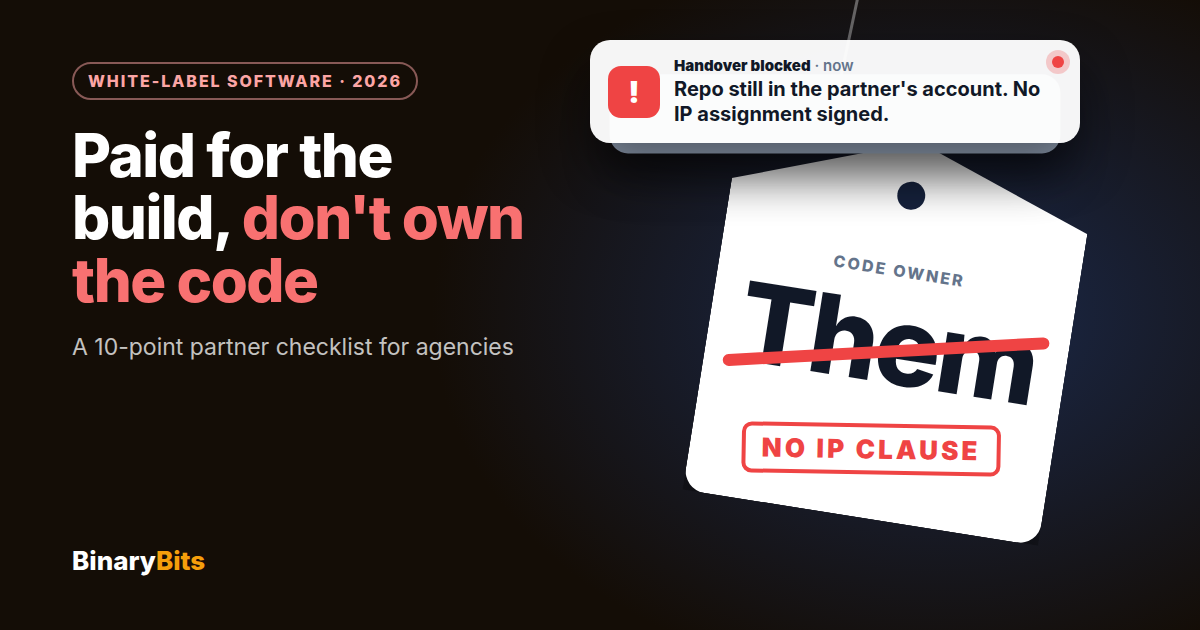
Whoever writes the code owns it until they sign it over. Under US law, a transfer of copyright isn't valid unless it's in writing and signed by the owner (17 U.S.C. § 204). So "we paid for it" isn't the same as "we own it."
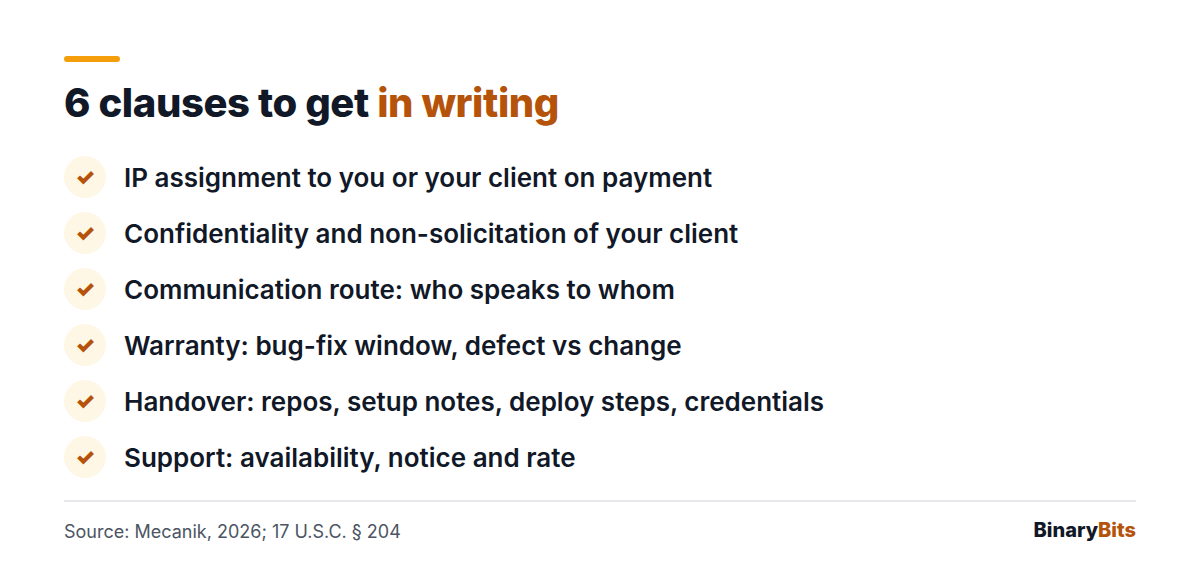
Get these clauses in writing before work starts:
- IP assignment: all code, designs and docs assigned to you or your client on payment.
- Confidentiality and non-solicitation: the partner can't approach your client, during or after the project.
- Communication route: who speaks to whom, and when the partner may join a call under your brand.
- Warranty: how long defects are fixed free, and what counts as a defect rather than a change.
- Handover: repository access, environment setup notes, deployment steps and credentials.
- Support: availability, notice period and rate after launch.
This list follows the clause set in Mecanik's guide for agencies, which also makes the same point under UK law: a verbal understanding transfers nothing.
⚠️ Note: This is general information, not legal advice. Have a lawyer in your state review the contract.
What happens when a developer leaves or time zones don't overlap?
These are the two problems that hurt agencies most after launch, and neither shows up in a sales call.
How do you protect a project when a developer leaves?
- Ask for a named backup developer who reviews the code every week.
- Require short handover notes in the code repository (where the source code lives), not in someone's head.
- Agree a notice period for team changes. On our dedicated teams, you can add or remove engineers with 2 weeks' notice.
How many overlap hours do you need?
Enough for one live call and quick answers to blocking questions. Ask for a fixed daily window in writing rather than "we're flexible." Our team in India works across US morning hours, so a morning standup and same-day answers are normal.
What does a real white-label build look like?
Here are two of our own projects, one of each kind.
A white-label LMS built in 12 weeks
A corporate training company was losing enterprise deals because its off-the-shelf LMS (learning management system, the platform that runs online courses) couldn't carry each client's brand. We built a white-label LMS from scratch with per-client domains, branding and separate learner data, plus support for existing SCORM 1.2, SCORM 2004 and xAPI courses.
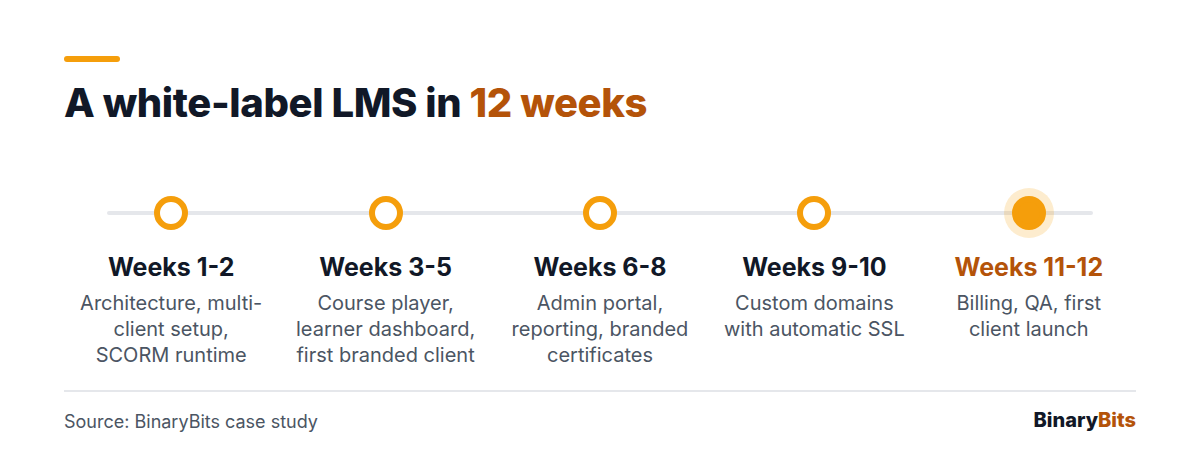
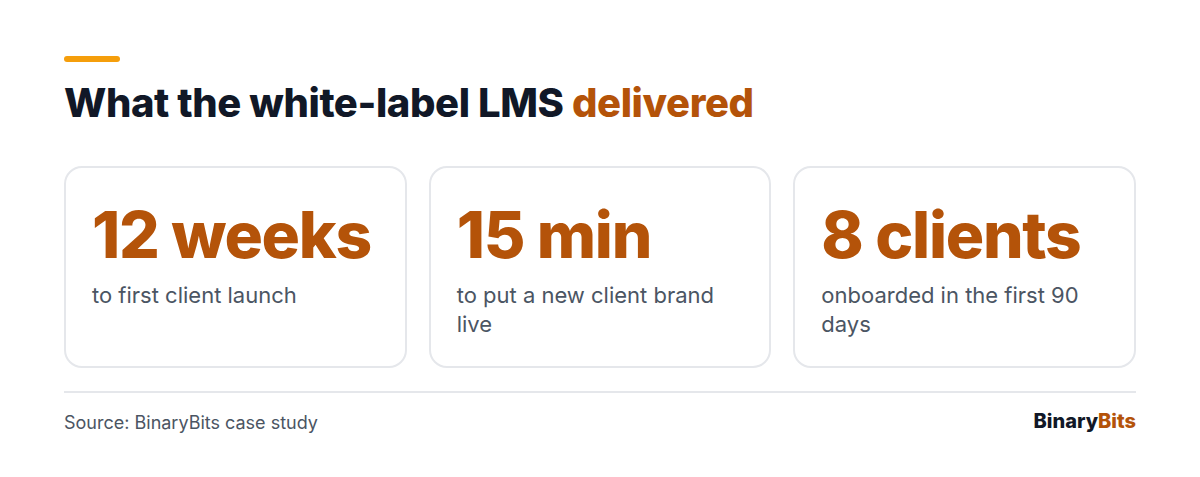
The results, from the case study:
- 12 weeks from start to first client launch.
- 15 minutes for a new client brand to go live.
- 8 corporate clients onboarded in the first 90 days.
- 12 SCORM packages tested before launch.
A field-service SaaS delivered under an agency's brand
For an agency client, we built a job management SaaS for a field-service company in 8 weeks: scheduling, dispatch, a mobile app for engineers, quotes, invoicing and a customer portal, all delivered under the agency's brand.
Need a partner who builds under your brand? See how we work with agencies on white-label development for agencies →
How much does white label software development cost?
It depends on where the team is and how you buy: by the day, by the month or by the project. Published rates give a useful range.
| Model | Typical published rate | Source |
|---|---|---|
| UK white-label day rate | £350-£550 a day | Mecanik, 2026 |
| UK retained developer | £6,000-£9,000 a month | Mecanik, 2026 |
| What agencies charge clients (UK) | £600-£1,200 a day | Mecanik, 2026 |
| BinaryBits, India-based team | $15-$25 an hour per team member | Our rate |
Offshore rates have also been falling. Accelerance's 2025 rates guide found global developer hourly rates down 9-16% across key regions, with South Asia down 16% (DesignRush, citing Accelerance).
The real cost driver is scope, not the rate. For a breakdown by product size, see what a SaaS app costs to build.
When is white label the wrong choice?
White label isn't always the answer. Skip it when:
- The work is your core product. If the software is what your agency sells every day, build the skill in-house.
- The client insists on meeting the developers. Some enterprise buyers require it. Then it's plain subcontracting, and you should say so.
- You can't review the work. Without someone technical on your side to check pull requests and demos, you can't tell good code from bad.
- The margin is too thin. If the client's budget can't cover the partner's fee plus your margin, the project will strain both of you.
If you need people rather than a project, a dedicated development team that works your hours on your tools may fit better.
Add software to your agency's services, under your brand
We build web apps, SaaS products, AI agents and backends for agencies, with an NDA before the brief and full IP transfer. No pitch, just a conversation about your next client project.
Frequently asked questions
What is white label software development?
White label software development is when one company builds software and another sells it under its own brand. For agencies, a partner builds custom apps, portals or integrations behind the scenes, and the agency keeps the client relationship, the billing and the margin. It also covers building products, such as an LMS, that customers can rebrand and resell.
How long does white label development take?
It depends on scope. A focused custom product usually takes about 8 to 12 weeks: our field-service SaaS took 8 weeks and our white-label LMS took 12, both to first launch. Small features or integrations take days to a few weeks. Ask any partner for a timeline broken into phases before you commit a date to your client.
Who owns the code in white label software development?
Whoever the contract says. In the US, a copyright transfer isn't valid unless it's in writing and signed, so the partner owns the code it writes until it assigns it. Ask for an IP assignment clause that transfers everything to you or your client on payment, and keep the code in your own repositories from the start.
Is white label development the same as outsourcing?
It's a type of outsourcing with stricter rules. A white-label partner works under your brand, never contacts your client, removes its name from everything it delivers and signs over the IP. A regular outsourcing firm may be visible to the client and may keep rights to reusable code. If a partner hesitates on those points, it isn't really white label.
How much does white label software development cost?
Published UK rates run about £350 to £550 a day, or £6,000 to £9,000 a month for a retained developer, according to Mecanik. India-based teams cost less: ours charges $15 to $25 an hour per team member, and offshore rates fell 9-16% in Accelerance's 2025 guide. The bigger driver is scope, so ask for a fixed quote before you price the work for your client.
Can a white-label LMS support SCORM?
Yes. A white-label LMS can play existing SCORM and xAPI courses without rebuilding them, as long as it includes a SCORM runtime. The LMS we built supports SCORM 1.2, SCORM 2004 and xAPI, and we tested 12 course packages before launch. Each client gets its own domain, branding and learner data on the same platform.