The best data pipeline development services do four things you can check before you sign: they map every source, they clean and deduplicate the data, they deliver it where your team already works, and they show you the monitoring that keeps it running. Pick a provider by its upkeep plan and a paid trial on one real source, not by a top-10 list.
This guide gives you a 10-point checklist, the cost drivers, the billing models and one real system we built, with its numbers.
💡 What you'll get from this post: a way to compare providers this week, and the questions that expose a weak one.
TL;DR
- A data pipeline is the set of automated jobs that moves data from its sources to one place your team can use, cleaned and on a schedule.
- Hire a freelancer for one simple source, an agency or dedicated team for many sources you'll run for years.
- Price is driven by the number of sources, how fresh the data must be, the volume and the upkeep.
- Ask every provider what their monitoring caught last month and who fixes a broken source.
- Start with a paid trial on one source and a written pass mark.
What do data pipeline development services include?
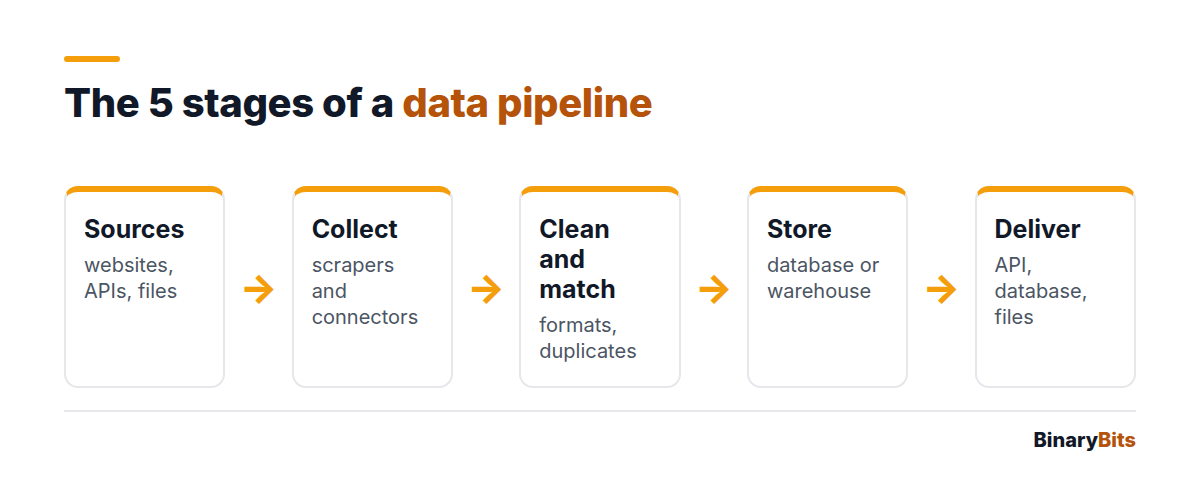
They cover everything between "the data is scattered across the web and your tools" and "it's clean, in one place, and updated on time." A provider designs, builds and usually runs the collection jobs for you.
Most vendor pages list the same scope. Here's what each part means in practice:
| Deliverable | What it means | What to ask for |
|---|---|---|
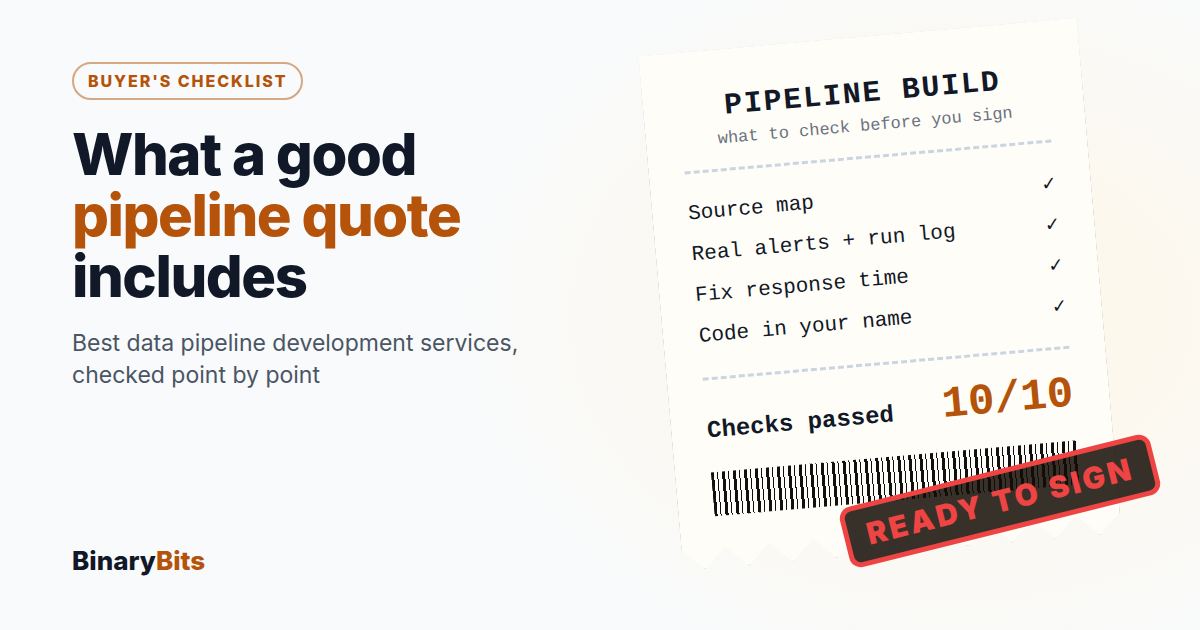
| Source map | Every website, API, file and database the data comes from | A written list with owner, format and refresh rate |
| Collection jobs | Scrapers, API connectors and file imports | Code in your own code account, not theirs |
| Cleaning and matching | Fixing formats, removing duplicates, joining records across sources | The rules, written down, with test cases |
| Storage | A database or warehouse (one big store built for reporting) | A table layout your team can read |
| Delivery | REST API, database access, CSV or JSON files | The format your team already uses |
| Scheduling and monitoring | Running jobs on time and alerting when they fail | A sample alert and a run log |
| Upkeep | Fixing jobs when a source changes | A response time in the contract |
Should the data be cleaned before or after it's stored?
Either works. ETL (extract, transform, load) cleans data before it's stored; the newer approach loads raw data first and cleans it inside the warehouse. A good provider asks how your team will query the data, then picks one.
Who needs a data pipeline built?
You need one when people on your team copy data between systems by hand, or when the data you need lives in many places that don't talk to each other. Common cases we see:
- E-commerce and retail: competitor prices and stock from many online stores, refreshed daily.
- Venture capital and market research: company, funding and founder data gathered from hundreds of public sources.
- HR tech and job boards: job postings from career pages, put into one consistent format.
- SaaS products: outside data pulled into the app's backend so customers see it live.
- AI teams: documents and records collected and labeled for model training. If you need to source hard-to-find data for AI model training, start with our list of real-time data sources for AI agents and MVPs.
In-house, freelancer or agency: which should you hire?
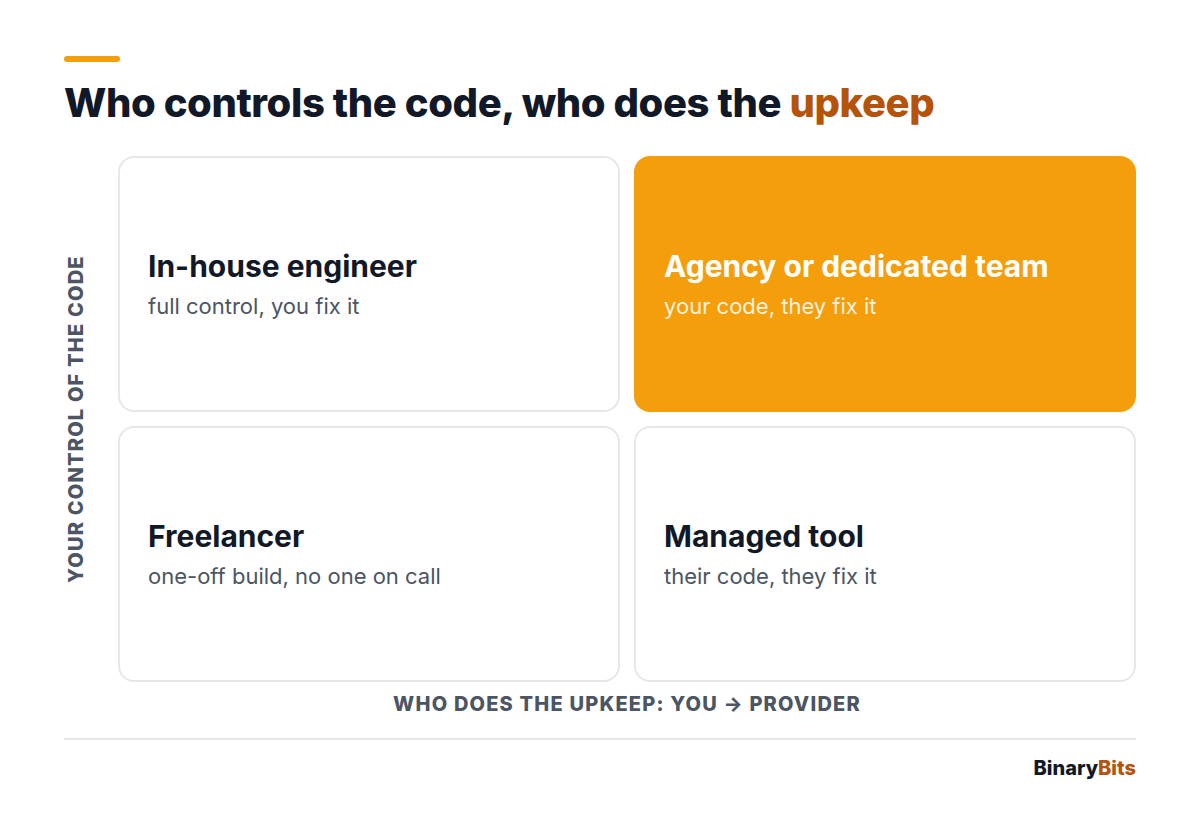
It depends on how many sources you have and how long the system will run. One stable source and a short project suits a freelancer. Many sources that change often, run for years, suit an agency or a dedicated team. An in-house hire makes sense once the data flow is core to the product.
| Option | Best for | Watch out for |
|---|---|---|
| Freelancer (Fiverr, Upwork) | One or two sources, a one-off build | No one on call when a source breaks |
| Agency or dedicated team | Many sources, ongoing upkeep, a deadline | Code and accounts held in the agency's name |
| In-house engineer | Data flows that are the core of your product | Hiring time and one person holding all the knowledge |
| Managed connector tool | Standard SaaS sources (CRM, ads, payments) | Costs that rise with volume; no custom web sources |
How much does an in-house data engineer cost?
A full-time hire is the most expensive option for a single project. The US median pay for database architects, the closest official job category, was $139,500 a year in May 2025, according to the US Bureau of Labor Statistics. That's before benefits, tools and the months it takes to hire.
How to choose the best data pipeline development services: a 10-point checklist
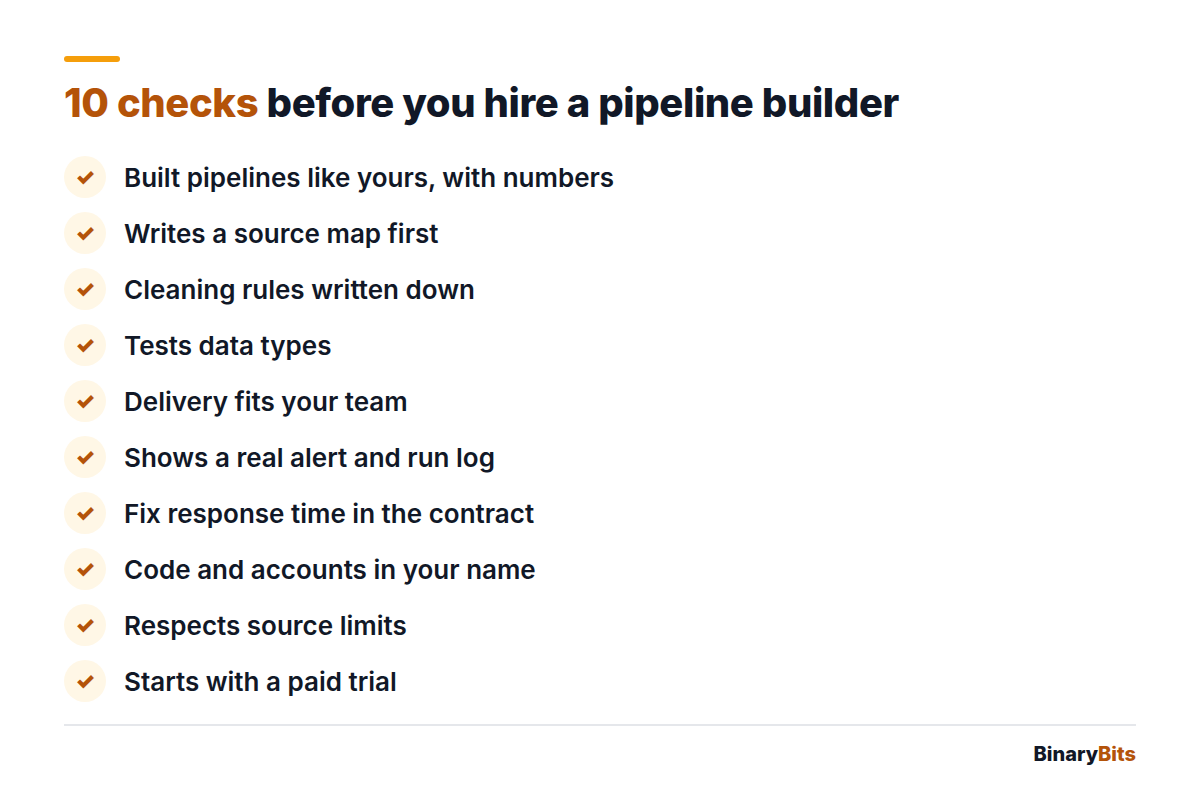
Score each provider against these ten points. A strong one answers all ten with evidence, not adjectives.
- They've built systems like yours: similar sources, similar volume, and they can show the numbers.
- They write a source map first: every source, its format, how often it changes and who owns it.
- Their cleaning rules are written down: formats, duplicates and cross-source matching, with test cases.
- They test data types: wrong data types cause 33% of data flow faults, according to a Cornell study cited by Fivetran's checklist.
- Delivery fits your team: an API, database access or files, in the format you already use.
- Monitoring is real: they can show an alert and a run log from a live system.
- Upkeep has a response time: who fixes a broken source, and how fast, is in the contract.
- You own everything: code, cloud accounts, passwords and data are in your name from day one.
- They respect source limits: they follow robots.txt and site terms, slow down when asked and prefer an official API where one exists.
- They'll start with a paid trial: one source, one to two weeks, a written pass mark.
Want us to score your current setup against this list? See how we build web data systems →
What does a real data engineering pipeline look like?
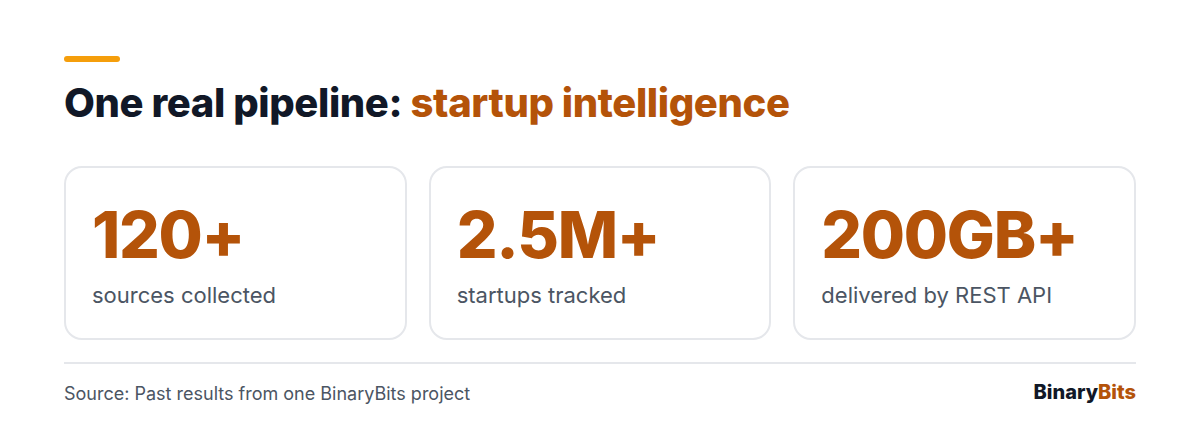
Here's one we built for a venture capital client: a global startup intelligence system. It replaced manual startup tracking with automated collection of funding rounds, founders, growth metrics and tech stacks.
What went into it?
- Sources: 120+ public websites and data sources.
- Collection: Python and Scrapy jobs on AWS, scheduled per source.
- Storage: PostgreSQL, with startups matched across sources so each company appears once.
- Delivery: a REST API (a way for other software to request the data) and a custom dashboard.
What did it deliver?
It tracked 2.5M+ startups and delivered 200GB+ of data through the API and dashboard. These are past results from one project, not a promise for yours.
What did monitoring catch?
Sources change their layouts without warning, and the system has to notice. On a job data platform we led, with 50,000+ deduplicated listings a day across 12 countries, we automated scheduling, monitoring and recovery so thousands of scrapers ran without someone watching them. The lesson carries to every build: alert on missing records, not only on crashes.
How much does data pipeline development cost?
Cost depends on four things: how many sources, how fresh the data must be, how much of it there is, and how often sources change. Ask every provider to price each driver separately so you can compare quotes line by line.
| Cost driver | Pushes the price up | Keeps it down |
|---|---|---|
| Number of sources | Hundreds of different websites | A few APIs with documentation |
| Freshness | Near real-time updates | A daily or weekly batch |
| Volume | Millions of records a day | Thousands a week |
| Source changes | Sites that redesign often | Stable feeds and APIs |
| Cleaning and matching | Joining the same company across many sources | One source, one format |
How long does the build take?
A basic build takes 3 to 4 weeks on average, and complex ones can take several months, according to Airbyte's build-vs-buy guide. Upkeep never ends, so budget for it from the start.
Fixed price, hourly or milestones?
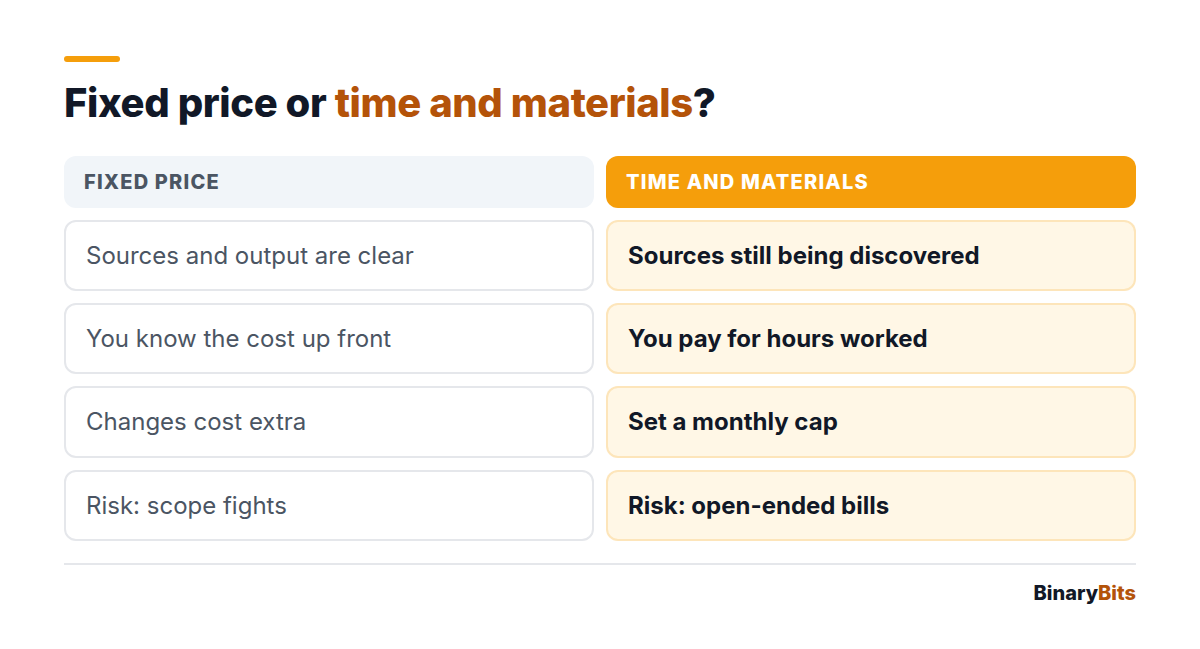
- Fixed price: good when the sources and output are clear. Changes cost extra.
- Time and materials (hourly): good when sources are still being discovered. Set a monthly cap.
- Milestones: a middle ground. Pay per working source or per delivered stage.
- Monthly upkeep retainer: covers fixes when sources change. Ask what's included.
Why does a real-time scraping pipeline keep missing updates?
Usually because it checks too rarely, a source changed its layout, or it only alerts on crashes and not on silent gaps. If your real-time scraping setup keeps missing updates, check these in order:
- Schedule: does each source run as often as it changes?
- Layout changes: do jobs fail loudly when a page changes, or return empty rows?
- Record counts: is there an alert when today's count drops well below yesterday's?
- Duplicates: is a new record being treated as a copy of an old one?
We cover the common causes in why your web scraper keeps breaking, and compare the tools in our guide to the best web scraping tools.
What should you ask before you sign?
Ask these in the first call. Vague answers tell you more than the sales deck.
- What did your monitoring catch on a live system last month?
- Who fixes a broken source, and within how many hours?
- Whose name are the code, cloud accounts and data in?
- How do you handle a source that asks you to slow down or stop?
- What does the backend that serves the data look like? (Our backend and API development page shows ours.)
- Can we start with a paid trial on one source?
Agencies reselling this work to their own clients can also ask for white-label delivery, where the provider works under the agency's name.
When shouldn't you hire anyone?
Don't commission a custom build if a ready-made connector already covers your sources. Standard SaaS tools like CRMs, ad platforms and payment systems are better served by managed connector tools than by custom code.
And if you only want the data, not a system your team owns, a managed data feed is cheaper and faster. Our sister company TheDataHQ sells those. Hire a builder when the data flow itself needs to live inside your product or your stack.
⚠️ Note: Collecting data from websites is subject to each site's terms and local law, including personal-data rules. This is general information, not legal advice.
Need a data system built and kept running?
We've built data platforms and products across 200+ projects over 10+ years. Tell us your sources and we'll tell you honestly whether to build, buy or wait. No pitch, just a conversation.
Frequently asked questions
What is data pipeline development?
It's designing and building the automated jobs that collect data from its sources, clean it, and load it into a database, warehouse or app on a schedule. The work includes the source map, collection code, cleaning rules, storage, delivery by API or files, and the monitoring that tells you when a job fails or a source changes.
What is a pipeline in data engineering?
It's a chain of steps that moves data from where it's created to where it's used. Each step does one job: collect, check, clean, deduplicate, reshape, store or deliver. Steps run in order on a schedule or when new data arrives, and a scheduler such as Airflow keeps track of what ran and what failed.
What is the purpose of a data pipeline?
To give your team reliable, up-to-date data without anyone copying it by hand. It pulls scattered data into one place, in one format, on time, so reports, dashboards, apps and AI models all work from the same numbers. A good one also tells you when something breaks before your users notice.
What does a data pipeline development provider do?
The provider maps your sources, writes the collection and cleaning code, sets up storage and delivery, and adds scheduling and monitoring. Most also offer upkeep: fixing jobs when a website or API changes. The best ones hand you the code and accounts in your name and agree a response time for fixes in the contract.
How much does data pipeline development cost?
It depends on the number of sources, how fresh the data must be, the volume, how often sources change and how much cleaning and matching is needed. A few documented APIs on a daily batch cost far less than hundreds of websites updated in near real time. Ask providers to price each driver separately, plus monthly upkeep.
What is the difference between a data pipeline and ETL?
ETL (extract, transform, load) is one kind: it cleans data before storing it. The wider term also covers loading raw data first and cleaning it in the warehouse, streaming setups that process records as they arrive, and systems that deliver data to an app through an API rather than to a warehouse.
How long does it take to build one?
A basic build with a few well-documented sources takes about 3 to 4 weeks, according to Airbyte's build-vs-buy guide. Systems with many web sources, cross-source matching and near real-time updates take several months. Start with a one to two week paid trial on a single source, so you see the provider's work before committing to the full build.