AI agent development cost is mostly developer hours. At our $15–$30 an hour, a 2-week pilot costs $1,200–$2,400 per developer, and the agents we've delivered took 6 to 12 weeks to reach production. US agencies quote $15,000 to $400,000+ for the same tiers. Then there's a monthly running cost for the AI model, hosting and upkeep.
Below: real week counts from three agents we built, why quotes differ 10x, and the maths for the monthly bill.
💡 What you'll get from this post: enough numbers to sanity-check any AI agent quote, including the running cost most quotes leave out.
TL;DR
- Build cost = hours × rate. The hourly rate explains most of the gap between a $4,000 quote and a $40,000 one.
- Our three delivered agents took 6, 8 and 12 weeks. That's $3,600–$14,400 per developer at $15–$30 an hour.
- Integrations drive the hours: every system the agent reads from or writes to adds work.
- Running cost is mostly the AI model's usage fees. The same task can cost $0.01 or $0.54 depending on the model.
- Start with a paid pilot on your own data before you commit to a full build.
How much does AI agent development cost?
Here's what each tier costs at our rate, using the real length of agents we've delivered. The costs are per developer on the project: a team of two doubles them. They're arithmetic on our rate (40 hours a week), not quotes.
| Tier | Example we built | Weeks | Hours per developer | At $15–$30/hour |
|---|---|---|---|---|
| Pilot on your data | One workflow, real cases, pass or fail | 2 | 80 | $1,200–$2,400 |
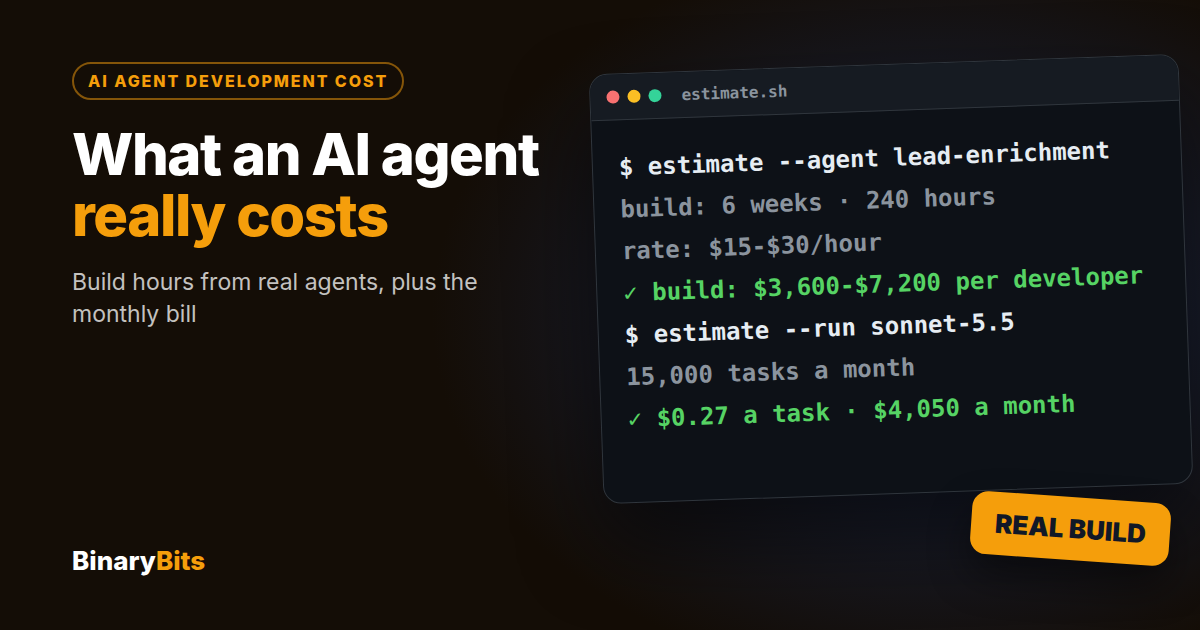
| Single-workflow agent | Lead enrichment inside HubSpot | 6 | 240 | $3,600–$7,200 |
| Agent with document search and several integrations | Customer support agent | 8 | 320 | $4,800–$9,600 |
| Several agents across departments | 6 operations agents | 12 | 480 | $7,200–$14,400 |
| Running it each month | Model usage, hosting, upkeep | Ongoing | - | Set per project |
What do agencies quote for an AI agent?
Published ranges are much higher, mainly because of the hourly rate. RaftLabs lists $15,000–$40,000 for a single-workflow agent, $40,000–$85,000 for a support agent and $150,000–$400,000 for a multi-agent system, and says its example builds are hypothetical. SoftTeco puts RAG agents at $100,000–$300,000.
For UK buyers, LeverX gives £10,000–£30,000 for a single-workflow agent (5–9 weeks) and £30,000–£80,000 for a multi-step agent with integrations (10–18 weeks).
Why do AI agent quotes range from $5,000 to $500,000?
Two things move the number: how many hours the work takes, and what each hour costs. The hours depend on the agent. The rate depends on who builds it and where.
SoftTeco lists US AI and machine-learning engineers at $80–$180 an hour. Take our lead enrichment agent's 6 weeks, 240 hours for one developer, and price it at each rate:
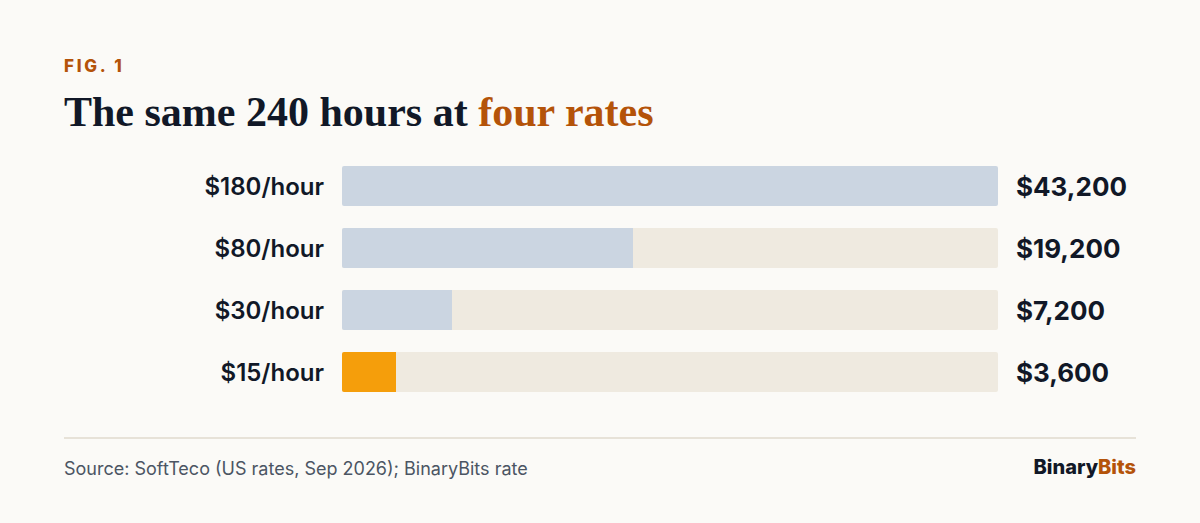
- $180 an hour: $43,200
- $80 an hour: $19,200
- $30 an hour: $7,200
- $15 an hour: $3,600
The other reason is that "AI agent" means different things. One vendor's $10,000 agent answers questions from a script. Another's $400,000 agent runs six workflows across your CRM and finance system. Compare quotes for the same scope, not the same label.
What drives the cost of AI agent development?
The model itself is the cheap part. The hours go into connecting the agent to your systems and making sure it's right often enough to trust.
How many systems does it connect to?
Each integration (a connection that lets the agent read or write data in a tool through its API) is its own small project: login, data mapping, error handling and testing. Our lead enrichment agent connected to HubSpot, Slack and several company-data APIs. Older in-house systems cost more: our operations project needed a custom connector for SAP.
Does it need to search your documents?
A RAG agent (one that looks up your own documents before it answers) needs the documents cleaned, split up and loaded into a vector database, a store built for searching text by meaning. That's real work, and it gets redone whenever the documents change a lot.
What is it allowed to do alone?
Guardrails are the rules on what the agent may do without a person: refund under a set amount, never touch a legal complaint. Our support agent sends every complaint and fraud case to a human. Writing and testing those rules takes time.
How will you know it's right?
A test set is a batch of real past cases with the right answers, run after every change. We tested the support agent on 1,000+ past tickets before launch. Skip this and you pay for it later in fixes.
What did our three agents take to build?
These are agents we delivered, with the week counts and results from their case studies. They're past results, not a promise for your project.
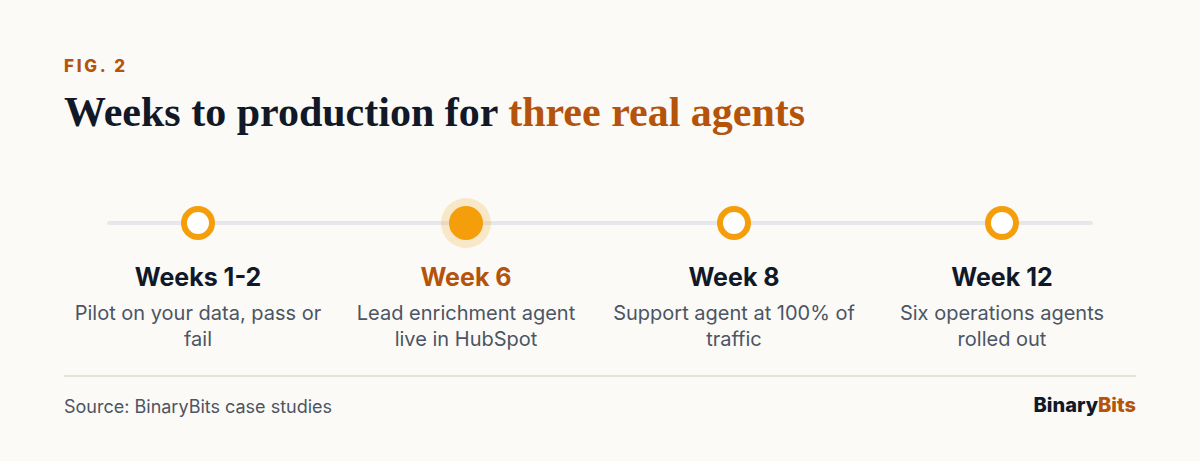
Lead enrichment agent: 6 weeks
It researches every new lead and posts a brief to the HubSpot record. A brief takes about 90 seconds instead of 45–60 minutes of manual research. One week went on discovery with the sales reps, two on the data connections, one on the writing quality, and two on launch and a pilot. See the lead enrichment agent case study.
Customer support agent: 8 weeks
A RAG agent connected to the store's order data and helpdesk. It resolves 70% of queries on its own. Two weeks went on reading 6 months of past tickets, and it ran on 20% of traffic before full rollout. See the AI customer support case study.
Operations agents: 12 weeks
Six agents for lead qualification, follow-ups, invoices, anomaly checks, reports and approvals, across Salesforce, HubSpot and SAP. Manual operations work fell 80%. See the AI process automation case study.
Want hours and a price for your own workflow? See how we scope and build AI agents →
How much does it cost to run an AI agent each month?
The running cost is mostly the AI model's usage fees, charged per token (a token is roughly three-quarters of a word). Railway's guide says the token bill usually beats the hosting bill "by an order of magnitude".
How do you work out the cost per task?
Railway's formula: cost per run = model calls per run × (input tokens × input price + output tokens × output price). Its example task makes 10 calls, sends about 11,000 tokens in and gets 500 back each time.
Here's that task at today's Claude API prices (Haiku 5.5 $0.10/$0.50, Sonnet 5.5 $2/$10, Opus 5.5 $4/$20 per million tokens in/out), at 500 tasks a day:
| Model | Cost per task | Per month (15,000 tasks) |
|---|---|---|
| Haiku 5.5 | $0.0135 | $202.50 |
| Sonnet 5.5 | $0.27 | $4,050 |
| Opus 5.5 | $0.54 | $8,100 |
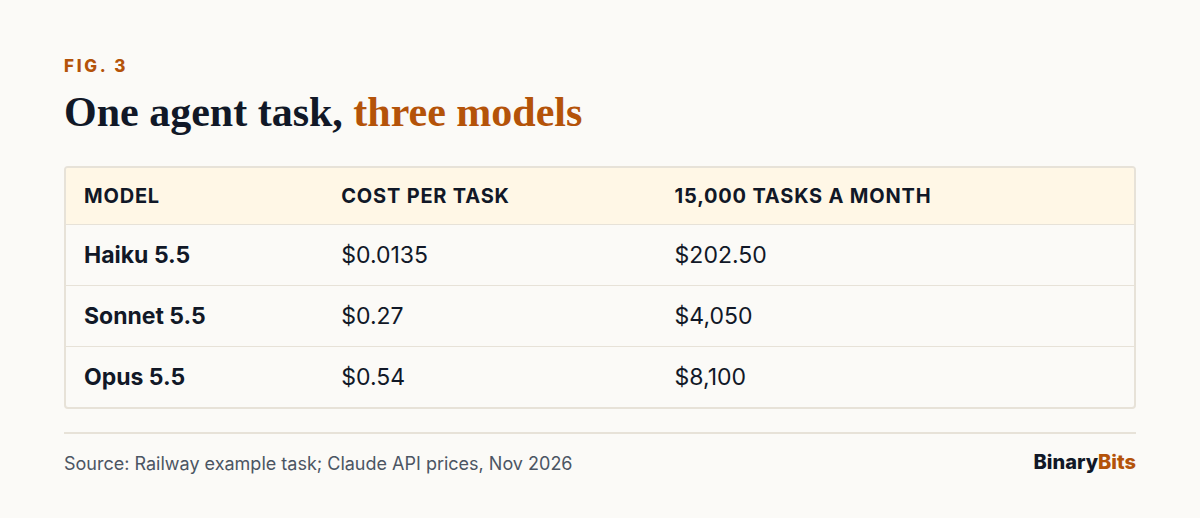
At those published prices, the model you choose moves the bill 40x. A good build uses the cheap model wherever it's accurate enough and the expensive one only where it isn't.
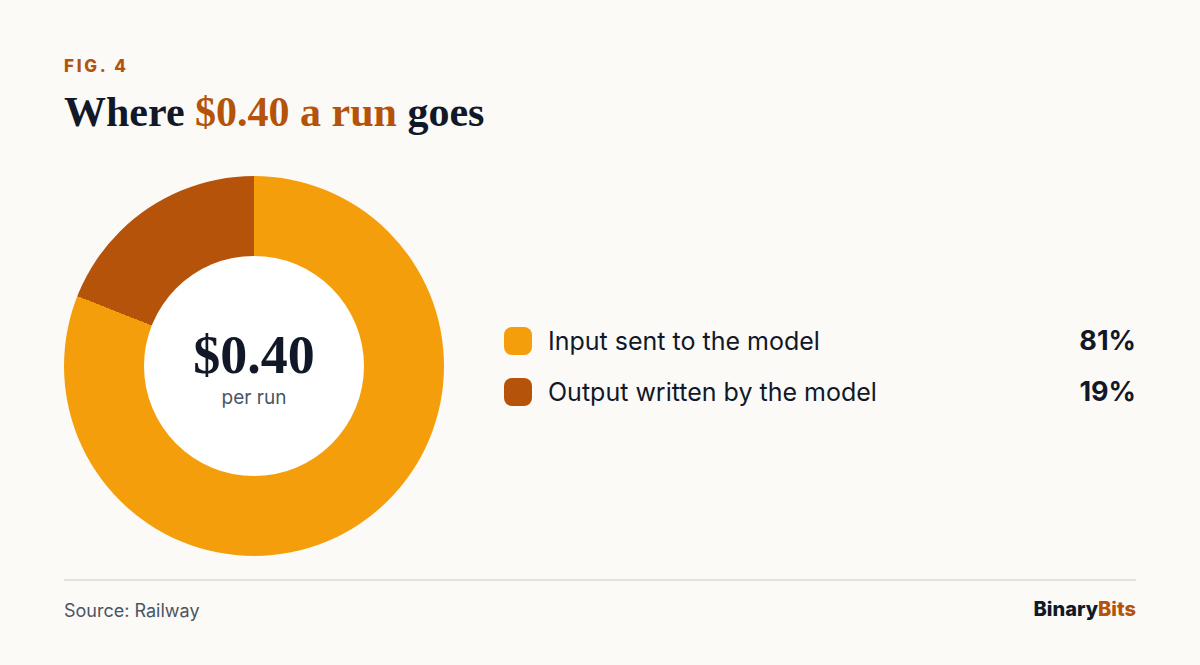
Why does the input cost more than the output?
Because the agent re-sends its growing context on every call. In Railway's own example ($0.40 a run), input is $0.33 and output $0.075: about 81% of the cost is what goes in. Trimming the context and caching repeated work cut the bill most.
What else is on the monthly bill?
- Hosting: the server or cloud functions the agent runs on.
- A vector database, if it searches your documents.
- Logging and monitoring: every run, its cost and every human correction.
- Upkeep: fixes when a connected tool changes its API or a model is retired.
We set the running cost per project, after a call, because it depends on volume, the model and how many systems the agent touches.
Which pricing models do AI agent developers use?
- Hourly: you pay for the hours worked. Fair when the scope will change, but set a cap.
- Fixed price per phase: a set price for the pilot, then for the build. Best once the workflow is clear.
- Monthly team: the same developers every month for ongoing agent work.
- Per task or per seat: what agent platforms charge. Cheap to start, expensive at high volume.
Whatever the model, ask for the build and the running cost as separate lines.
Is it cheaper to build in-house, buy a tool or hire a team?
For one or two agents, hiring a team is usually cheaper than hiring staff. The median US software developer earned $135,980 a year in May 2025, according to the US Bureau of Labor Statistics: about $65 an hour before benefits and months of hiring.
- Build in-house if agents are your product and you'll improve them for years.
- Buy a no-code tool if the workflow is short and uses popular apps. Our guide to custom AI automation without hiring developers covers that route.
- Hire a company to build a custom AI product when it touches older systems, sensitive data or high volume.
How do you get an accurate quote?
Send the vendor enough to count hours. A vague brief gets a padded quote.
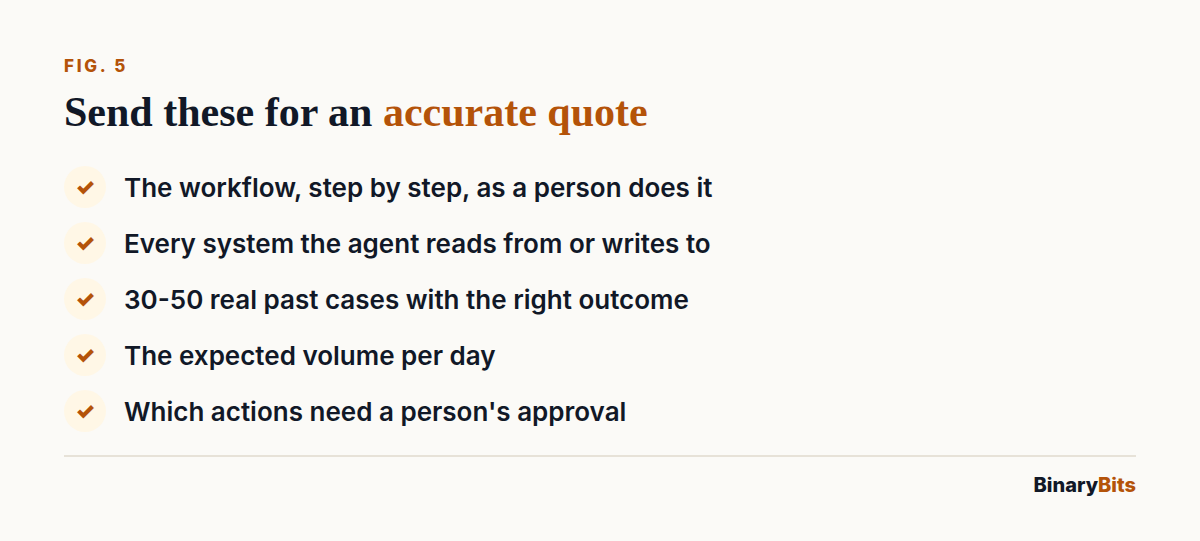
- The workflow, step by step, as a person does it today.
- Every system the agent must read from or write to.
- 30–50 real past cases with the right outcome.
- The expected volume per day.
- Which actions need a person's approval.
Then judge the answer with our checklist for choosing an AI agent development company.
When isn't an AI agent worth the cost?
When the task is rare, changes every week, or nobody can write down how a person decides it. Gartner expects over 40% of agentic AI projects to be canceled by the end of 2027, as Reuters reported, because of rising costs, unclear business value or weak risk controls. If an agent would save a few hours a month, a checklist or a simple automation is cheaper. We'll tell you that on the call.
Get a real number for your agent
Book a free 30-minute call. We'll map your workflow, estimate the hours and talk through what it would cost to run. No pitch, just a conversation.
Frequently asked questions
How much does AI agent development cost?
It depends on hours and the hourly rate. At $15–$30 an hour, a 2-week pilot is $1,200–$2,400 per developer, and the agents we've delivered took 6–12 weeks, or $3,600–$14,400 per developer. US agencies publish $15,000–$40,000 for a single-workflow agent and $150,000–$400,000 for multi-agent systems. Add a monthly running cost for model usage, hosting and upkeep.
Is it cheaper to do AI agent development in-house?
Usually not for one or two agents. A US software developer's median pay is $135,980 a year (BLS, May 2025), about $65 an hour before benefits, and hiring takes months. In-house pays off when agents are your core product and you'll keep improving them for years. Otherwise, a short pilot with an outside team tests the idea for a fraction of a salary.
How much does an AI voice agent cost to develop?
More than a text agent with the same job. A voice agent adds phone-line integration, speech-to-text and text-to-speech, each with its own per-minute fees, plus testing for accents and noisy lines. RaftLabs publishes $50,000–$150,000 for a voice AI agent. The hours depend mostly on how many systems it must check during a call.
How much does an AI sales agent cost?
A sales agent that researches leads or qualifies them is usually a single-workflow build. Our lead enrichment agent took 6 weeks, which is $3,600–$7,200 per developer at $15–$30 an hour. Its running cost depends on how many leads it processes a day and which AI model writes the briefs.
How much does it cost to run an AI agent each month?
Mostly the model's usage fees. A 10-call task costs about $0.0135 on Claude Haiku 5.5 and $0.54 on Opus 5.5 at today's prices, so 15,000 tasks a month cost roughly $200 or $8,100. Add hosting, a vector database if it searches documents, monitoring and upkeep. We set the running cost per project once the volume is clear.
How long does it take to build an AI agent?
A pilot on your own data takes about 2 weeks. A production agent for one workflow took us 6 weeks; a support agent with document search took 8; six operations agents across departments took 12. The biggest variable is integrations: older in-house systems without a good API add weeks.