Custom SaaS development services are outside teams that design, build, launch and support a subscription software product to your spec, with the code handed to you. Choose one by its SaaS track record: ask how it keeps each customer's data apart, how it handles billing, who owns the code and accounts, and for a week-by-week plan. A focused MVP takes 6–10 weeks.
Below is what you should get for your money, a 10-point checklist for comparing providers, the questions to ask before you sign, and the red flags. The numbers come from four SaaS builds we've shipped and written up as public case studies.
💡 What you'll get from this post: a checklist you can run against every proposal on your desk, with real build timelines to check the quotes against.
TL;DR
- What you buy: discovery, design, the build in 2-week sprints, testing, launch, then support. You should own the code, the cloud accounts and the data.
- Real timelines: our builds took 8, 10, 12 and 14 weeks, from a field service app to an API platform serving 1M+ calls a day.
- The SaaS-specific questions: how each customer's data is kept apart, how billing edge cases work, and what happens at handover.
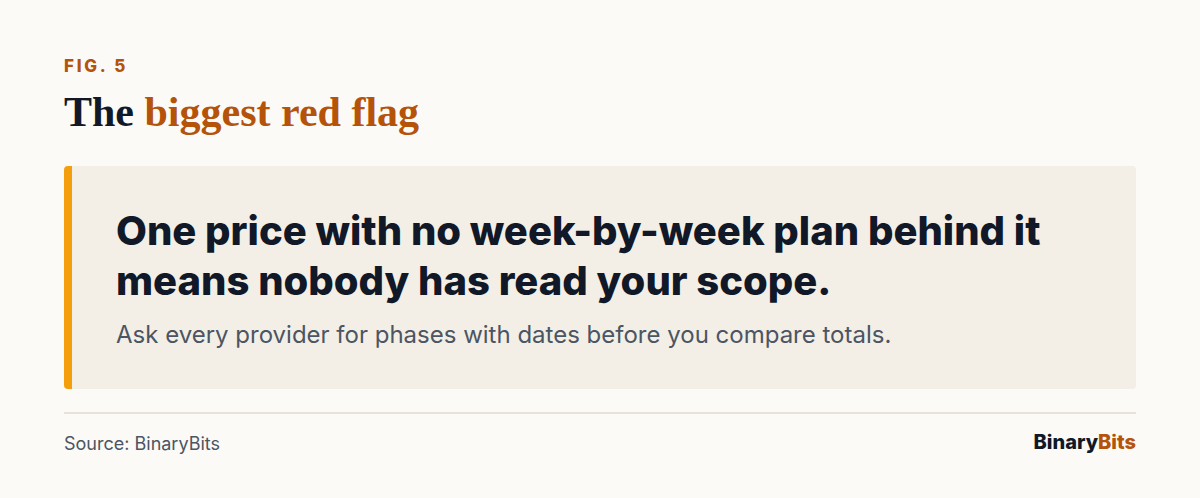
- Biggest red flag: one price with no week-by-week plan behind it.
- When not to hire anyone: if an existing tool already does most of the job, or you haven't talked to ten would-be customers.
What do custom SaaS development services include?
A full-service provider takes you from a feature list to a live product with paying users. These are the parts you should see in any proposal, whoever writes it:
| Deliverable | What it means | Ask to see |
|---|---|---|
| Discovery | Mapping your workflow, users and data before any code | A written scope and a week-by-week plan |
| Design | Screens and user flows you approve before the build | Clickable designs, not just mood boards |
| Architecture | How customers' data is kept apart, how it scales | A one-page diagram in plain language |
| Build | Features shipped in short cycles called sprints | A working demo every two weeks |
| Billing | Plans, trials, invoices, failed-payment retries | Which payment provider, and who owns that account |
| Testing and launch | QA, data migration, going live | A test plan and a launch checklist |
| Handover and support | Code, docs, accounts, then fixes after launch | How long support lasts and what it covers |
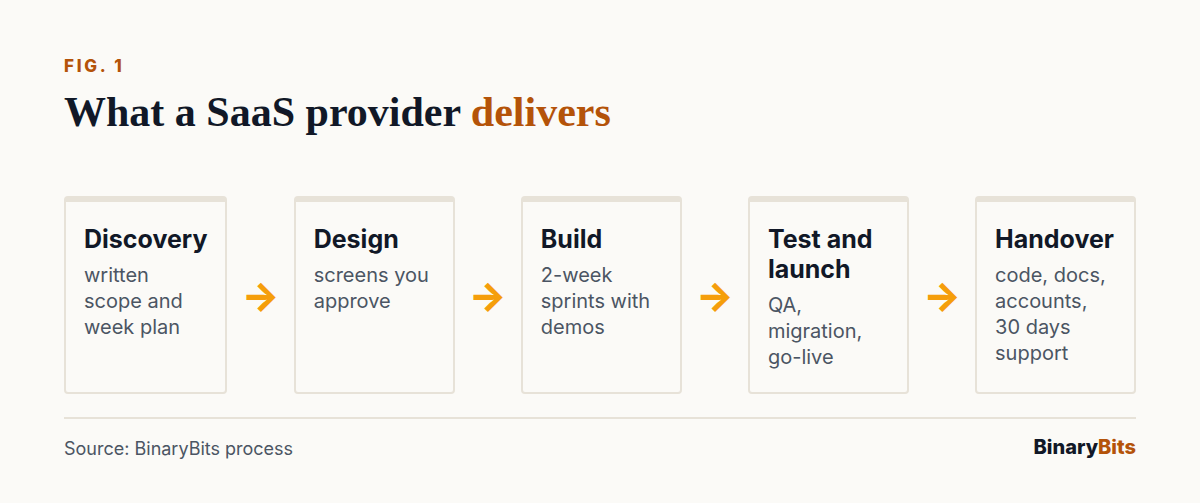
On our own projects, that's two-week sprints with a demo at the end of each, 30 days of support after launch, and the full source code and IP handed over (how we run custom web and SaaS builds). Use it as a baseline, not a sales pitch: any good provider should match or beat it.
What is a custom SaaS platform, and who needs one?
A custom SaaS platform is software you sell or run as a subscription, built around your own process instead of rented off the shelf. It's usually multi-tenant: one codebase serving many customer companies, each seeing only its own data.
The buyers we see most often:
- Founders turning a service or a niche workflow into a product they charge for monthly.
- Operations-heavy businesses whose process no longer fits generic tools, and who may resell the result.
- Data and API companies that need per-customer keys, usage limits and metered billing.
- Agencies that sell a branded platform to their own clients.
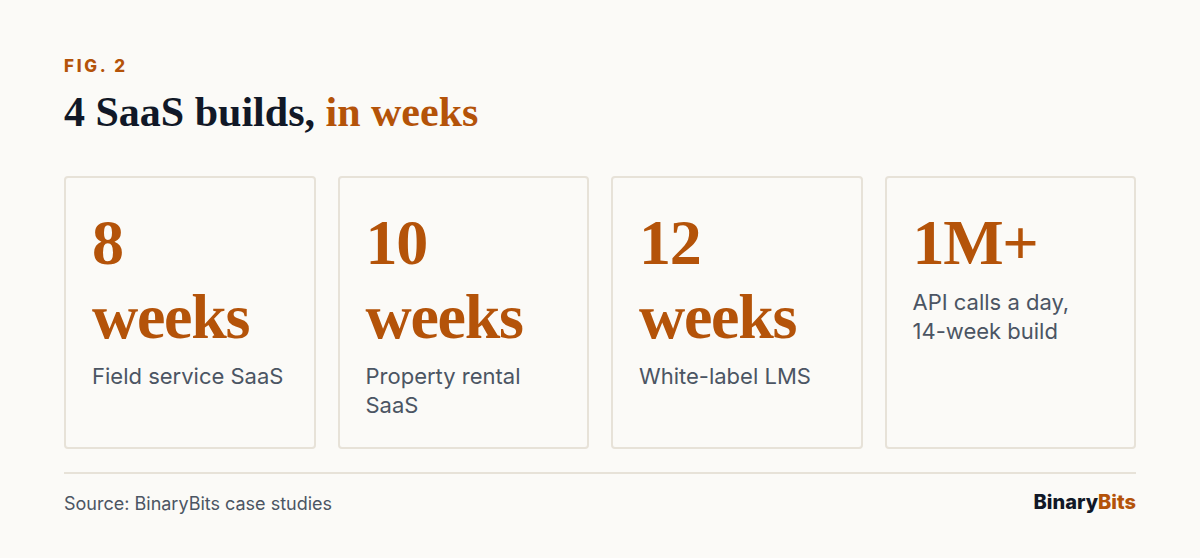
Four of our builds show the range. A field service job management SaaS took 8 weeks. A property rental platform with landlord and tenant portals took 10. A white-label learning platform, resold under each client's brand, took 12. A multi-tenant API platform took 14 weeks and now serves 1M+ calls a day across 80+ customer companies (multi-tenant API platform case study).
Should you build custom SaaS in-house or outsource it?
For a first version, outsourcing is usually faster and cheaper. The median US software developer earns $135,980 a year (US Bureau of Labor Statistics), before benefits, recruiting and the months it takes to hire. A small in-house team is a six- or seven-figure yearly commitment before the product has a single user.
Outside rates vary as much as salaries. Index.dev's 2026 data puts median senior full-stack rates at $100–$150 an hour in the US, $58–$85 in Eastern Europe and $34–$52 in India (Index.dev).
Two questions settle it:
- Is the software your product? If it's the business itself and the roadmap runs for years, you'll want your own team eventually.
- Is the scope settled? A clear first version suits an outside team on a fixed price. A moving target suits people who work only on your product.
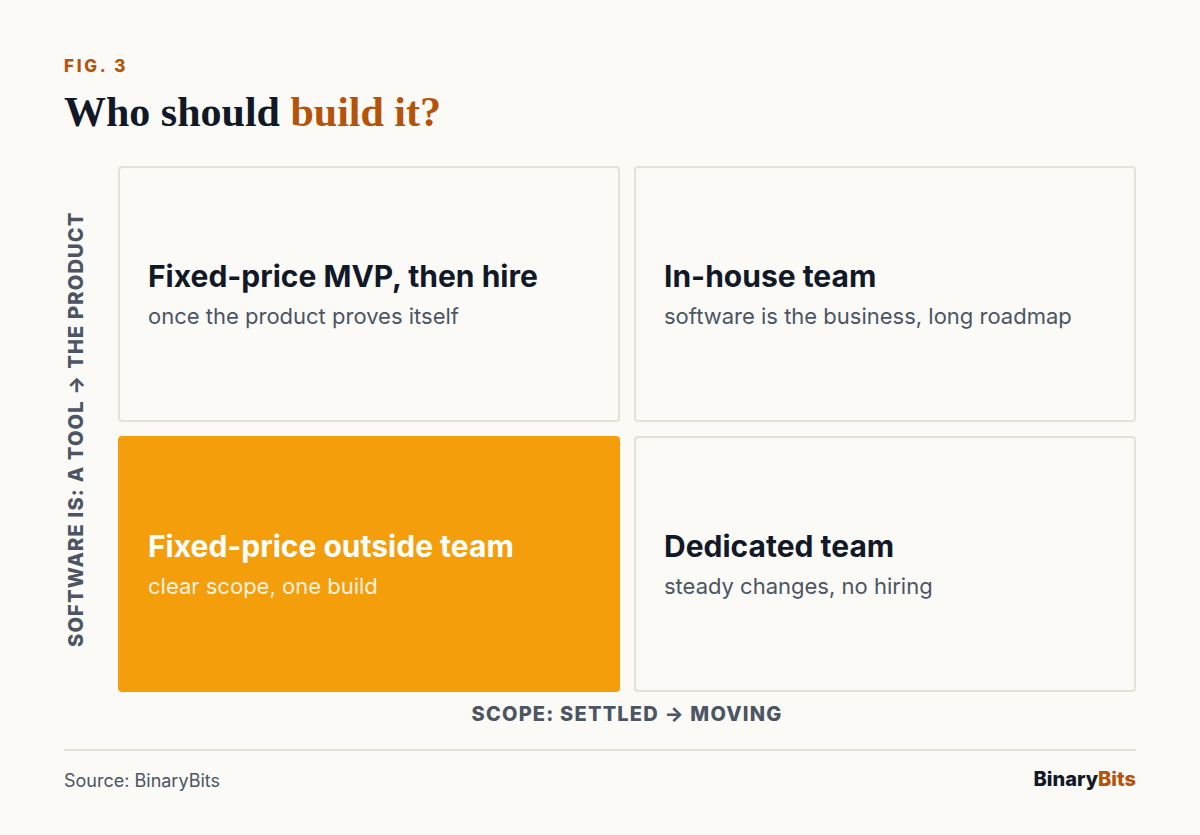
A common path is a fixed-price MVP with an outside team, then a dedicated development team once real users start asking for features, then in-house hires once you know exactly which skills you need.
How do you choose a custom SaaS development company?
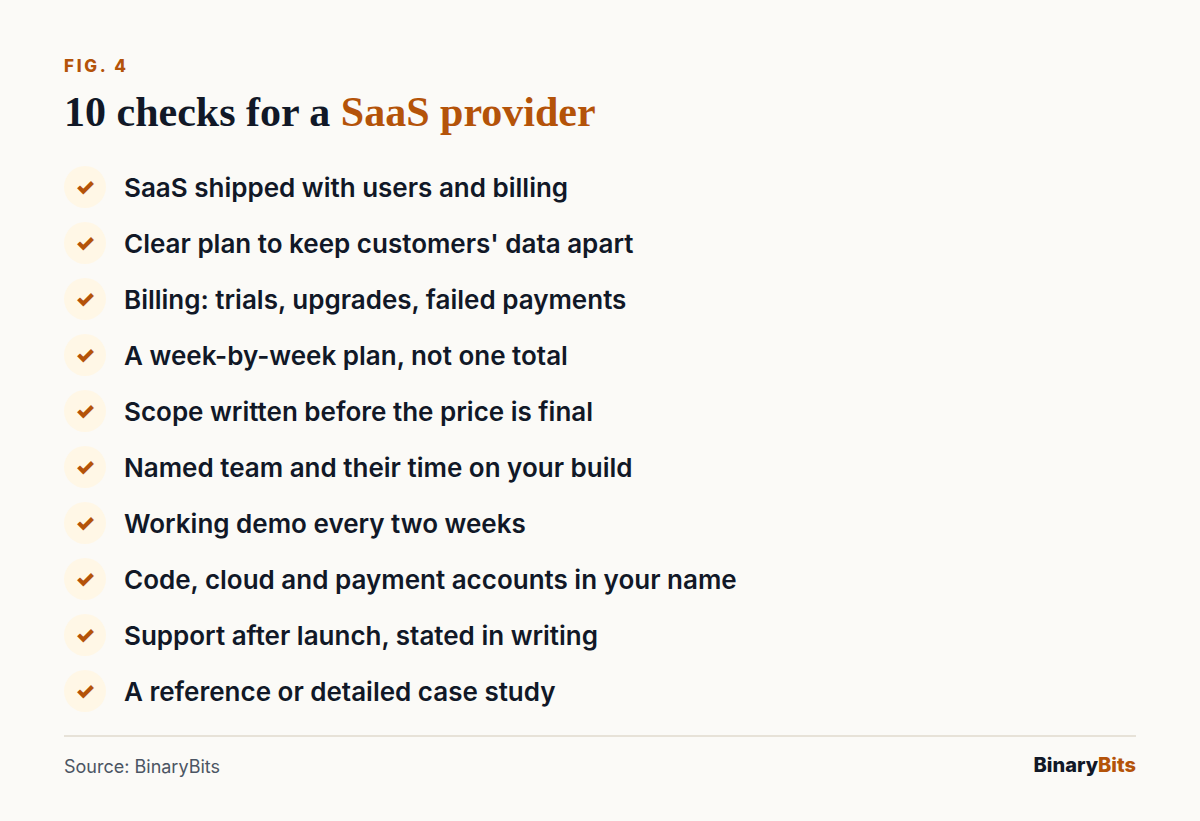
Run every provider through the same ten points. Score each one pass or fail before you compare prices, so a cheap quote can't hide a missing answer.
| # | Check | A good answer |
|---|---|---|
| 1 | SaaS they've shipped | Live products with users and billing, not just websites |
| 2 | Keeping customers' data apart | A clear model, explained in plain words |
| 3 | Billing | Trials, plan changes, failed payments, invoices covered |
| 4 | Week-by-week plan | Phases with dates, not one total |
| 5 | Paid or included discovery | Scope written down before the build price is final |
| 6 | Named team | The people on your build, and how much of their time |
| 7 | Demos | Working software every two weeks |
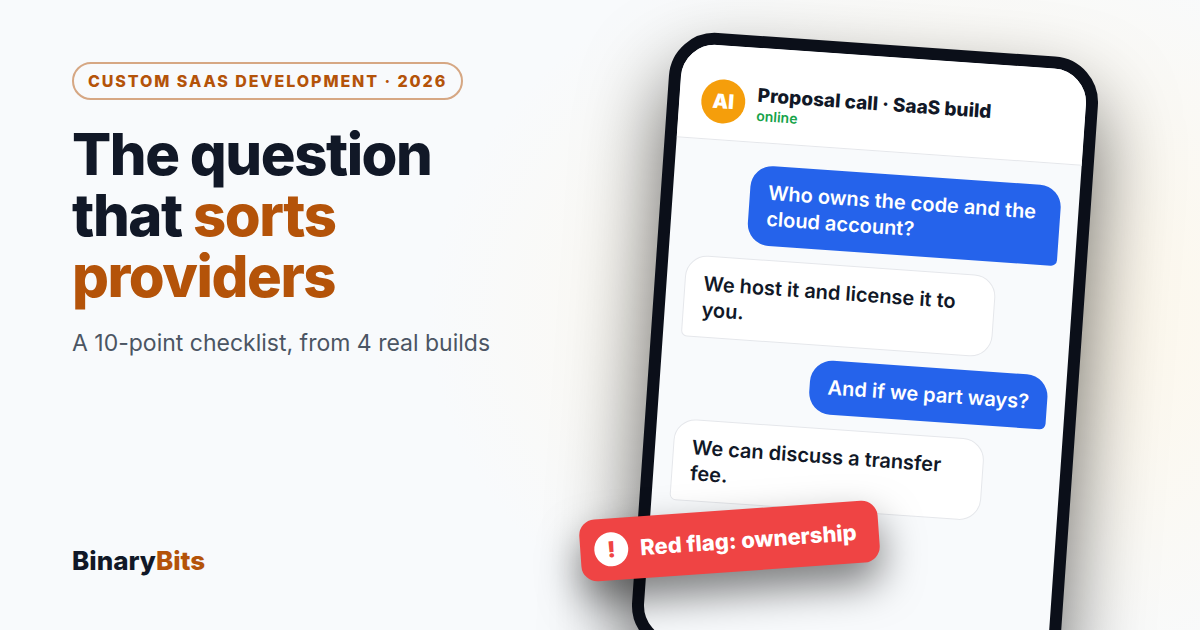
| 8 | Code and account ownership | You own the repo, cloud, domain and payment accounts |
| 9 | Support after launch | A stated period and what it covers |
| 10 | References | A client you can call, or a detailed public case study |
Comparing proposals already? Send us your feature list and we'll reply with a week-by-week plan you can hold the others against. Get a custom SaaS build plan →
How will they keep each customer's data apart?
This is the decision that's hardest to change later. AWS's guidance on SaaS design calls tenant isolation, keeping one customer from ever reaching another's data, a requirement every SaaS provider should define up front, and notes that shared databases make it harder to get right (AWS SaaS Tenant Isolation Strategies). Ask which model they'll use and why it fits your customers.
How will they handle billing?
Billing looks like one feature and is really a dozen: trials, upgrades mid-month, failed cards, refunds, tax, invoices. Ask which payment provider they'll use and whether the account is in your name. Also price in the fees: Stripe's subscription billing tool charges 0.7% of billing volume on top of card fees (Stripe pricing).
Who owns the code?
You should, in writing. Under US law, a commissioned work only counts as "made for hire" if it falls into one of nine listed categories and both sides sign an agreement saying so (US Copyright Office, Circular 30). Custom software isn't on that list, so ask for a clause that assigns the copyright to you as well.
⚠️ Note: This is general information, not legal advice. Have a lawyer read the IP and ownership clauses before you sign.
How much do custom SaaS development services cost, and how long do they take?
Time is the honest starting point, because cost is hours times rate. A focused MVP usually takes 6–10 weeks, and a full SaaS platform 3–6 months. Our four builds fit that: 8, 10, 12 and 14 weeks.
We broke down the budget side, with market price ranges, a weeks-to-dollars formula and the costs after launch, in SaaS app development cost in 2026. The short version: the same build costs about six times more at US senior rates than with an offshore team at $15–$25 an hour.
What adds weeks, in our experience:
- Customer data kept apart: design work up front, tested on every screen.
- Extra user types: landlord and tenant, staff and admin, each with its own screens.
- White-label: per-client branding and custom domains took 2 of the learning platform's 12 weeks.
- Moving off an old system: the API platform moved 80 customers in batches of 10 with zero disruptions, which took careful planning.
What should you ask a SaaS development company before you sign?
Put these in writing and compare the answers side by side:
- Who exactly is on my build, and what share of their week is mine?
- What will I see at the end of each two-week sprint?
- Is this a fixed price, and how are changes priced?
- Which accounts (code, cloud, domain, payments, email) are set up in my name from day one?
- What does support after launch cover, and for how long?
- What happens if we part ways halfway: what do I get, and how fast?
- How many hours a day overlap with my time zone?
What are the red flags in a SaaS development proposal?
Most bad builds are visible in the proposal. Watch for these:
- A single number with no plan: nobody has thought about your scope.
- A quote within hours of your first call, with no questions about users, billing or data.
- A portfolio of screenshots and no live product you can sign up for.
- Accounts in their name: your app on their cloud, payments into their Stripe.
- A senior team in the pitch and unnamed people on the contract.
- No mention of how data is kept apart for a product with many customers.
When shouldn't you hire a custom SaaS developer?
When an existing tool already does most of the job and your edge isn't in the part it can't do. A subscription is cheaper than any build until your process stops fitting it. We wrote about where that line falls in why small businesses move to custom SaaS.
And don't hire anyone yet if you haven't spoken to ten would-be customers. A clickable prototype costs a fraction of a build and tells you whether anyone wants it.
Get a week-by-week plan for your SaaS build
Send us your feature list and we'll reply with the weeks, the team and a fixed price for your MVP, with the code and accounts in your name. No pitch, just a conversation.
Frequently asked questions
What does a custom saas development provider do?
It plans, designs, builds, launches and supports a subscription software product made for your business. That covers discovery and a written scope, screen designs, the build in short sprints with regular demos, billing, testing, data migration, launch, and fixes afterwards. A good provider also hands over the source code, documentation and every account, so you can run the product or switch teams without starting again.
How much does custom saas development cost?
It's hours times rate. A focused MVP usually takes 6–10 weeks and a full platform 3–6 months, so the team's hourly rate decides the bill. Median senior rates run $100–$150 an hour in the US and $34–$52 in India, according to Index.dev. The same build can cost about six times more at US rates than with an offshore team at $15–$25 an hour.
Should I build custom saas in-house or outsource it?
Outsource the first version unless the software is your whole business and you already know the roadmap. The median US developer earns $135,980 a year before benefits and hiring time, so an in-house team is a big fixed cost before you have users. Many companies outsource the MVP, add a dedicated team after launch, and hire in-house later.
How long does custom SaaS development take?
A focused MVP typically takes 6–10 weeks from a clear scope, and a full platform 3–6 months. Our builds took 8 weeks for a field service app, 10 for a property rental platform, 12 for a white-label learning platform and 14 for a multi-tenant API platform. Extra user types, billing, white-labeling and moving data from an old system add the most time.
Who owns the code when you outsource SaaS development?
Only you, if your contract says so. Under US copyright law, a contractor's work is "made for hire" only in nine listed categories with a signed agreement, and custom software isn't one of them. Ask for a clause that assigns all copyright and IP to you, and keep the code repository, cloud, domain and payment accounts in your company's name from day one. Have a lawyer check it.
Who should I hire to build custom AI agents for my SaaS product?
Pick a team that has shipped both SaaS and AI agents to production, because the agent has to respect your product's user roles, customer data separation and billing. Ask for a live example, how they test an agent's answers, and what it costs to run per month. Our guide to choosing a custom AI agent development company covers the checks in detail.
What is a custom SaaS platform?
It's subscription software built around a specific business process rather than bought off the shelf. Users log in through a browser, pay monthly or yearly, and usually share one codebase while seeing only their own company's data. Examples include field service scheduling apps, rental management portals, branded learning platforms and data APIs with per-customer keys and usage limits.