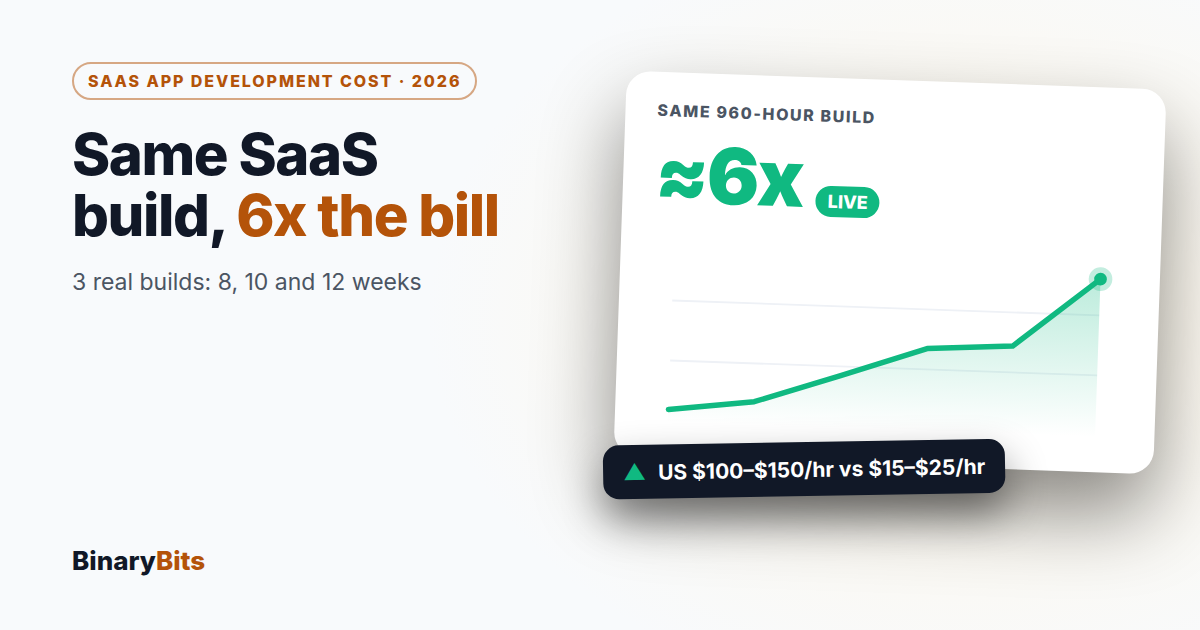
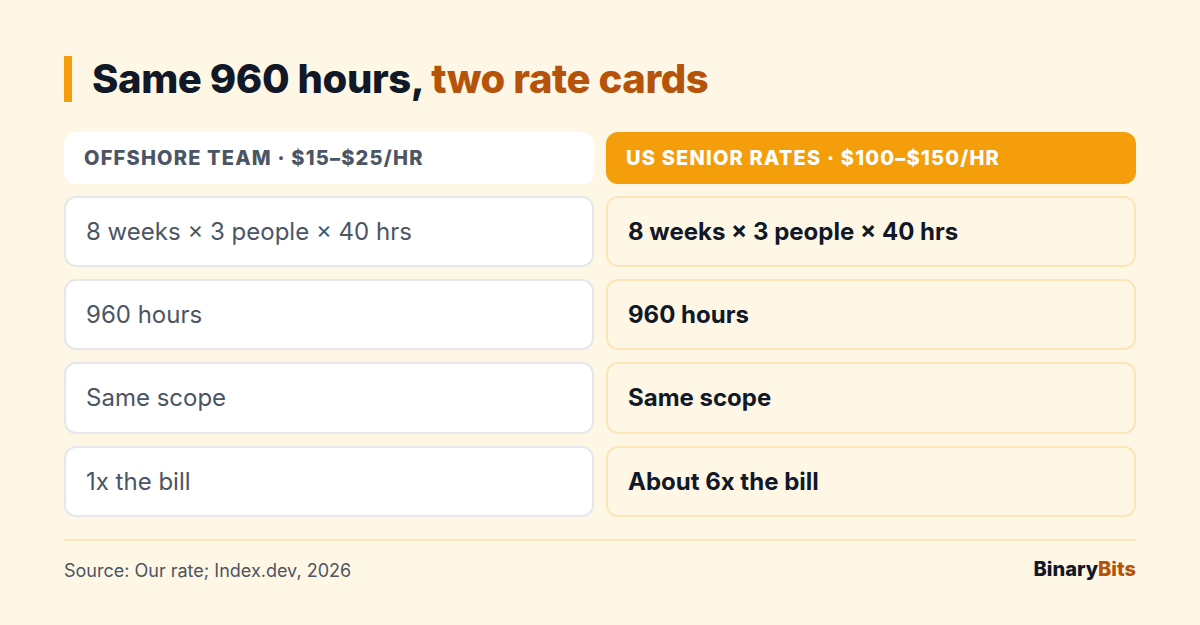
SaaS app development cost in 2026 runs from about $10,000 for a small MVP to $150,000+ for a complex platform, according to published guides from RaftLabs and DesignRevision. The gap is mostly hours times hourly rate: the same 8-week, 960-hour build costs about 6x more at US rates than with an offshore team at $15–$25 an hour.
Below are three real SaaS builds that took 8, 10 and 12 weeks, how to turn weeks into a budget, and the costs that show up after launch.
💡 What you'll get from this post: a way to estimate your own SaaS budget from scope, weeks and rates, checked against three builds we shipped.
TL;DR
- Market range: $10,000–$30,000 for an MVP, $30,000–$150,000 for a full product, $120,000+ for complex platforms.
- Our three builds: 8, 10 and 12 weeks, from a field service app to a white-label learning platform.
- Budget formula: weeks × people × 40 hours × hourly rate. Rate is the biggest lever: $15–$25/hr offshore vs $100–$150/hr for US seniors.
- Budget for year two: maintenance runs about a quarter of the build cost each year.
- Biggest cost drivers: multi-tenancy, billing, roles, integrations and a mobile app.
How much does SaaS app development cost in 2026?
Most published guides agree on three tiers. RaftLabs puts an MVP at $10,000–$20,000 over 6–8 weeks and a full-featured product at $20,000–$60,000 over 12–14 weeks (RaftLabs). DesignRevision's ranges are wider: $5,000–$30,000 for an MVP, $30,000–$150,000 for a production SaaS, $150,000+ for complex builds (DesignRevision).
| Tier | What you get | Typical time | Published range |
|---|---|---|---|
| MVP | 1–3 core workflows, login, basic billing | 6–10 weeks | $5,000–$30,000 |
| Full product | Several roles, integrations, admin panel, reporting | 10–14 weeks | $20,000–$150,000 |
| Complex platform | Multi-tenant, white-label, compliance, AI features | 4+ months | $120,000+ |
The ranges are wide because they mix team locations and scopes. A better way to budget is to estimate the weeks your scope needs, then multiply by the team and its rate.
What did 3 real SaaS builds include, and how long did they take?
These are three SaaS products we built, each written up as a public case study. A multi-tenant app, one codebase serving many customer companies with their data kept apart, shows up in all three.
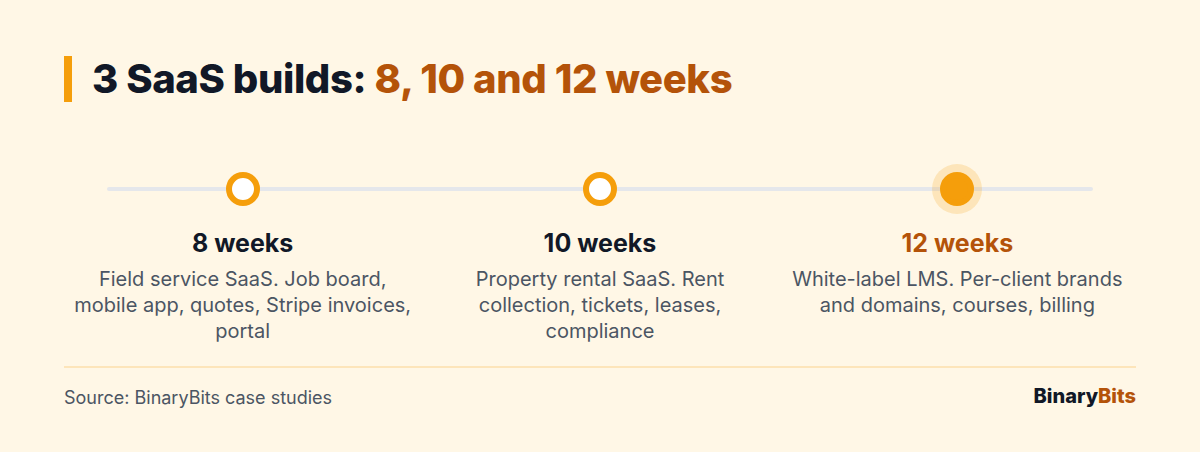
Field service job management SaaS: 8 weeks
A job board, engineer scheduling with clash detection, a mobile web app for engineers with digital job sheets, a quote builder, automatic invoices with Stripe payment links, a customer portal and SMS alerts. Week 1 was process mapping, weeks 2–4 the core job board, weeks 5–6 the mobile app, week 7 quotes and payments, week 8 the portal and launch. Read the field service SaaS case study.
Property rental management SaaS: 10 weeks
Separate landlord and tenant portals on one backend, recurring rent collection through Stripe, maintenance tickets with photos, digital leases with e-signing, a compliance calendar and data migration from spreadsheets. Discovery and the data model took two weeks, because two user types share everything. Read the property rental platform case study.
White-label corporate LMS: 12 weeks
A learning platform resold under each client's own brand: per-client colors, logos and domains with automatic SSL, a database schema per client, SCORM course imports, reporting, certificates and Stripe billing per client. Two of the 12 weeks went on custom domains alone. Read the white-label LMS case study.
How do you turn build weeks into a SaaS app development cost?
Use one formula: weeks × people × 40 hours × hourly rate. Our rate is $15–$25 an hour per team member, depending on the work's complexity. Each of the three builds ran with a 3-person team, which gives these hours:
| Build | Weeks | Team | Hours |
|---|---|---|---|
| Field service SaaS | 8 | 3 people | 960 |
| Property rental SaaS | 10 | 3 people | 1,200 |
| White-label LMS | 12 | 3 people | 1,440 |
Multiply the hours by the rate you're quoted to compare teams. Index.dev puts the median senior full-stack rate in the US at $100–$150 an hour (Index.dev). Same hours, same scope, roughly 6x the bill of a team at $15–$25.
Have a feature list? Send it over and we'll turn it into weeks, hours and a fixed number. Get a SaaS development estimate →
Where does the money go in a SaaS build?
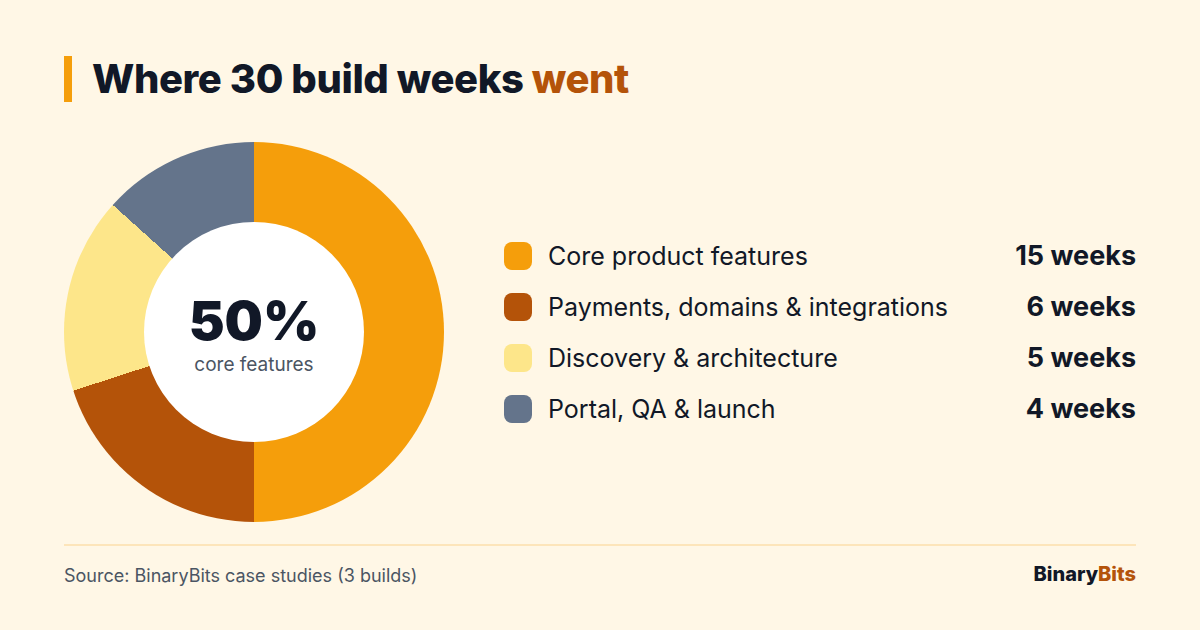
Across our three builds, 30 weeks in total by the week plans in our case studies, half the time went on the core product features. The rest split between planning, payments and integrations, and launch.
- Discovery and architecture: 5 weeks (17%). Mapping the workflow, the data model and how to keep each customer's data apart.
- Core product features: 15 weeks (50%). Job boards, course players, tenant portals, admin panels.
- Payments, domains and integrations: 6 weeks (20%). Stripe, e-signing, SMS, custom domains.
- Portal, QA and launch: 4 weeks (13%). Testing, data migration, training, go-live.
Skimping on discovery is the usual false saving. The two weeks spent on the LMS's database design decided whether each new client brand took minutes or a rebuild.
What drives SaaS development cost up or down?
Features that touch every screen cost the most, because they're built once but tested everywhere.
- Multi-tenancy: keeping each customer's data apart adds design work up front.
- Billing: subscriptions, failed-payment retries and invoices take a week or more on their own.
- User roles: each extra role (landlord, tenant, admin) multiplies screens and tests.
- Integrations: every outside service (e-signing, SMS, CRM) adds setup, error handling and testing.
- Mobile: a mobile web app is cheaper than separate iOS and Android apps.
- Data migration: moving old spreadsheets in cleanly is real work, often forgotten.
- White-label: per-client branding and domains took 2 of the LMS's 12 weeks.
What brings the cost down: one user type at launch, a single plan in Stripe, and integrations you can add in a later phase.
How do developer rates in the US, Europe and India change the price?
Rate is the biggest single lever. Index.dev's 2026 marketplace data puts median senior full-stack rates at $100–$150 an hour in the US, $58–$85 in Eastern Europe, $50–$80 in Latin America and $34–$52 in India (Index.dev).
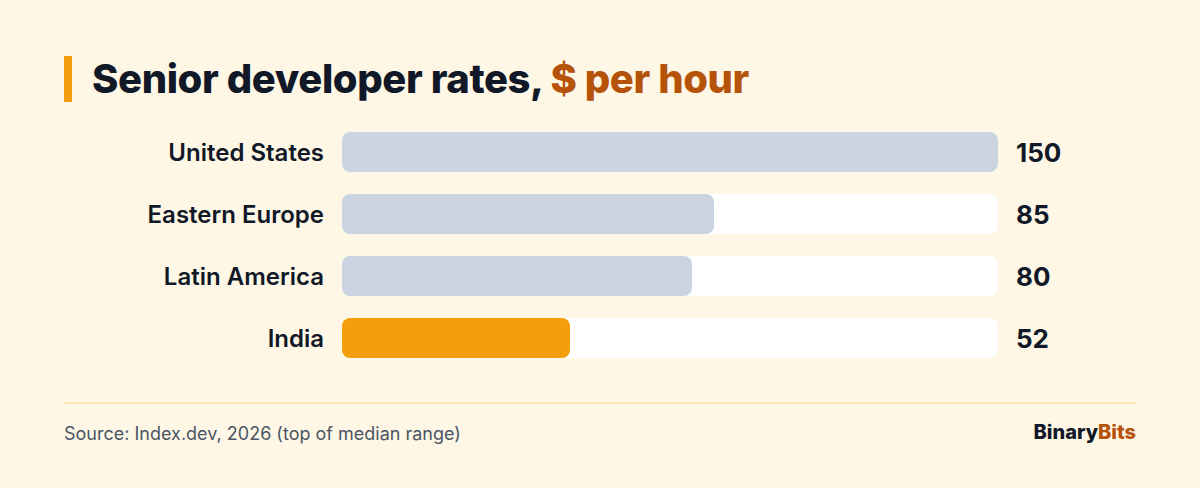
Our $15–$25 is below those medians because it's a blended team rate, not a senior freelancer's rate. The fair question for any offshore team is about overlap and process: do they cover US working hours, demo every two weeks and write things down?
Which pricing model fits: fixed price, hourly or a dedicated team?
- Fixed price: best for an MVP with a written feature list. You know the number; changes go through a change request.
- Hourly (time and materials): best when the scope will move. You pay for hours used and can reprioritize each sprint.
- Dedicated team: best after launch, when you need a steady roadmap. You pay monthly for engineers who work only on your product. See how our dedicated development teams work.
A common path is fixed price for the MVP, then a dedicated team once real users start asking for features.
What hidden costs come after launch?
The build is the first bill, not the last. Plan for these before you sign.
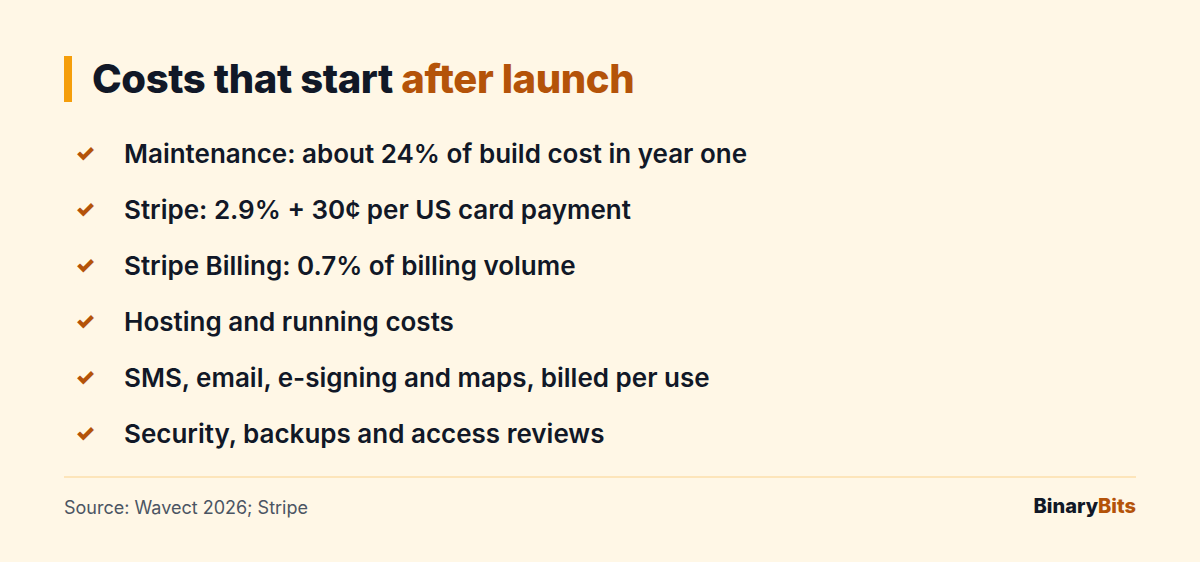
- Maintenance: a 2026 benchmark of 24 SaaS products found median yearly maintenance of 24% of the build cost in year one, 21% in year two and 26% in year three (Wavect). On a $50,000 build, that's about $12,000 in year one.
- Payment fees: Stripe charges 2.9% + 30¢ per US card payment, plus 0.7% of billing volume for its subscription billing tool (Stripe pricing).
- Hosting and running: RaftLabs estimates $2,000–$8,000 a month to operate a live SaaS, including more than servers (RaftLabs). An early product with few users usually spends far less on hosting alone.
- Outside services: SMS, email, e-signing and maps are billed per use.
- Security and compliance: audits, backups and access reviews as you sell to bigger customers.
Is it cheaper to build a SaaS app in-house?
Usually not for the first version. The median US software developer earns $135,980 a year (US Bureau of Labor Statistics), about $65 an hour before benefits, hiring costs and equipment. Three in-house developers cost about $408,000 a year in salary alone.
In-house makes sense once the product is the business and the roadmap is years long. Before that, an outside team gets you to real users faster and cheaper, and you hire once you know what you need.
How do you get an accurate SaaS development quote?
A quote is only as good as the brief. Give any team these, and compare quotes line by line:
- The 3–5 jobs a user must be able to do on day one.
- Every user type (customer, staff, admin) and what each can see.
- How customers pay: plans, trials, per-seat or usage billing.
- Every outside service it must talk to.
- Data you're bringing in from spreadsheets or an old system.
- Web only, or a mobile app too.
- Who hosts it and who owns the code.
A team that answers with a week-by-week plan, like the ones above, has thought about your scope. A single number with no breakdown hasn't. If you're still shaping the MVP, our guide to going from idea to MVP in 6 weeks covers what to cut.
When shouldn't you build a custom SaaS app?
When an existing tool already does 80% of the job and your edge isn't in that last 20%. A monthly subscription to off-the-shelf software is cheaper than any build until your process stops fitting it. We wrote about where that line falls in why small businesses move to custom SaaS.
Don't build either if you haven't spoken to ten would-be customers. A clickable prototype costs a fraction of a build and answers whether anyone wants it.
Get a week-by-week plan for your SaaS build
Send us your feature list and we'll reply with the weeks, the team and a fixed price for your MVP. No pitch, just a conversation.
Frequently asked questions
How much does saas app development cost?
Published guides put a SaaS MVP at $5,000–$30,000, a full product at $20,000–$150,000 and complex platforms at $120,000 or more. The real driver is hours times rate. An 8-week build with three people is 960 hours, which costs about six times more at US senior rates of $100–$150 an hour than with an offshore team at $15–$25. Scope sets the weeks; the team's location sets the rate.
Is it cheaper to do saas app development in-house?
For a first version, rarely. The median US software developer earns $135,980 a year before benefits, so a three-person team costs around $408,000 a year in salary alone. An outside team can ship an MVP in 8–12 weeks for a fraction of that. In-house starts to pay off once the product is your business and the roadmap runs for years.
How much does a SaaS MVP cost in 2026?
Most agency guides quote $10,000–$30,000 for a SaaS MVP with one or two core workflows, login and basic billing. Offshore teams sit at the lower end and US agencies well above it. Keep it cheap by launching with one user type, one payment plan and no integrations you can add later, and get a fixed price against a written feature list.
How long does it take to build a SaaS app?
It depends on the scope. A focused MVP usually takes 6–10 weeks from a clear brief. Our field service SaaS took 8 weeks, a property rental platform with landlord and tenant portals took 10, and a white-label learning platform took 12. Multi-tenancy, billing, extra user roles and data migration are what add the most weeks.
How much does it cost to maintain a SaaS app each year?
Plan for about a quarter of the build cost each year. A 2026 benchmark of 24 SaaS products found median maintenance of 24% of the original build cost in year one, 21% in year two and 26% in year three. On a $50,000 build, that's roughly $10,000–$13,000 a year, plus hosting, payment fees and outside services.
Can I build a SaaS app with no-code to save money?
For testing an idea, yes. No-code tools let you launch a simple version for little more than a monthly subscription. They get harder once you need several customer companies with separate data, custom billing or integrations the platform doesn't support. Many founders validate with no-code, then rebuild custom code once they have paying users and clear requirements.