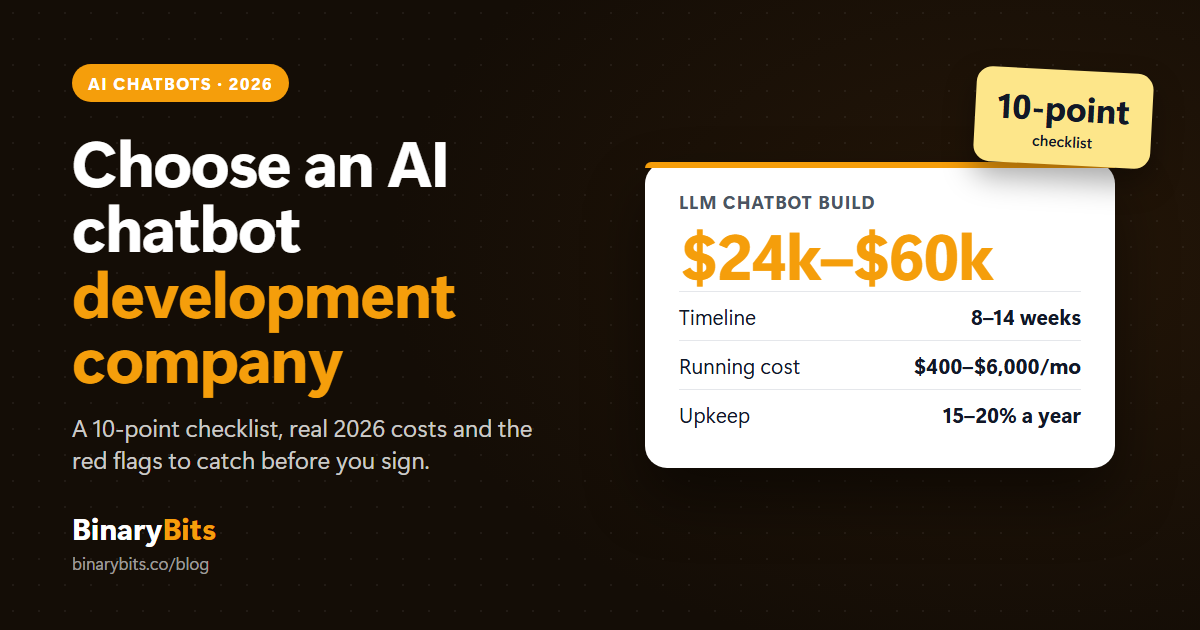
To choose an AI chatbot development company, ask for a live bot they built that's still in production, a fixed-scope quote with monthly running costs, and a test set of your real questions the bot must pass before launch. Expect $24,000–$60,000 and 8–14 weeks for an LLM chatbot (one built on a large language model like GPT or Claude) connected to your systems, plus $400–$6,000 a month to run it.
Below: what a good provider delivers, the checklist we'd use if we were buying, real prices, and numbers from one of our own builds.
💡 What you'll get from this post: a deliverables table, a vendor checklist, sourced 2026 prices and the questions that expose a weak provider.
Key takeaways
- Price: about $4,500–$12,000 for a rule-based bot, $24,000–$60,000 for an LLM chatbot, $72,000+ for an enterprise agent.
- Running cost: $400–$6,000 a month for model usage and hosting, plus 15–20% of the build cost a year for upkeep.
- Best test: a live production bot you can try, not a demo.
- Biggest red flag: no plan for measuring wrong answers before launch.
- Our result: a support agent that auto-resolves 70% of 800–1,200 daily tickets, built in 8 weeks.
What does an AI chatbot development company deliver?
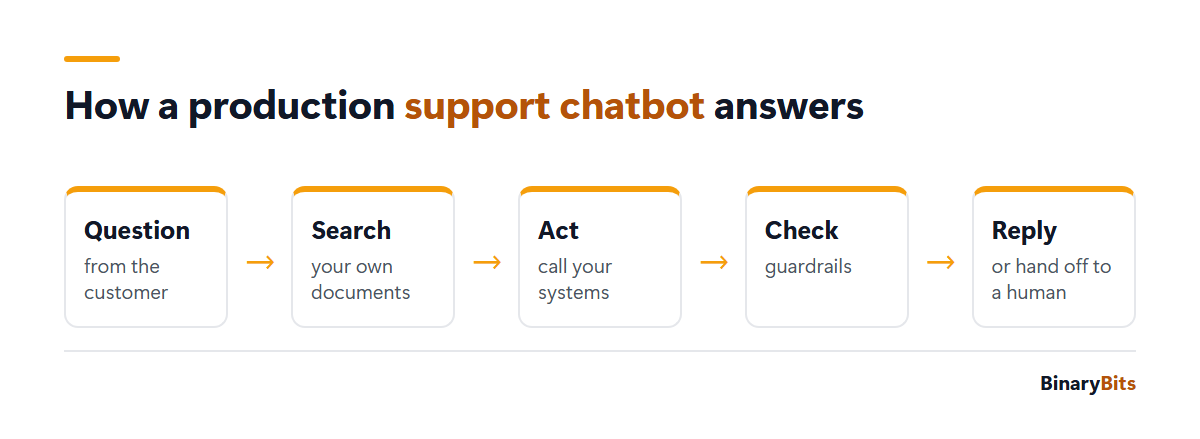
A working system, not just a chat window: the bot, its connection to your data, the actions it can take, tests that prove it answers correctly, and monitoring after launch. If a quote only covers "chatbot UI and training", most of the work is missing.
| Deliverable | What it means | Red flag if missing |
|---|---|---|
| Discovery and scope | Your top 50–100 real questions, sorted by volume and risk | Price given before anyone reads your tickets |
| Knowledge pipeline | RAG (the bot looks up your own documents before it answers), kept in sync with your help center | "We'll train it on your website" and nothing more |
| Integrations and actions | Order lookup, CRM updates, bookings, refunds through your APIs | Bot can only talk, never do |
| Guardrails and handoff | Rules on what it must not say, and a clean handoff to a human | No answer to "what happens when it's wrong?" |
| Evaluation set | A fixed list of test questions with correct answers, run before every release | Quality judged by "it looked fine in the demo" |
| Monitoring and support | Dashboards for resolution rate, cost per chat and escalations | Support ends at launch |
| Ownership | Your code, prompts, data and model accounts | Bot runs only on the vendor's platform |
Is an AI chatbot the same as an AI agent?
Not quite. A chatbot answers questions; an AI agent also takes actions, like issuing a refund, and decides the next step. Most AI agent development companies sell both, so ask which actions the bot takes alone and which need approval.
Who needs AI chatbot development services?
You need one when the same questions arrive hundreds of times a week and the answers already exist in your documents or systems. The fastest paybacks we see:
- E-commerce and retail: order tracking, returns and product questions. Shoppers used to Amazon and Walmart expect answers in seconds.
- Real estate: listing questions, viewings and lead qualification, the instant answers buyers expect from Zillow.
- Home services and contractors: quotes, scheduling and service-area questions around the clock.
- Recruiting: screening applicants from job boards like Indeed and answering status questions.
- B2B SaaS: onboarding help, in-app support and lead enrichment.
- Agencies: white-label bots under your brand (see AI agents for small businesses for typical client jobs).
When is a chatbot the wrong answer?
When questions are rare, high-stakes or need judgment. At 20 support emails a week, a good help-center page beats a $30,000 bot. Where answers carry legal or medical risk, let the bot draft and a human send.
Should you build your AI chatbot in-house or outsource it?
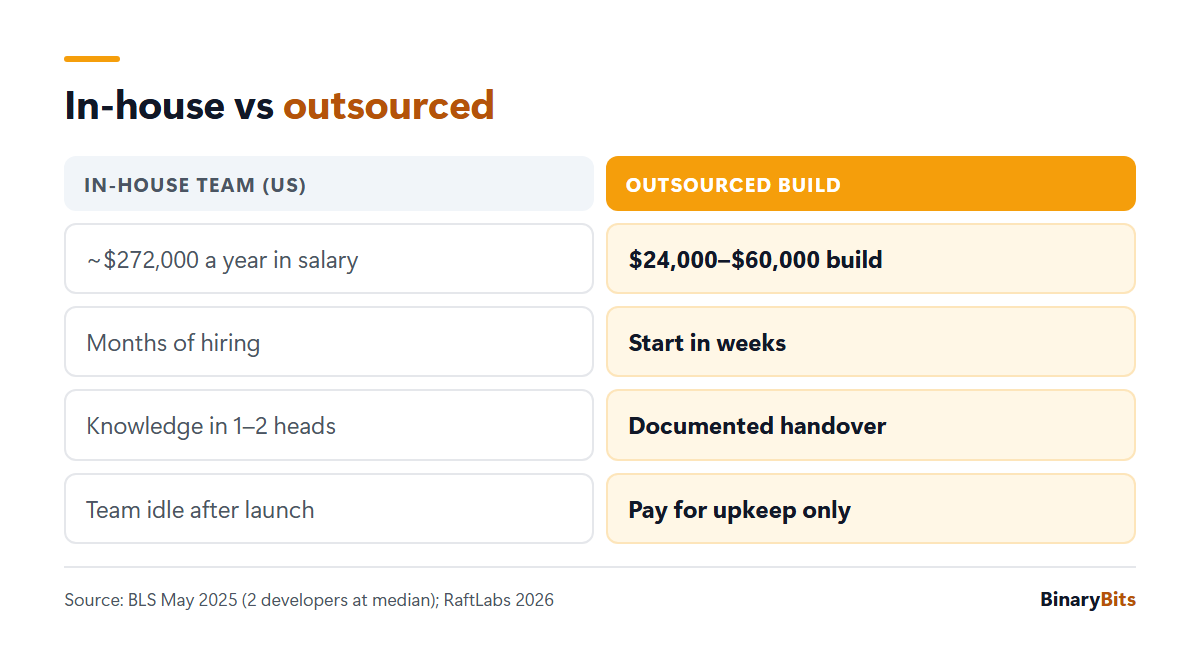
Outsource the first version unless AI is your core product. An in-house team costs more per year than most builds cost in total, and hiring takes months. Bring it in-house once the bot is proven.
What does an in-house AI team cost in the US?
The median US software developer earns $135,980 a year, according to the Bureau of Labor Statistics (May 2025). A production bot needs at least two people (AI and data, plus backend and integrations), so by our arithmetic that's about $272,000 a year in salary alone, before benefits and recruiting.
What does outsourcing cost?
Agency rates run about $100–$200 an hour in North America, $50–$75 in Europe and $25–$50 in India and Southeast Asia, according to Monocubed's 2026 cost guide. The same guide puts upkeep at 15–20% of the build cost per year.
What are the risks of each?
- In-house: slow hiring, knowledge in one head, and a team idle once the bot is built.
- Outsourced: lock-in, weak handover and a provider who vanishes after launch. The checklist below catches these.
How do you evaluate an AI chatbot development company? A 10-point checklist
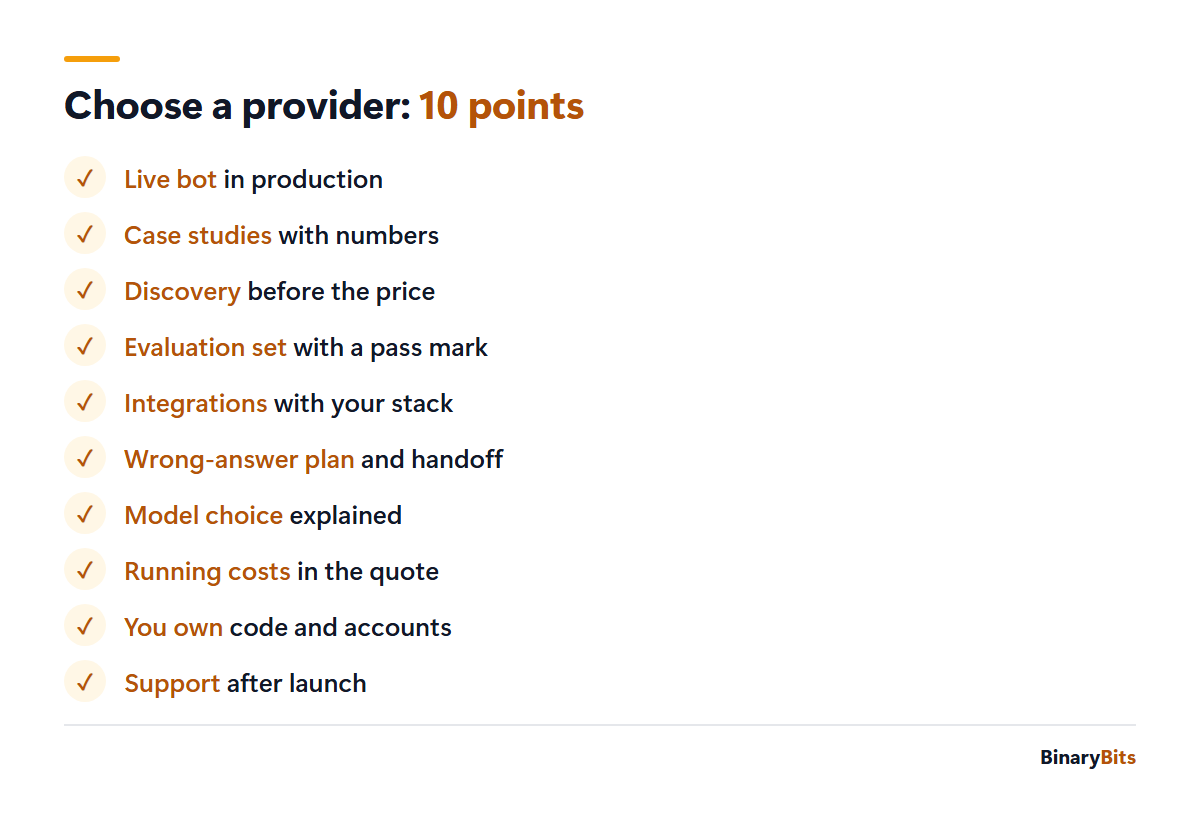
Score every provider on these 10 points. A strong one shows you each, not promises it.
- A live bot in production you can try today, ideally with real traffic numbers.
- Case studies with numbers: resolution rate, response time, cost saved.
- Discovery before the price: they ask for your tickets, FAQs or call logs first.
- An evaluation set: a written pass mark (for example, 90% of 200 test questions correct) before launch.
- Integration experience with your stack: Shopify, Zendesk, HubSpot, Salesforce or your own APIs.
- A plan for wrong answers: guardrails, confidence limits and a human handoff.
- Model choice explained: why GPT, Claude or an open model, and how they'd switch if prices change.
- Running costs in the quote: a monthly estimate for model usage at your volume.
- Your ownership: code, prompts, data and model accounts in your name.
- Support after launch: a named contact, a response time and someone reviewing failed chats each month.
What are the red flags?
Be careful with any vendor that calls a rebranded rules bot an "AI agent". Gartner calls this "agent washing", estimates only about 130 of the thousands of agentic AI vendors are real, and predicts over 40% of agentic AI projects will be canceled by the end of 2027. Other warning signs:
- A fixed price quoted in the first call, before they've seen your data.
- Accuracy promises like "99% accurate" with no test set behind them.
- Monthly model costs left out of the quote.
- The bot only works inside their platform, so you can't leave.
- Only demos, never a production bot or a client you can speak to.
What does AI chatbot development cost in 2026?
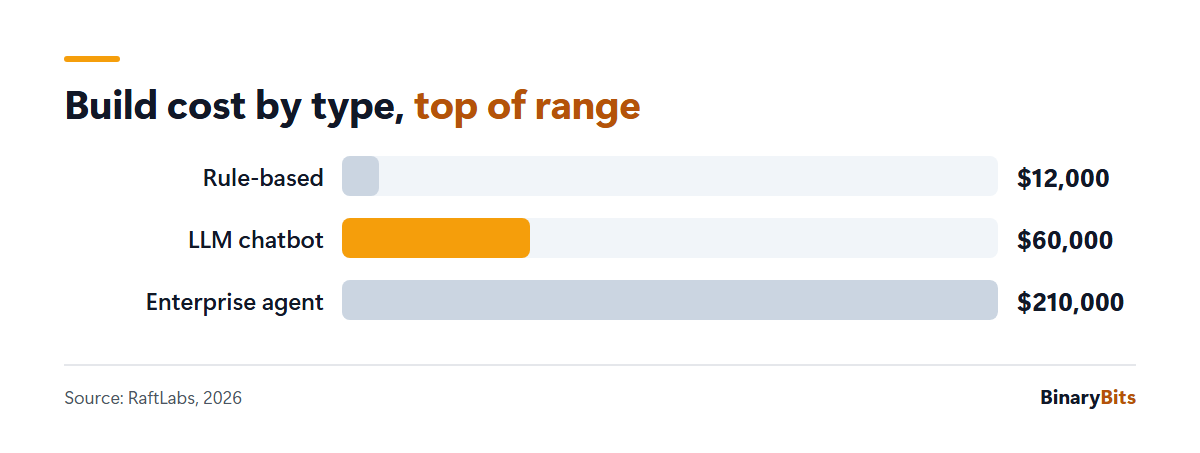
An LLM chatbot connected to your systems typically costs $24,000–$60,000 and takes 8–14 weeks. The ranges below are from RaftLabs' 2026 cost guide:
| Type | Build cost | Timeline | Good for |
|---|---|---|---|
| Rule-based chatbot | $4,500–$12,000 | 3–5 weeks | Fixed menus, simple FAQs, lead capture |
| LLM chatbot with integrations | $24,000–$60,000 | 8–14 weeks | Support, sales and booking with real answers |
| Enterprise AI agent | $72,000–$210,000 | 16–28 weeks | Multi-system actions, compliance, several channels |
What does it cost to run each month?
Plan for $400–$6,000 a month: $200–$5,000 in model usage and $100–$500 for hosting, per the same RaftLabs guide. Model usage is billed per token (roughly a short word), so cost grows with chat volume. Ask every vendor for an estimate at your traffic.
Why do quotes for the same bot differ so much?
- Integrations: each system adds about 1–3 weeks, per RaftLabs.
- Channels: web chat only, or also SMS, WhatsApp and voice.
- Compliance: HIPAA or payment rules add review and hosting work.
What did a real AI chatbot project cost in time and results?
Here's one of ours. An e-commerce brand was getting 800–1,200 support tickets a day, with first replies taking 6+ hours at peak. About 70% were repeats: tracking, returns, product questions and payments. Details are in the AI customer support case study.
We built a GPT-4o agent with RAG over the product docs, FAQs and past tickets, connected to Shopify and Zendesk so it could track orders and start returns itself. It took 8 weeks:
- Weeks 1–2: ticket analysis to find what repeats.
- Weeks 3–4: the knowledge pipeline.
- Weeks 5–6: the agent and its actions.
- Week 7: soft launch inside Zendesk on 20% of traffic.
- Week 8: full rollout.
Results, from our case study: 70% of queries resolved without a human, average reply under 8 seconds, customer satisfaction of 4.6/5 against 4.4 for the human team, and 65% lower support cost in the first 3 months. During one sale it handled 2,400 tickets in 24 hours.
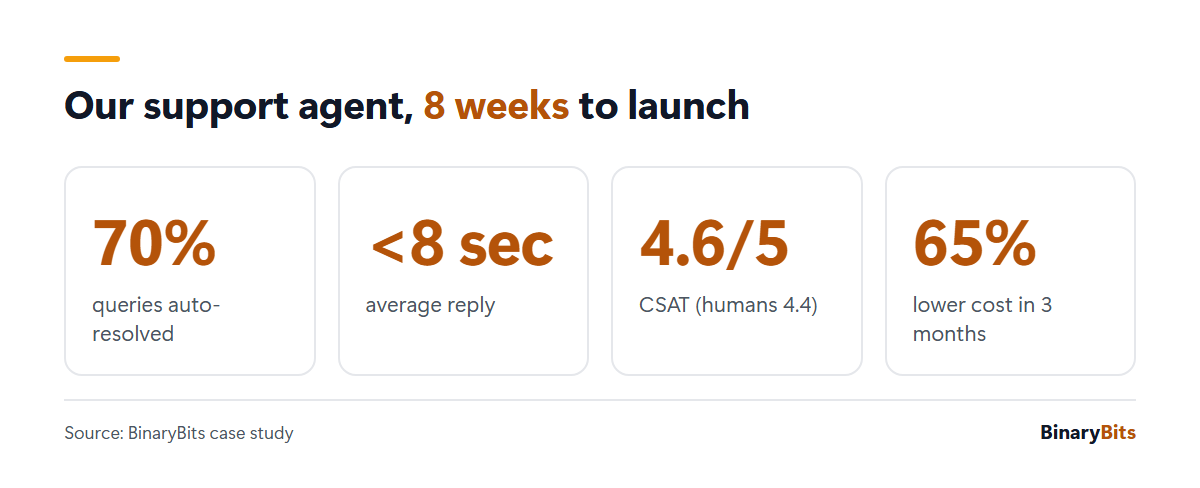
The lesson for buyers: the two weeks of ticket analysis decided the result. Order tracking reached 88% auto-resolution; payment issues only 61%, because they need a human more often.
Want the same breakdown for your tickets or leads? Book a free 30-minute call about your AI chatbot →
What should you ask an AI chatbot development company before you sign?
Ask these on the first call. A good provider answers them in writing.
- Can I try a bot you built that's live today?
- What will you need from us in the first two weeks?
- How will you test accuracy, and what's the pass mark before launch?
- What will it cost per month to run at our volume?
- What happens when the bot doesn't know the answer?
- Who owns the code, prompts and model accounts when we part ways?
- What's your response time after launch, and who do we call?
- If the bot uses data from other websites, how is it collected?
⚠️ Note on data from other sites: In the US, the Computer Fraud and Abuse Act (CFAA) is the main anti-hacking law. In hiQ v. LinkedIn (2022), the Ninth Circuit held that collecting publicly visible pages generally isn't "unauthorized access" under the CFAA, but a site's terms of use can still be enforced as a contract, and anything behind a login is different. This is general information, not legal advice.
Does it matter if the provider is offshore?
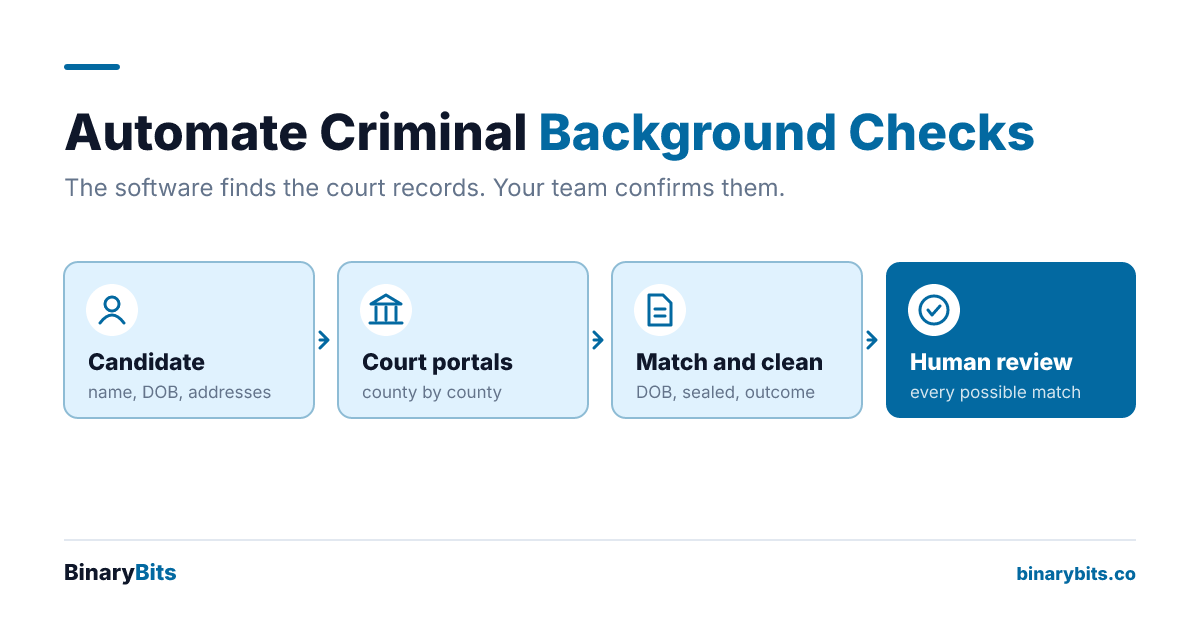
Less than the checklist, if hours and accountability are clear. BinaryBits is an engineering partner for startups, agencies and enterprises: AI agents, custom software and SaaS, backends and dedicated developer teams from India, delivered to Western standards. We've delivered 200+ projects for clients in 10+ countries, including a US background-check company where our automation took over 90% of manual record searches. We reply to support requests within 4 business hours.
If the bot is part of a bigger product, see custom web app development and AI-first Laravel development. Early-stage? Read how startups launch AI agents without failing.
Get a straight answer on your chatbot
We'll look at your tickets or workflow and tell you what a bot would handle, what it costs to build and run, and whether it's worth it. No pitch, just a conversation.
Frequently asked questions
What does an ai chatbot development provider do?
An AI chatbot development provider scopes, builds and runs a chatbot for your business. That covers studying your real questions, connecting the bot to your documents and systems, setting rules for what it must not say, testing it against a fixed set of questions, launching it and monitoring its answers afterward. Good providers also hand over the code and accounts.
How much does ai chatbot development cost?
In 2026, a rule-based chatbot costs about $4,500–$12,000, an LLM chatbot connected to your systems $24,000–$60,000, and an enterprise AI agent $72,000–$210,000, according to RaftLabs. Running costs add $400–$6,000 a month for model usage and hosting, and upkeep is usually 15–20% of the build cost each year.
Should I build ai chatbot development in-house or outsource it?
Outsource the first version unless AI is your core product. Two US developers at the median wage cost about $272,000 a year in salary alone, more than most chatbot builds cost in total. Once the bot is proven and you know which skills it needs, bringing the work in-house becomes a much safer decision.
How long does it take to build an AI chatbot?
A rule-based bot takes 3–5 weeks and an LLM chatbot with integrations 8–14 weeks; enterprise agents run 16–28 weeks. Our own e-commerce support agent took 8 weeks, including a week of soft launch on 20% of traffic. Each extra system you connect adds roughly 1–3 weeks.
What is the difference between an AI chatbot and an AI agent?
A chatbot answers questions in a conversation. An AI agent can also take actions, such as issuing a refund, booking a meeting or updating a CRM record, and decides which step to take next. Many projects start as a chatbot and add agent actions once the answers are reliable enough to trust.
How do I find the best AI chatbot development company?
Shortlist three providers and score them on the same checklist: a live production bot you can try, case studies with numbers, discovery before pricing, a written test pass mark, running costs in the quote, and your ownership of code and accounts. The best provider for you is the one that proves each point.