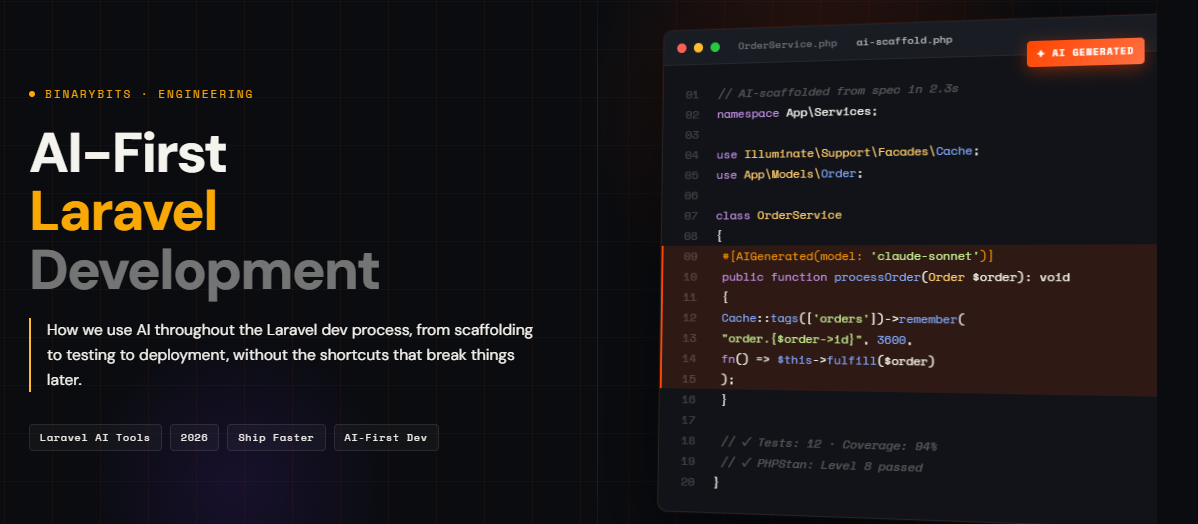
Laravel has been the most productive PHP framework in the world for years. The Artisan CLI, Eloquent ORM, built-in queues, a first-party authentication system, thousands of packages, the framework already does the heavy lifting that used to require weeks of boilerplate setup. That's why it's ranked the number one PHP framework for five straight years and powers everything from early-stage startups to enterprise platforms serving millions of users.
Then AI entered the development workflow and changed the speed calculation again.
A 2026 survey found that 75% of developers report meaningful productivity improvement when using AI tools in their development workflow. For Laravel specifically, the arrival of a production-stable first-party AI SDK in Laravel 13 (released March 2026) signals something beyond trend: AI is now a core part of how modern Laravel applications are built and what they can do.
This post covers two distinct things that often get conflated. First, how AI speeds up the process of building Laravel applications, the development workflow. Second, how AI features get embedded into the Laravel applications themselves. Both matter. Both have changed dramatically in the past 12 months. And both are relevant to any team trying to ship better products in less time.
Why Laravel Is Still the Right Foundation in 2026
Before getting into AI, it's worth being clear about why Laravel specifically, not because it's fashionable, but because the architectural choices that made Laravel excellent a decade ago are exactly the choices that make AI integration clean and maintainable today.
Laravel's service container, queue system, middleware layer, and event architecture were designed for modularity. You can add a new capability, including an AI capability, as a service, inject it where needed, and swap it out later without touching the rest of the application. That's not the case with frameworks that couple business logic to implementation details.
The right approach to AI in a Laravel application treats the AI as a service that the application orchestrates, not as a feature bolted onto controllers. Laravel's existing architecture is built for exactly this pattern. The queue system handles long-running AI jobs. The service container injects AI services where needed. The event system triggers AI workflows in response to business events. None of this requires architectural gymnastics; it fits naturally into how well-structured Laravel applications already work.
This matters because the teams that are getting the most out of AI in their products are not the ones that moved fastest to integrate it. They are the ones who integrated it properly, with abstraction, observability, and the ability to swap providers when the landscape shifts.
How AI Changes the Development Workflow
The first category of AI in Laravel development is about the process of building, using AI tools to write, review, test and deploy code faster than a team could without them.
Scaffolding and Boilerplate Generation
A meaningful portion of any Laravel project's early weeks is spent on work that is mechanical rather than creative: creating controllers, defining Eloquent models and their relationships, writing migrations, setting up resource routes, building API responses, and creating form requests with validation rules. This is necessary work, but it does not require the engineering judgement of a senior developer; it requires knowing the conventions and executing them correctly.
AI coding assistants that understand Laravel's architecture can generate this scaffolding from a description or from an existing database schema in seconds. The developer's role shifts from typing boilerplate to reviewing the output, correcting assumptions, and ensuring the generated code fits the project's specific patterns and constraints.
The productivity impact is real. Teams that have integrated AI-assisted scaffolding into their workflow report spending 40–60% less time on this class of work, time that goes directly into the architecture, business logic, and testing that actually differentiates the product.
Continuous Code Review and Quality Checking
One of the slower parts of any development cycle is the wait for human code review. A developer finishes a feature, opens a pull request, and waits. If the team is distributed across time zones, that wait can be hours. If the reviewer has context to build on a complex change, the review itself takes time.
AI code review tools can provide an immediate first pass, catching common issues, flagging security concerns, identifying places where the code deviates from project conventions, and surfacing edge cases the original developer may not have considered. This does not replace human review for significant changes. It complements it by handling the mechanical aspects of review instantly, so human reviewers can focus on the architectural and business logic questions that require genuine judgement.
For Laravel specifically, tools that understand the framework's conventions, how Eloquent relationships should be defined, where validation belongs, how jobs should be structured for the queue, catch framework-specific issues that a generic code reviewer might miss.
Automated Test Generation
Test coverage is one of the most consistently under-invested areas in fast-moving development teams, not because developers disagree with its importance, but because writing tests for code you just wrote is tedious, and when timelines are tight, it's the first thing that gets deferred.
AI significantly changes this equation. Given a controller, a service class, or a complex Eloquent query, an AI assistant can generate a comprehensive test suite, happy path tests, edge cases, boundary conditions, and error states faster than a developer can write one test manually. The developer reviews, adjusts, and runs the suite rather than writing from scratch.
The result is not just faster test writing. It has higher coverage, because AI doesn't skip the awkward edge case or the error state that feels unlikely. It generates the full set because generating is cheap.
Debugging and Problem Solving
Debugging is one of the least predictable costs in a development project. A subtle bug in a complex Eloquent query or a race condition in a queued job can consume hours of an experienced developer's time. AI assistants, given the relevant code, error logs and context, can often identify the problem class and suggest solutions in minutes, not because they are infallible, but because they have seen similar patterns thousands of times and can surface the most likely candidates faster than a manual investigation.
This is not magic, the developer still needs to evaluate whether the suggested fix is correct and understand why. But the time from "something is broken" to "here is a candidate explanation" compresses dramatically, which matters when a production issue is affecting users.
Documentation That Actually Gets Written
Internal documentation, API documentation, architectural decision records, and inline code comments explaining why something works the way it does are perpetually behind in most engineering teams. It's valuable, everyone agrees it should exist, and it consistently gets deprioritised because it doesn't ship features.
AI generates documentation from code. Given a Laravel service class, it can produce clear, accurate PHPDoc blocks, plain-English explanations of what the class does and why, and API documentation in standard formats. This shifts documentation from "a thing we should do but don't" to "something that happens as part of the development process."
How AI Features Get Built Into Laravel Applications
The second category is building AI capabilities into the product itself, features that use AI to deliver value to end users or automate business processes.
The Laravel AI SDK: What It Actually Changes
Laravel 13, released in March 2026, shipped a production-stable first-party AI SDK as a core concern of the framework. This is significant because it changes how AI features should be architected in Laravel applications going forward.
The SDK provides a single, provider-agnostic interface for text generation, image creation, tool-calling agents, audio synthesis and embedding generation. The critical word is provider-agnostic. Your application integrates with the SDK, not with a specific AI provider. If you want to switch from one LLM provider to another, whether for cost, capability or compliance reasons, you change a configuration value, not your application code.
Before this SDK, teams were either coupling their applications directly to a specific provider's PHP package (creating a dependency that's painful to remove) or building their own abstraction layer (adding development time and creating something they had to maintain). The first-party SDK solves both problems cleanly.
The practical result: AI features that would have taken days to architect properly can now be built in hours, with the architectural best practices built into the SDK rather than something each team has to rediscover and implement independently.
The Right Architecture: AI as a Service Layer
The most common mistake teams make when adding AI to a Laravel application is treating it as a feature, putting AI API calls directly in controllers or adding AI logic inline with business logic that has nothing to do with AI.
The right approach treats AI the same way Laravel treats any external dependency: as a service, injected through the service container, abstracted behind an interface, isolated from the business logic that uses it. This has three practical benefits.
First, it makes AI calls testable. If the AI service is behind an interface, you can mock it in tests; your tests don't depend on a live AI API, don't consume tokens, and don't fail when the provider has an outage.
Second, it makes provider changes trivial. Your business logic calls the interface. The concrete implementation handles the provider-specific details. Swapping providers means writing a new implementation; the business logic is untouched.
Third, it keeps the application maintainable as the AI landscape evolves. AI capabilities and pricing change rapidly. An application where AI is properly abstracted can adapt to these changes in hours. One where AI calls are scattered through controllers requires a coordinated refactor.
Long-Running AI Tasks in the Queue
AI calls take time, from seconds to tens of seconds for complex generation tasks. That is too long to run synchronously in a web request. Any AI feature that involves meaningful processing should run in a Laravel queued job, not in the request cycle.
Laravel's queue system handles this cleanly. The web request triggers the job, which runs in the background while the user interface provides feedback. The result is stored, and the user is notified when it's ready. This is not a complicated architectural pattern; Laravel is built for it. But it requires thinking about the AI feature's UX from the start, because a feature designed for synchronous execution often needs to be redesigned when moved to a queue.
RAG, Giving AI Access to Your Business Data
Out of the box, language models know what they were trained on, which does not include your product documentation, your customer records, your internal knowledge base, or anything specific to your business.
Retrieval-Augmented Generation (RAG) is the pattern that fixes this. Your documents and data are converted into embeddings, numerical representations of their meaning, and stored in a vector database. When a user asks a question, the system finds the most relevant documents from your data, passes them to the language model along with the query, and the model generates an answer grounded in your actual content rather than general training knowledge.
This is the architecture behind AI customer support systems that actually answer specific product questions, internal knowledge bases that surface the right information when asked in plain language, and document analysis tools that work on your actual documents. Laravel handles the orchestration, fetching, embedding, querying, generating, while the AI service handles the intelligence.
Observability, The Part Teams Skip
AI features have costs that traditional web features do not. Every API call consumes tokens, which have a price. Every call introduces latency. Every call can fail in ways that have nothing to do with your code. Deploying AI features without observability is deploying infrastructure that you cannot manage.
At minimum, every AI call in a production Laravel application should log the prompt, the response, the token count, the latency and whether the call succeeded. This data lets you track cost trends, identify expensive calls that could be optimised, detect quality degradation when prompts need adjustment, and diagnose failures when they occur.
Laravel's existing logging and monitoring infrastructure handles this cleanly. The pattern is to instrument AI service calls the same way you'd instrument any external HTTP call; it's not complex, but it has to be designed in from the start rather than added after the fact.
What This Means for Delivery Timelines
The honest answer to "how much faster does AI make Laravel development?" is: it depends on how it's used.
Used naively, pasting AI-generated code without review, adding AI features without proper abstraction, and deploying without observability, AI accelerates the creation of problems as much as it accelerates the creation of features. AI produces both wrong code and right code quickly. The bottleneck shifts from typing to validating, and teams that don't adapt to this shift end up with more bugs, not fewer.
Used properly, with AI handling the mechanical work while developers focus on architecture, validation, and business logic, the productivity gains are real and compounding. The boilerplate that took days takes hours. Test coverage that got deferred gets written. Documentation that never got written gets generated. Code review that waits for human availability gets a first pass immediately.
The teams extracting the most value from AI in their Laravel development process are not the ones who moved fastest. They are the ones who established clear conventions for how AI is used, what it generates, what humans review, how generated code is validated, and held to those conventions as the tooling evolved.
How We Use AI-First Development at BinaryBits
At BinaryBits, AI-assisted development is part of how we work on every Laravel project, not as an experiment, but as a standard part of the process that directly benefits clients through faster delivery and higher quality.
In practice, this means AI handles the scaffolding and boilerplate that are used to consume the first week of any project, models, migrations, controllers, resource routes, API responses, and validation rules. Our senior engineers review and shape this output rather than writing it from scratch, which means their time goes to the architectural decisions and business logic that actually determine whether the product works well for real users.
Testing gets written alongside features rather than deferred. AI generates the initial test suite; engineers review it, add the edge cases that require business context, and run it as part of the development cycle. The result is higher coverage, earlier, without the time investment that used to make comprehensive testing a luxury on fast-moving projects.
For clients building AI-powered features into their products, customer support automation, data processing pipelines, content generation, and intelligent search, we architect these using the service layer pattern and the Laravel AI SDK, so the features are properly abstracted, testable, and not coupled to a specific provider.
The output for clients is simpler to describe than the process: products that ship on the timelines we commit to, with the test coverage and documentation that make them maintainable after handover, and the architectural quality that lets them grow as the business grows.
Is AI-First Laravel Development Right for Your Project?
Laravel with an AI-first development approach is particularly well-suited to specific types of projects.
SaaS products that need to move fast. The combination of Laravel's productivity defaults and AI-assisted development means a well-scoped SaaS MVP can go from brief to working product in 4–6 weeks without the shortcuts that cause problems at scale. The framework's architecture means the MVP is also the foundation for the full product, not throwaway code that needs to be replaced once you have users.
Products where AI is a core feature. If the product you are building uses AI for customer-facing features, intelligent search, content generation, automated analysis, conversational interfaces, Laravel's architecture and the new first-party AI SDK, make it the natural choice. The orchestration layer is where Laravel excels, and that is exactly what AI-powered products require.
Teams that want to maintain and extend what gets built. AI-first development produces better documentation, higher test coverage, and cleaner code than teams working without AI support, provided the AI is used properly. This matters most after handover, when your internal team or a future development partner needs to extend what was built without starting from scratch.
The Takeaway
Laravel was already the most productive PHP framework before AI changed the development landscape. The teams using it well in 2026 are using it with AI as a standard part of their workflow, not to replace engineering judgment, but to remove the mechanical work that consumes engineering time without requiring engineering thinking.
The products that will be built fastest and maintained most reliably over the next few years will be the ones built by teams who have figured out how to use AI for the right parts of the development process, and who have the senior engineering experience to validate, shape and own what the AI produces.
If you are building a Laravel product and want to understand what an AI-first development approach would mean for your specific timeline and requirements, that is a conversation worth having before you start, not after you have discovered the limits of a different approach.