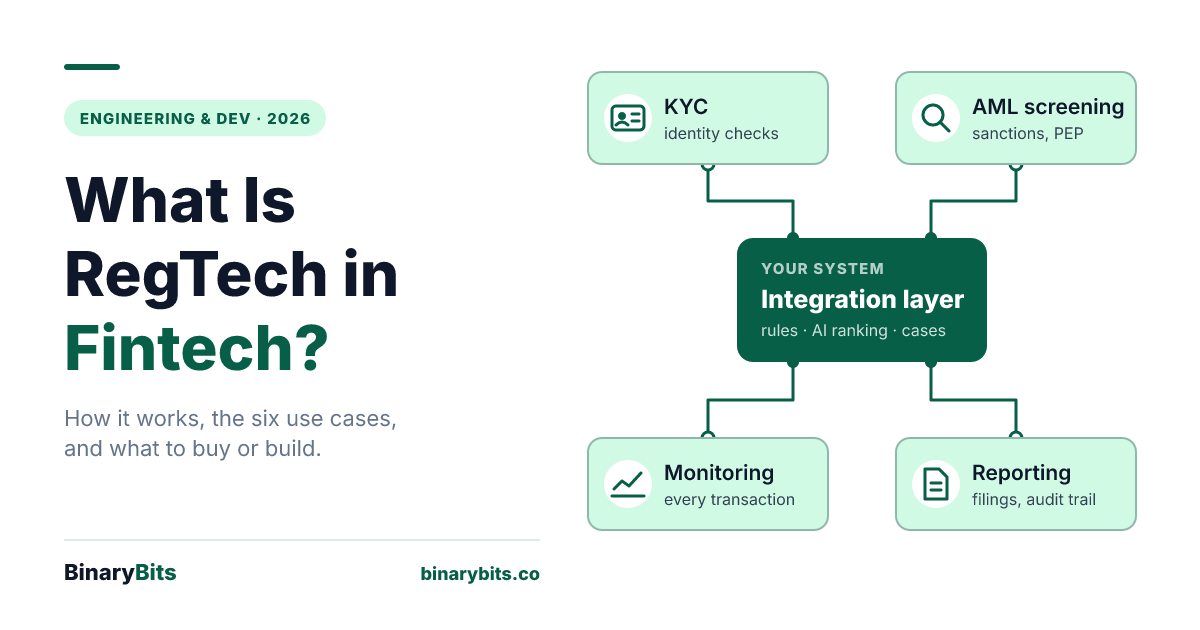
RegTech (regulatory technology) is software that helps financial companies meet their legal obligations automatically: checking who customers are, screening them against sanctions lists, watching transactions for money laundering and fraud, and producing the reports regulators ask for. In fintech, it's what lets a small compliance team keep up with thousands of customers without checking each one by hand.
Below: how it works, the six use cases that matter, where AI helps, and what to buy or build.
💡 What you'll get from this post: a plain-English map of RegTech, sourced numbers, a buy-or-build comparison, and what software can't do for your compliance.
TL;DR
- RegTech automates identity checks, sanctions screening, transaction monitoring, fraud detection, risk scoring and regulatory reporting.
- It works in five stages: collect, check, flag, human review, report.
- AI helps most with ranking alerts, reading documents and spotting unusual patterns. Rules still do most of the work.
- Most fintechs should buy the specialist checks and build the connections between them.
- Software doesn't make you compliant. Your firm stays responsible for every decision, automated or not.
What is RegTech?
RegTech is any technology that helps a regulated company follow its rules faster and with fewer mistakes than doing it by hand. The UK's Financial Conduct Authority defines it as "new technologies developed to help overcome regulatory challenges in financial services".
In simple words: a fintech must prove it knows its customers, isn't moving criminal money and reports what it's told to. RegTech does the checking, keeps the records and raises its hand when something looks wrong.
What does RegTech stand for?
RegTech stands for regulatory technology: software and data services that handle compliance work, mostly in banking, payments, lending, insurance and crypto.
Is RegTech part of fintech?
Yes, it's usually treated as a branch of fintech. The difference is the job:
- Fintech delivers financial services: payments, lending, wallets, investing.
- RegTech keeps those services within the law.
The day you move money for customers, you're a RegTech buyer too.
What's the difference between RegTech, SupTech and GRC?
They sit on different sides of the same rules:
| Term | Who uses it | What it does |
|---|---|---|
| RegTech | Regulated firms | Automates the checks and reports a firm must do |
| SupTech (supervisory technology) | Regulators | Helps regulators collect and analyse what firms report |
| GRC (governance, risk and compliance) | Any company | Tracks policies, risks, controls and audits |
GRC software records that you have a control. RegTech is often the control itself, running on live data.
Why do fintech companies need RegTech?
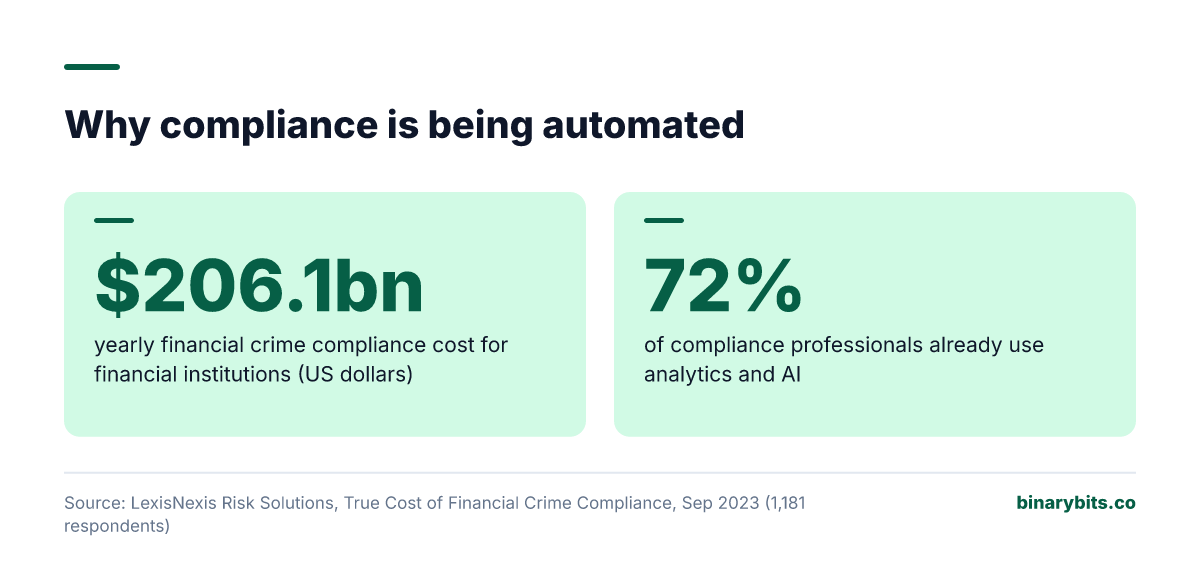
Because compliance by hand doesn't scale. A 2023 LexisNexis Risk Solutions study of 1,181 compliance professionals put the yearly cost of financial crime compliance for financial institutions at US$206.1 billion. In the same study, 72% said they already use analytics and AI in their compliance work.
Fortune Business Insights estimates the RegTech market at US$23.43 billion in 2026, up from US$19.06 billion in 2025. Other analysts' estimates differ, so treat it as a rough guide.
For a fintech, the pressure is more direct: banking partners and investors ask about your controls before they sign, and "we check manually" stops being accepted once you have real volume.
How does RegTech work?
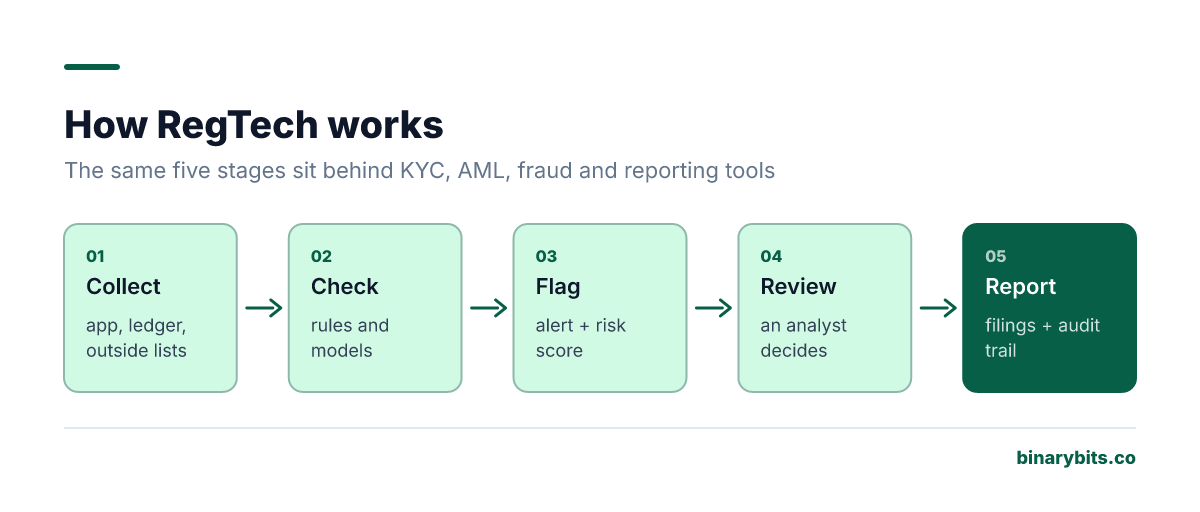
RegTech collects data from your systems, checks it against rules and models, flags what breaks a rule, and sends those cases to a person to decide. Every step is logged, so you can show a regulator what happened and why.
- Collect: customer details, documents and transactions from your app, your ledger (the record of every balance and payment) and outside data providers.
- Check: each record against rules, such as "a large payment to a payee added today", and increasingly against models trained on past cases.
- Flag: matches become alerts with a risk score.
- Review: a compliance analyst looks at the alert and decides.
- Report: decisions and filings are sent where the law requires, with an audit trail (a time-stamped record of who did what).
What data does a RegTech system use?
- Customer data: name, date of birth, address, ID documents, company ownership.
- Transaction data: amounts, dates, counterparties, countries.
- Outside lists: sanctions lists, politically exposed persons or PEPs (public officials and their families, who carry more corruption risk), and adverse media (negative news about a person or company).
In our experience of data projects, messy data is where most automation effort goes. A name spelled three ways across three systems gives three answers, whatever software sits on top.
Is RegTech AI?
Not by definition. Much RegTech is rules and automation, which is often right because rules are easy to explain to a regulator. AI is used where rules struggle:
- Ranking alerts so analysts see the riskiest first.
- Spotting unusual patterns no one wrote a rule for.
- Reading documents such as IDs and bank statements.
- Summarising a case for the analyst.
In one published study, a machine learning model (software that learns patterns from past examples) cut false positives by 80% while still catching over 90% of genuine suspicious cases. That was one institution's data: what's possible, not a promise.
How do APIs and integrations connect it all?
Through APIs, the channels one piece of software uses to request something from another. Your onboarding screen sends a customer's details to an identity-check provider and gets a result in seconds; your ledger sends transactions to a monitoring tool; alerts land on a case screen. Most RegTech projects are really integration projects.
What are the key RegTech use cases?
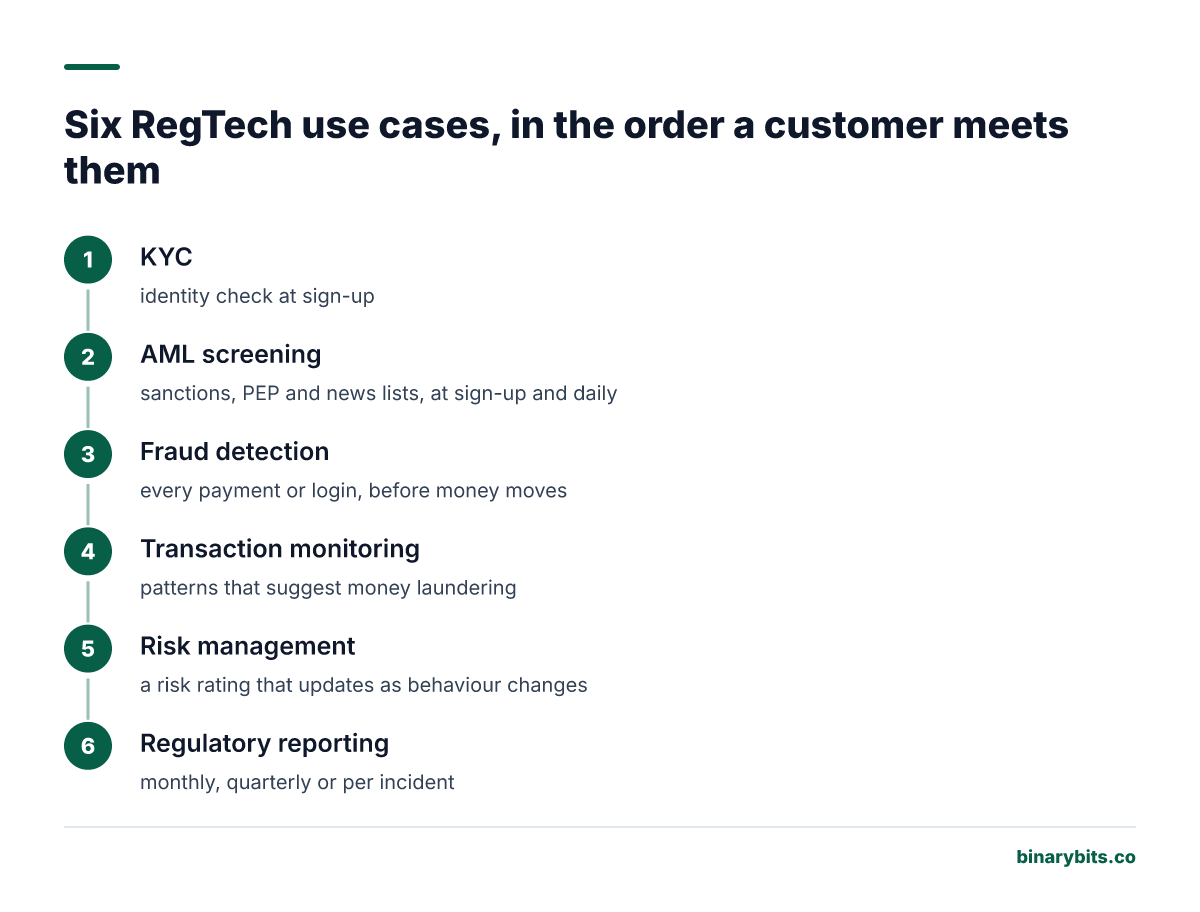
Six use cases cover most of what a fintech needs:
| Use case | What it checks | When it runs | Where AI helps |
|---|---|---|---|
| KYC | Is this person or company real? | Onboarding, then periodically | Reading documents, matching selfies to IDs |
| AML screening | Are they on a sanctions or PEP list, or in bad news? | Onboarding, then daily | Sorting true name matches from false ones |
| Transaction monitoring | Does their activity look like money laundering? | Every transaction, or in batches | Ranking alerts, finding new patterns |
| Fraud detection | Is this payment or login genuine? | In real time | Scoring each event before money moves |
| Risk management | How risky is this customer overall? | Ongoing | Updating scores as behaviour changes |
| Regulatory reporting | Have we filed what we must, correctly? | Periodically or per incident | Drafting reports and case notes |
How does RegTech handle KYC?
KYC (know your customer) is the identity check at sign-up: software checks the ID document is genuine, reads it and matches the selfie to it. For business customers, KYB (know your business) adds company registry checks and who ultimately owns the company. Only unclear cases go to a person.
What is AML screening?
AML (anti-money laundering) screening checks each customer against sanctions lists, PEP lists and adverse media, at sign-up and whenever the lists change. Common names match many entries, so tools use fuzzy matching (names that are similar, not identical) plus date of birth and nationality to cut the noise.
How does AML transaction monitoring work?
It watches activity for laundering patterns, such as deposits just under a reporting threshold or money passing straight through an account. An alert goes to an analyst; if it's still suspicious, the firm files a suspicious activity report with the authorities.
The weakness is noise. A 2024 University of Strathclyde white paper notes that banks "have begun to understand that their legacy rules-based systems cannot effectively mitigate risks related to money laundering". Most alerts are false positives, normal activity that tripped a rule, which is where AI ranking earns its keep.
How does RegTech detect fraud?
It scores each payment or login for signs it isn't genuine: a new device, an odd location, a pattern the customer has never shown. Unlike AML monitoring, it must decide before the money moves, so it can pause a payment until someone confirms it.
How is RegTech used for risk management?
Every customer gets a risk rating (low, medium, high) that decides how often you re-check them and how closely you monitor them. RegTech keeps the rating current, so a customer who suddenly starts sending money abroad moves up without anyone noticing by hand.
How is regulatory reporting automated?
Reporting tools pull the figures regulators want from your systems, format them and keep a record of what was sent: suspicious activity reports, safeguarding reconciliations (proof customer money is held apart from yours) and periodic returns. It removes the spreadsheet copy-paste where reporting errors usually start.
What are examples of RegTech companies?
Most RegTech companies specialise in one or two use cases. Some well-known examples:
- Identity verification: Sumsub verifies users, businesses and transactions, with case management for checks that need a person.
- AML screening and monitoring: ComplyAdvantage screens customers against sanctions, PEP and adverse media data, and monitors transactions.
- Crypto compliance: Chainalysis analyses blockchain activity for investigations and compliance.
- Case management: Hummingbird gives financial crime teams one place to investigate alerts and prepare filings.
These are examples, not recommendations. Your shortlist depends on your countries, products and volume.
Should you buy RegTech software or build your own?
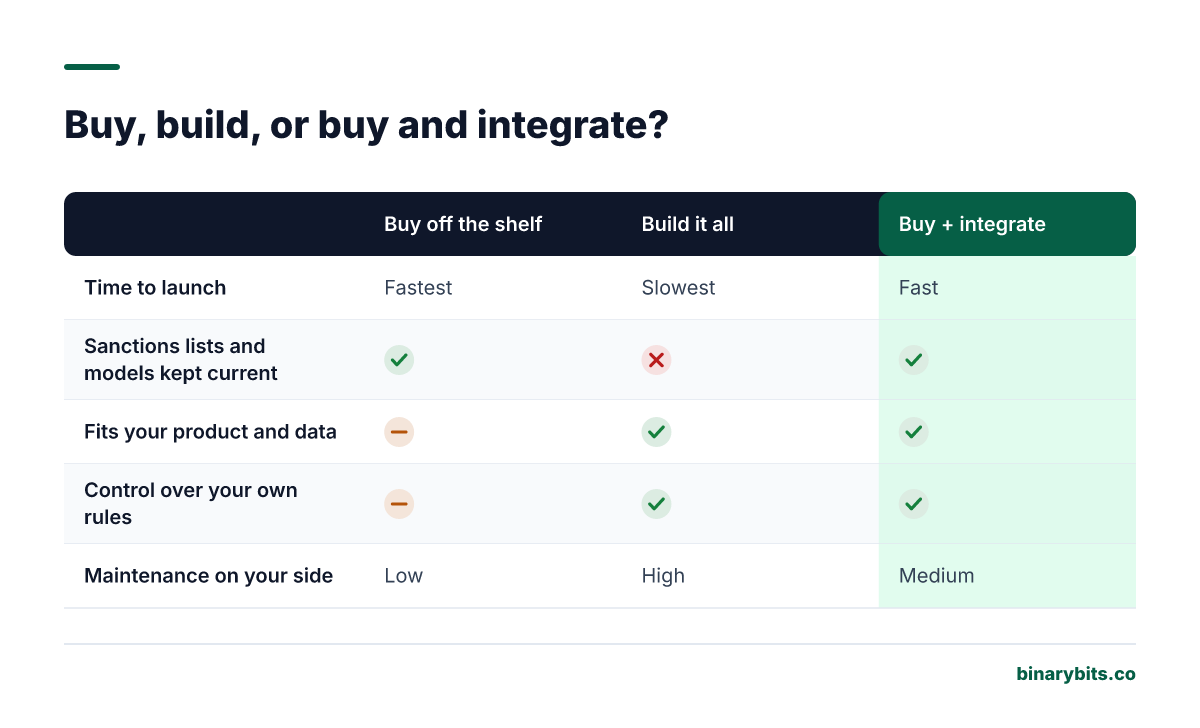
For most fintechs: buy the specialist checks, build the parts that connect them to your product.
- Buy off the shelf: fastest, and the vendor keeps lists and models current. You work the tool's way, and connecting it to your systems is still on you.
- Build it all: full control, but you'd rebuild sanctions data and document checks vendors already maintain. Rarely worth it below bank scale.
- Buy and integrate: buy identity and screening, then build your own rules, alert ranking, case screens and reports around them.
What drives the cost of a RegTech system?
We won't quote a price for a system we haven't scoped, but these move it most:
- Volume: most vendors charge per check or per customer.
- Countries: each can add document types, lists and reporting rules.
- Systems to connect: app, ledger, card processor, CRM, banking partner.
- Data quality: cleaning existing records is often the biggest task.
- How much you automate: AI ranking costs more to build and test than rules.
Choosing vendors and working out what to build around them? Talk to us about scoping the integration layer →
When is RegTech not the answer?
RegTech doesn't make you compliant. Your firm stays responsible for every decision, including the ones software makes. Be careful:
- Before launch or at low volume, a good compliance officer and a written process may be enough.
- When you can't explain the model. "The AI decided" isn't an answer a regulator accepts.
- When your data isn't ready. Automation on messy records gives confident, wrong results faster.
- When nobody owns it. Rules need tuning as your product changes.
⚠️ Note: This is general information, not legal advice. Your obligations depend on your licence and countries. Confirm them with a compliance specialist or lawyer.
How can BinaryBits help you build RegTech solutions?
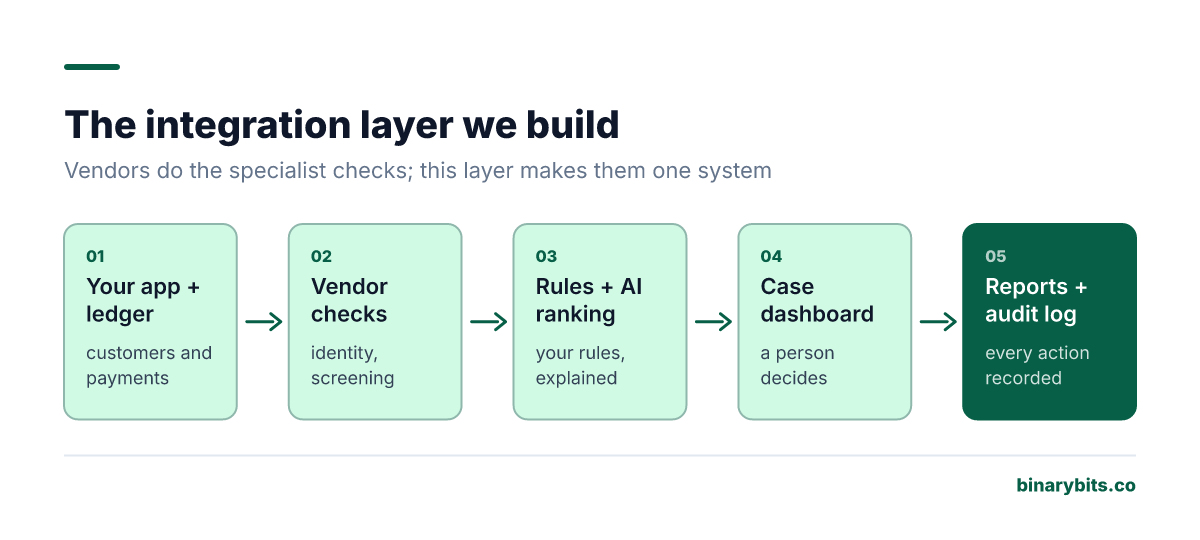
We build the software around the checks: the connections, data work, AI and dashboards that turn separate vendor tools into one compliance system. We've delivered 200+ projects for clients in 10+ countries since 2014.
- Vendor integrations: connecting identity, screening and monitoring providers to your app and ledger through their APIs, with retries and logs so nothing goes missing.
- Data cleaning and matching: getting customer and transaction records into one consistent shape, like the work in how we replaced 40 hours of manual data work a week.
- Rules and alert ranking: your own monitoring rules, plus AI that ranks alerts and says why, with a person always making the call.
- AI agents for review work: software that gathers documents and news for a case and drafts a summary. New to agents? Start with what an AI agent is, or see the six AI agents we built across sales, finance and operations, including invoice processing and anomaly detection.
- Case dashboards and reports: one screen for alerts, decisions and notes, with an audit trail on every action.
What would we build first?
The connection layer, because everything else depends on it:
- Map your obligations with your compliance lead: which checks, when, what evidence to keep.
- Connect identity and screening vendors to onboarding.
- Send transactions from your ledger into monitoring, with your first rules.
- Build the case screen so every alert has an owner.
- Add AI ranking once you have enough reviewed alerts to test it against.
We build the software that connects your compliance tools
Vendor integrations, clean data, alert ranking, case dashboards and reports, built around your product and your compliance lead's rules. No pitch, just a conversation.
Frequently Asked Questions
What is RegTech in simple words?
RegTech is software that helps banks and fintechs follow financial rules automatically. It checks who customers are, screens them against sanctions lists, watches transactions for money laundering and fraud, and prepares reports for regulators. The software handles routine checks and sends only unclear or suspicious cases to a person.
What does RegTech stand for?
RegTech stands for regulatory technology: technology that helps a regulated company meet its legal obligations, mostly in financial services. Typical examples are identity verification, anti-money laundering screening, transaction monitoring and automated regulatory reporting.
Is RegTech fintech?
RegTech is generally seen as a branch of fintech. Fintech delivers financial services such as payments and lending; RegTech keeps those services within the law through identity checks, screening and monitoring. Every fintech that moves customer money needs some RegTech.
Is RegTech AI?
Not necessarily. Much RegTech runs on rules, which are easy to explain to regulators. AI is added for ranking alerts, spotting unusual patterns and reading documents. In one published study, a machine learning model cut false positive alerts by 80% while still catching over 90% of genuine cases.
What is RegTech used for?
Six main jobs: KYC identity checks, AML screening against sanctions and PEP lists, transaction monitoring for money laundering, real-time fraud detection, customer risk scoring and regulatory reporting. Each automates a check otherwise done by hand and keeps a record for regulators.
What is the difference between RegTech and GRC?
GRC (governance, risk and compliance) software records a company's policies, risks, controls and audits. RegTech usually performs the controls on live data: verifying identities, screening names, monitoring transactions. GRC tracks that a control exists; RegTech is often the control itself. Larger firms use both.
What is RegTech in banking?
It's the software banks use to meet anti-money laundering, know-your-customer, fraud and reporting rules at scale, through automated monitoring, alert ranking and case management. A 2023 LexisNexis Risk Solutions study put financial institutions' yearly financial crime compliance cost at US$206.1 billion.