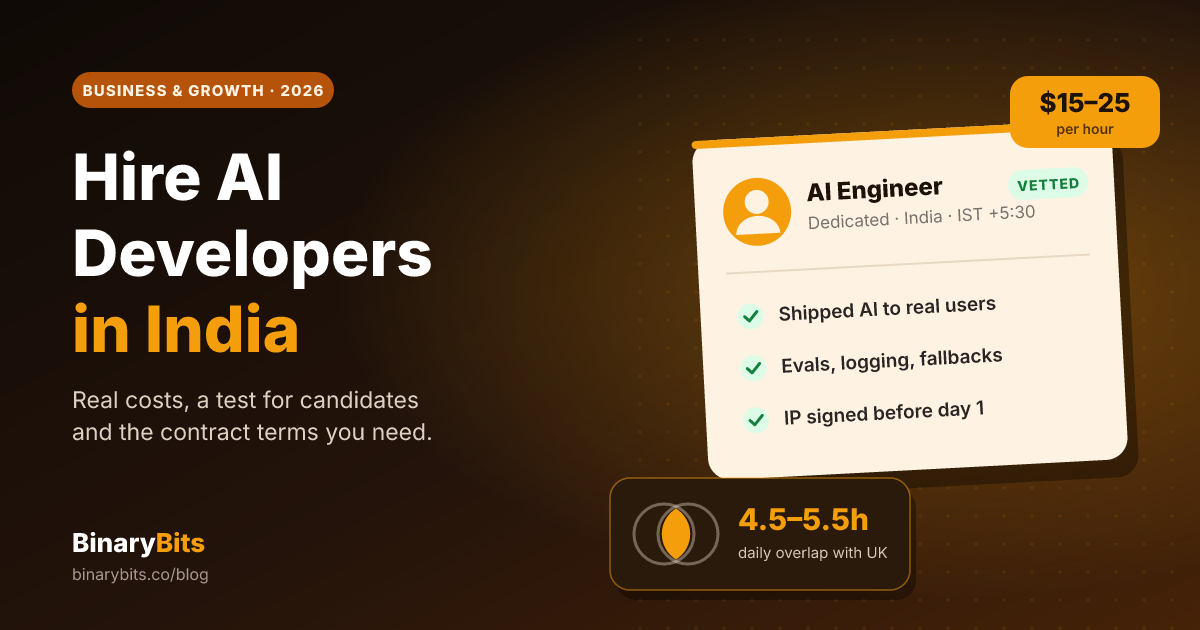
Yes, you can hire an experienced AI developer from India, and through an agency it typically costs $15-25 an hour. That's what we charge. For comparison, the US median salary in the nearest government job category is $140,300 a year, before any employer costs. The rate isn't what decides whether it works. Three things do: whether the developer has shipped AI to real users, whether your data contract is right, and whether you get enough overlapping working hours.
This guide covers all three, plus what goes wrong and when you shouldn't hire offshore at all.
💡 What you'll get from this post: real salary and rate numbers with sources, a test you can run on any candidate, and the contract points that protect your data and code.
TL;DR
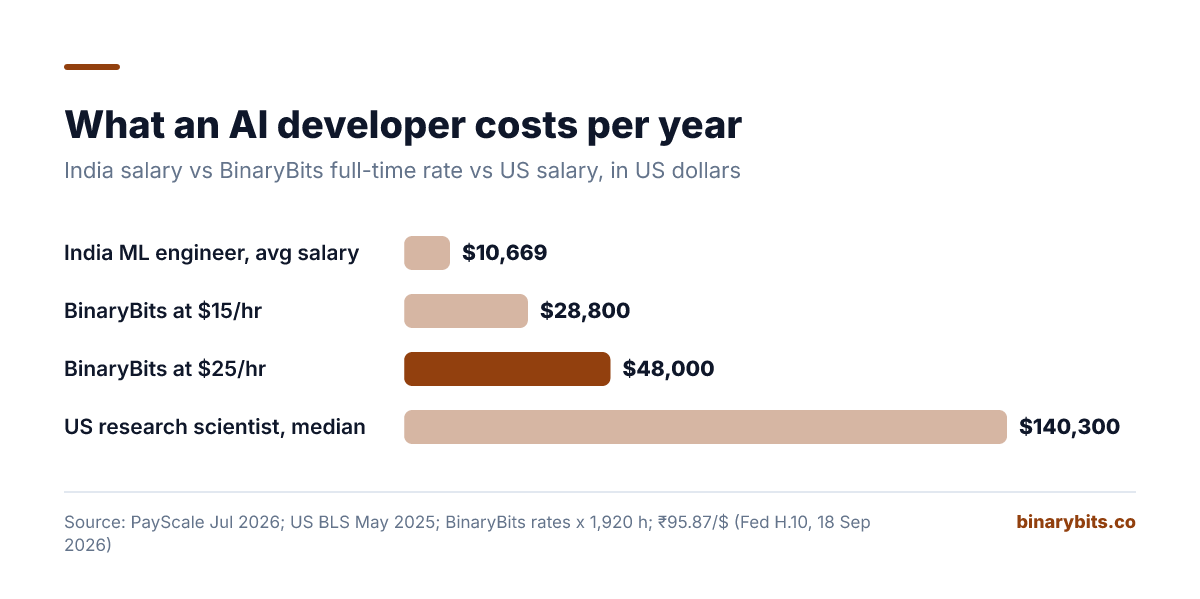
- A machine learning engineer in India earns about $10,669 a year on average. Agency rates are higher because they cover employment costs, cover for absence and senior review.
- We charge $15-25 an hour, or a fixed monthly retainer.
- Hire someone who has shipped AI to real users, not someone who has only connected a chatbot to an API.
- Test them on your own examples with a short paid task before you commit.
- A normal Indian working day overlaps 4.5-5.5 hours with the UK. For the US East Coast, the team has to shift its day.
- Sign an IP assignment and a data processing agreement before anyone sees your data.
Can you hire an expert AI developer from India?
Yes, and plenty of companies do. There are three ways to do it: a freelancer, a dedicated developer through an agency, or your own employee in India. Each has a different cost and a different amount of risk.
"Expert" is the word to be careful with. Most people who call themselves AI developers can build a demo. Far fewer have built something that ran for months with real customers, and that's the skill you're paying for.
Who are we to say?
BinaryBits is an Indian team, founded in 2014 in Jamnagar, Gujarat. We've delivered 200+ projects for clients in 10+ countries, and we sell dedicated AI developers. So we have an interest in this. We've tried to write the guide we'd want to read as a buyer, including the section on when not to hire offshore.
Why do companies offshore AI work to India?
Three reasons: there are a lot of developers, many of them have AI skills, and they cost less. Here are the first two with numbers.
How big is India's developer pool?
According to GitHub's 2025 Octoverse report, India has 21.9 million developers on GitHub, second only to the US. More than 5 million of them joined in a single year.
Are Indian developers good at AI?
On AI skills in particular, India ranks first. Stanford's 2026 AI Index (a yearly report on the state of AI), as reported by ThePrint, puts India top of LinkedIn's AI skills measure. AI skills appear on Indian members' profiles at three times the global average.
A skill on a profile isn't a shipped product, though. A big pool means more good people to choose from. It doesn't mean the average candidate is good, which is why the testing section below matters more than any statistic.
How much does it cost to hire AI developers in India?
Through an agency, expect roughly $15-25 an hour, or about $2,400-4,000 a month for a full-time developer. The salary underneath that rate is much lower. Here's where the gap comes from.
What does an AI developer earn in India?
PayScale's July 2026 data puts the average base salary of a machine learning engineer in India at about $10,669 a year. The middle 80% earn between $3,776 and $31,292.
PayScale reports in rupees. We converted at the Federal Reserve's rate for 18 September 2026, ₹95.87 to the dollar. The developers you want for production work are usually in the top part of that range.
Why is an agency rate higher than the salary?
Because salary is only part of what it costs to employ someone. An agency rate also has to cover:
- Employment costs: statutory contributions, paid leave, equipment and office.
- Cover: someone who can step in when your developer is ill, on holiday or leaves.
- Senior review: a lead who checks the work before it reaches you.
- Hiring: finding and vetting the person, which you'd otherwise do yourself.
- Margin: the agency is a business.
What does BinaryBits charge?
We work on two models:
- Hourly: $15-25 an hour, depending on seniority and the work.
- Fixed monthly retainer: one fixed monthly fee for a dedicated developer, so you know the bill before the month starts.
By our own maths, full time at $15-25 an hour comes to about $2,400-4,000 a month (160 hours), or $28,800-48,000 a year.
How does that compare with hiring in the US?
The US Bureau of Labor Statistics puts the median pay of computer and information research scientists, the closest official category to an AI engineer, at $140,300 (May 2025). That's salary alone. Payroll taxes, benefits and recruiter fees come on top.
What kind of AI developer do you need?
Name the job before the job title. Most business AI work falls into one of three kinds:
- Agents that act: software that reads a request, decides what to do and does it, such as a support agent that processes a return. Our customer support agent took 8 weeks.
- Research and enrichment: gathering information from many places into one brief. Our lead enrichment agent pulls from 14 sources into a sales brief in 90 seconds, and took 6 weeks.
- Automating back-office work: invoices, reports and approvals. The six agents we built for one operations team took 12 weeks.
Those are past projects, not quotes. They show roughly how long real scopes take.
What's the difference between an API wrapper and a production AI engineer?
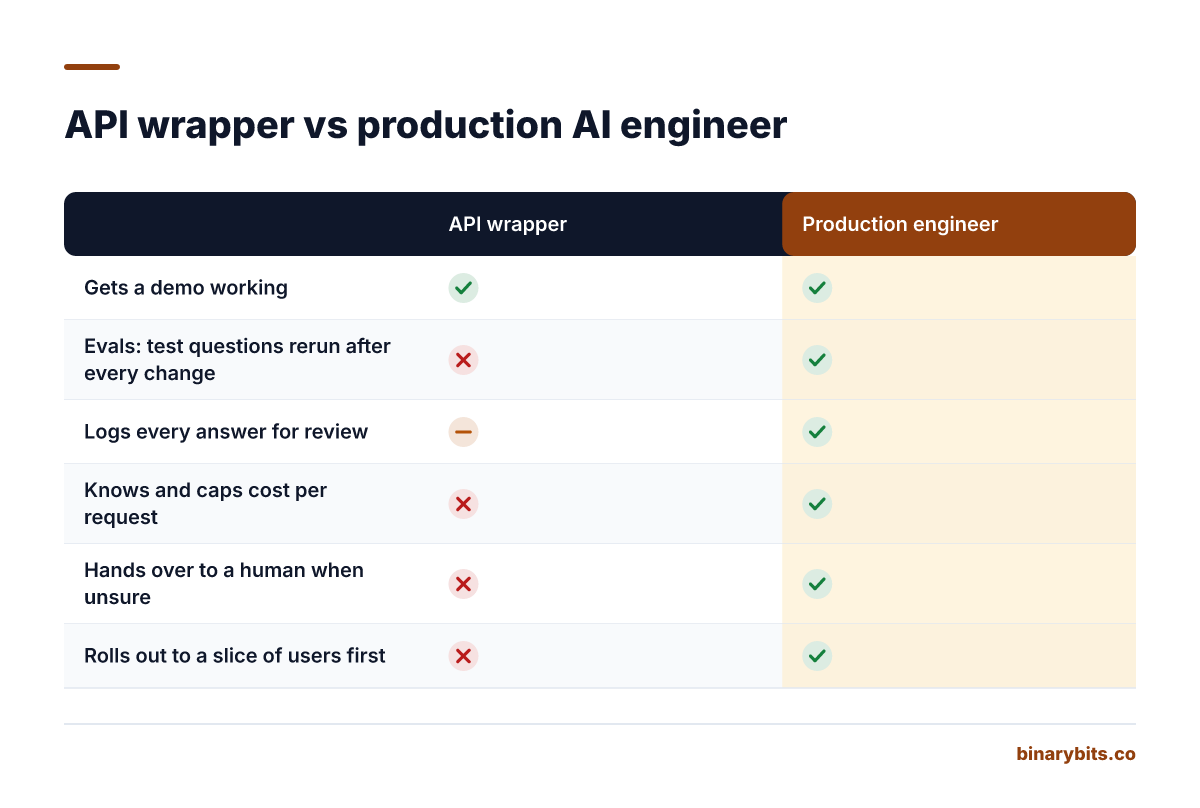
An API wrapper developer connects your app to a model like GPT through its API (the channel one piece of software uses to call another). That's enough for a demo. A production engineer builds everything that stops the demo from embarrassing you in front of customers.
Before we built the customer support agent above, the client's earlier chatbot made up answers. The fix wasn't a better prompt. It was answers grounded in the client's own help content, plus a soft launch to 20% of traffic in week 7 before the full rollout. The difference is things like that:
- Evals: a fixed set of test questions with known right answers, run again after every change.
- Logging: every answer saved so someone can review what went wrong.
- Cost control: knowing what each request costs and capping it.
- Fallbacks: handing over to a human when the model isn't sure.
- Staged rollout: a slice of real users first, then everyone.
How to hire AI developers in India, step by step
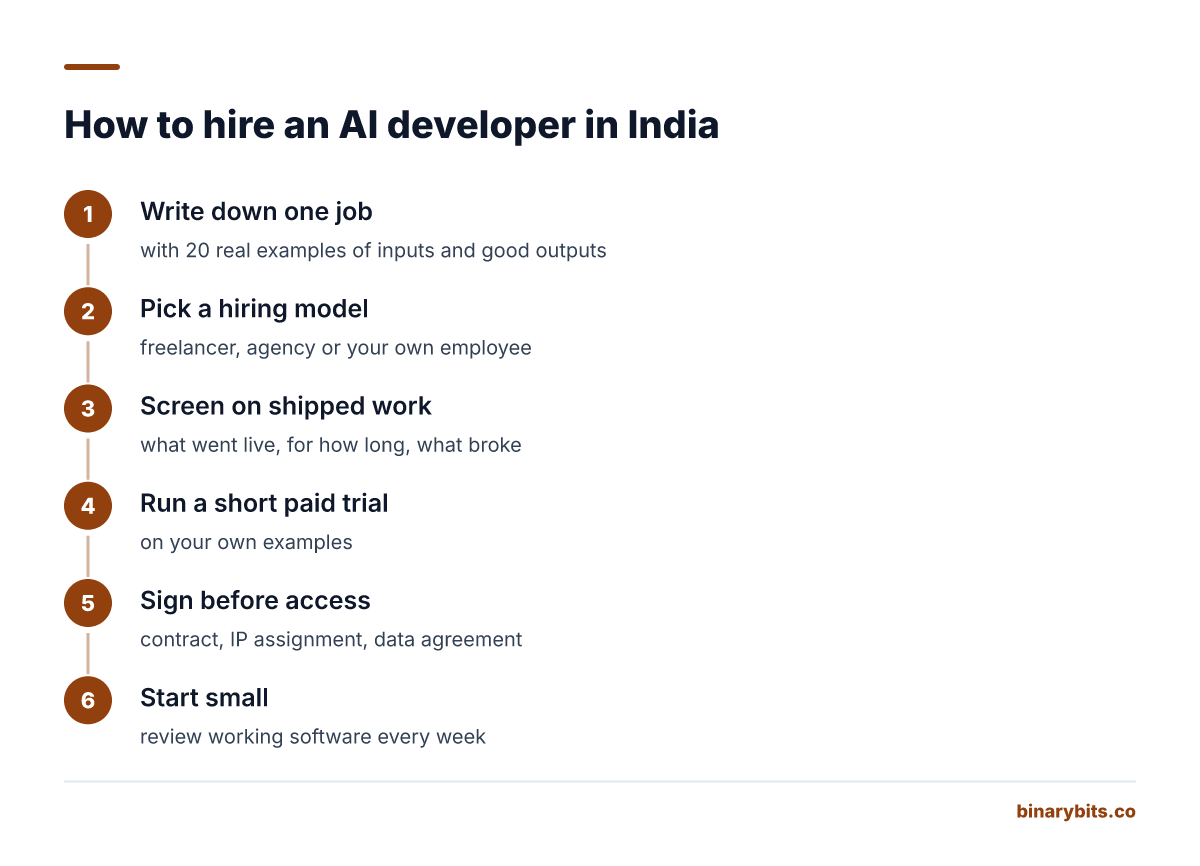
Six steps, in this order:
- Write down one job the AI must do, with 20 real examples of inputs and good outputs.
- Pick a hiring model: freelancer, agency or your own employee (below).
- Screen on shipped work. Ask what went live, for how long and what broke. Ignore lists of tools.
- Run a short paid trial on your own examples.
- Sign the contract, the IP assignment and the data agreement before anyone gets access.
- Start small and review working software every week.
Where to hire AI developers: freelancer, agency or your own hire?
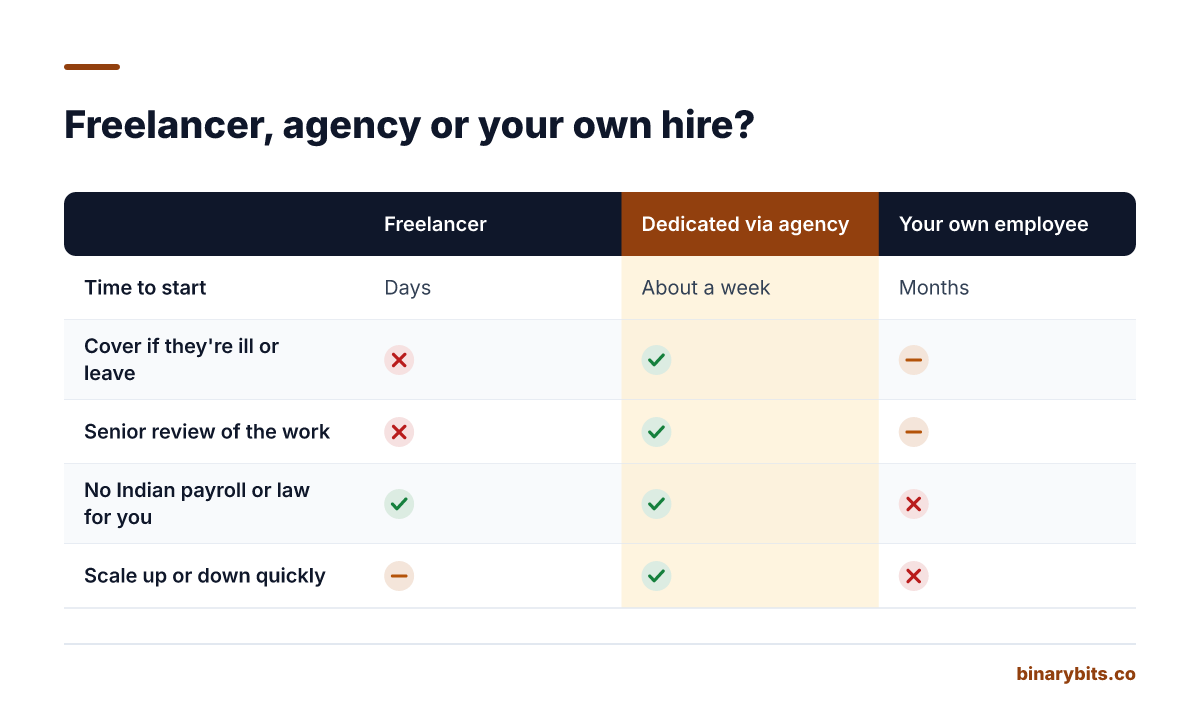
Each of the three suits a different situation:
- Freelancer: quickest to start and fine for small, well-defined work. There's no cover if they get ill or move on.
- Dedicated developer through an agency: one person works only on your project, with cover and review behind them. We match a developer and have them productive within 7 business days, and you can add or remove engineers with 2 weeks' notice.
- Your own employee in India: the most control, but you need an Indian entity or an employer-of-record service (a firm that legally employs staff on your behalf), and you handle Indian employment rules.
We compared these models in more depth in hiring a developer vs a dedicated team vs a freelancer.
How do you test an AI developer before you commit?
Use your own problem, not a coding puzzle. Four checks tell you most of what you need:
- Give them your 20 examples and ask how they'd measure whether the result is good. A strong answer describes evals before it mentions a model.
- Ask for a failure story from a real project: what broke, how they found out and what they changed.
- Ask what it will cost to run per 1,000 requests. Someone who has shipped AI knows roughly.
- Pay for a small task, one to two weeks, and judge the working result, not the call.
Want to run that test on one of our developers? Meet a dedicated AI developer from our team →
How many working hours overlap with India?
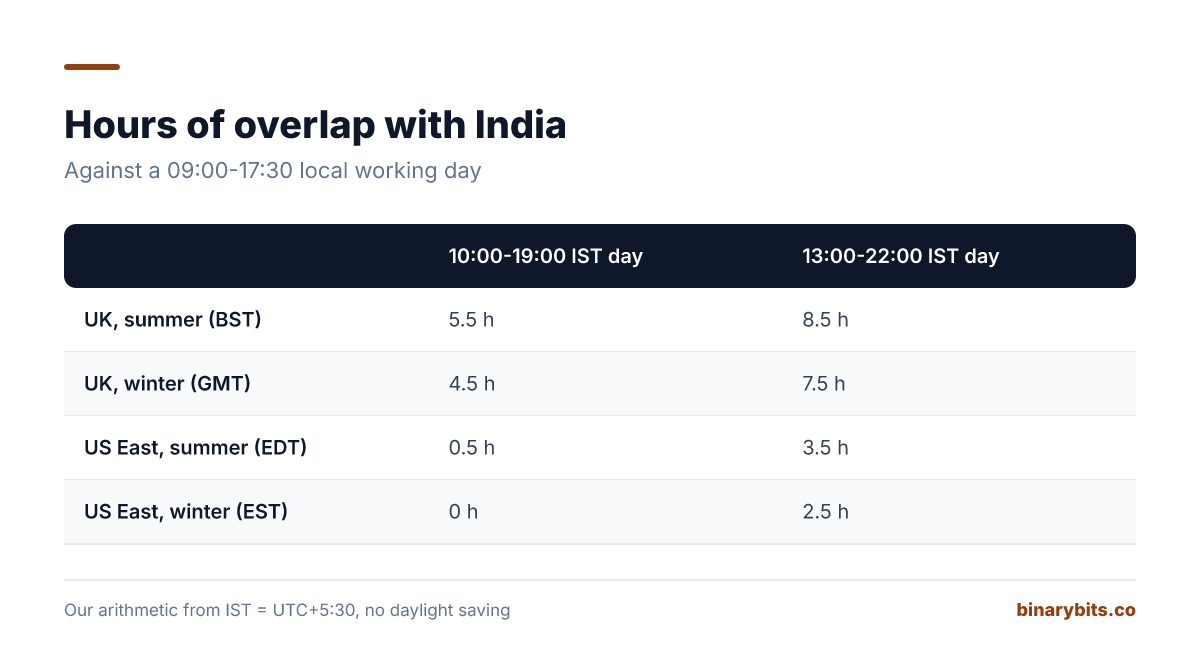
India Standard Time is UTC+5:30 and has no daylight saving. By our own arithmetic, a 10:00-19:00 Indian working day overlaps a 09:00-17:30 UK day by 5.5 hours in summer and 4.5 in winter. With the US East Coast it overlaps by half an hour in summer and not at all in winter.
For US clients, the fix is a shifted Indian day. At 13:00-22:00 IST, the overlap with the US East Coast is 3.5 hours in summer and 2.5 in winter, and UK clients get 8.5 and 7.5. Agree the hours in writing before you start.
What changes when the clocks go forward?
India doesn't change its clocks, so every UK or US clock change moves your overlap by an hour. You gain the hour in summer and lose it in winter. The UK and US also change on different dates, so for a few weeks each spring and autumn the gap is an hour off what you're used to. Put those weeks in the calendar.
Is your data and IP safe with an offshore team?
It's as safe as your contract and your access controls make it. An NDA alone isn't enough.
What does India's data protection law require?
India's Digital Personal Data Protection Act 2023 now has its Rules, notified in November 2025. According to DLA Piper's summary, most obligations apply from 13 May 2027. Breaches must be reported within 72 hours, penalties reach ₹250 crore (about $26 million), and data can go abroad except to countries the government blacklists.
Your own law still applies. Under UK or EU GDPR, your Indian team processes personal data on your behalf, so you need a data processing agreement and, usually, an approved transfer mechanism such as standard contractual clauses.
What should the contract say?
- IP assignment covering code, prompts, evals, training data and any fine-tuned models.
- Accounts in your name: model providers, cloud and code hosting. The developer is a user, not the owner.
- A data processing agreement naming what data they can see and where it's stored.
- Exit terms: access removed and a handover on the last day.
With us, the NDA and IP terms are signed before day 1, and all code our team writes belongs to you.
⚠️ Note: This is general information, not legal advice. Check your data transfer arrangements with a lawyer in your own country.
What goes wrong when hiring offshore AI developers?
Most failures come down to management, not talent. These are the common ones:
- A vague brief, so you get a good demo of the wrong thing.
- Nobody on your side owns it. Questions wait overnight, and a day goes by for every answer.
- One person, no cover. A resignation or illness stops the project.
- Accounts in the developer's name, which you find out about when they leave.
- No one watching model costs until the first large invoice.
When shouldn't you hire offshore?
Sometimes the honest answer is don't. Hire locally, or wait, if:
- The AI is your core product for years, and you need the person in the room every day.
- Your data legally can't leave your country, or the work needs security clearance.
- You have no one who can answer questions and review work each week.
- The job is a week of work. A freelancer or a no-code tool is cheaper.
- You need live support during US hours and won't agree a shifted day.
We provide dedicated AI developers from India
We match you with a developer who has shipped AI to real users, on an hourly or fixed monthly retainer basis. No pitch, just a conversation about what you need built.
Frequently Asked Questions
How much does it cost to hire AI developers?
From India, an agency typically charges around $15-25 an hour, which is our own range. That's about $2,400-4,000 a month full time. In the US, the median salary for computer and information research scientists, the closest official category, is $140,300 a year (BLS, May 2025), before employer costs. Price depends on seniority, and on whether the person has shipped AI to real users.
Where to hire AI developers?
You have three choices: freelance marketplaces, agencies that provide dedicated developers, or hiring your own employee. Freelancers suit small, well-defined tasks. Agencies add cover and senior review. Your own employee gives the most control but needs an entity or employer-of-record service in their country. Whichever you pick, judge candidates on AI they've shipped, not on the tools they list.
Why do companies offshore to India?
Mainly for the size of the talent pool and the cost. India has 21.9 million developers on GitHub, the second-largest community after the US (GitHub Octoverse 2025). Stanford's 2026 AI Index ranks it first for AI skills on LinkedIn profiles. An Indian machine learning engineer's average salary is about $10,669 a year (PayScale, July 2026), far below US levels.
How to hire an offshore development team in India?
Start with one clearly written job and 20 real examples. Choose between a freelancer, an agency or your own entity. Screen on shipped work, run a short paid trial on your own examples, and sign the IP assignment and data processing agreement before giving anyone access. Agree the overlapping working hours in writing, then review working software weekly.
What is the average salary of AI developer in India?
PayScale's July 2026 data puts the average base salary of a machine learning engineer in India at about $10,669 a year, converted from rupees at ₹95.87 to the dollar. The middle 80% earn between $3,776 and $31,292. Experienced engineers who have shipped AI to real users are usually in the upper part of that range.
Should you hire a freelance AI engineer?
For a short, well-defined task, often yes: it's quick to start and you only pay for the work. For anything customers will depend on, the risk is continuity. If the freelancer gets ill or moves on, work stops and the knowledge goes with them. Make sure accounts and code are in your name either way.
How do you hire dedicated AI developers?
Through an agency that assigns one developer to your project full time. You interview the candidate, agree the hours and sign the contract. They then work as part of your team, with the agency covering employment, absence and review. With us, onboarding takes about 7 business days, and you can scale up or down with 2 weeks' notice.