Yes, most of the county court search in a criminal background check can be automated, and criminal background check software pays for itself fastest at screening companies running high, steady volumes in the same counties. Where a court publishes its records online, the software searches it as soon as an order arrives and matches what it finds. A person still reviews every possible match, and your team still owns the report and the legal duties that come with it.
This guide is for US screening companies and staffing firms that already run checks under the Fair Credit Reporting Act. It covers how the software works, which accuracy rules it has to enforce, what it costs against paying per check, and when it isn't worth building.
💡 What you'll get from this post: a plain view of what court-search automation can and can't do, so you can decide whether to build your own tool or keep paying per report.
TL;DR
- County court records are the backbone of a US criminal check, and many counties publish them online. Those searches can be automated.
- Match on date of birth and address history, never name alone. US regulators have said name-only matching isn't reasonable.
- The software must drop duplicates and sealed or expunged records, and show how each case ended.
- Counties that aren't online still need a person at the courthouse. Automation shrinks that list; it doesn't remove it.
- Build your own tool when volume is high and steady. At low volume, paying per check is usually cheaper.
What does a criminal background check show for employment?
A criminal background check for employment shows court cases linked to the candidate: what they were charged with and how each case ended. County searches usually list the following details:
- Case details: defendant name, case number and filing date.
- The charge: what the offence was and whether it was a felony or misdemeanour.
- The disposition, meaning how the case ended: convicted, dismissed, acquitted or still pending.
- The sentence, if there was one.
What it can legally show depends on age and outcome, which we cover under the accuracy rules below.
Where do US criminal records come from?
They come from courts. The US has nearly 3,200 counties, and each keeps its own criminal court records. State courts, state repositories and federal courts hold further records, each in its own system.
What is a county criminal background check?
A county criminal background check is a search of one county's court records for a named person. It's the most complete source for most cases, because that's where most criminal cases are filed. Screening companies pick which counties to search from the candidate's address history.
Is a national criminal database search enough?
No. A "national database" is a bundle of records bought from many sources, and it's often out of date or missing how cases ended. A 2018 survey found that only an average of 64% of arrests in state databases from the past five years had a final outcome recorded. Most screening companies use a database search to find leads, then confirm each one at the county court.
How does criminal background check software search court records?
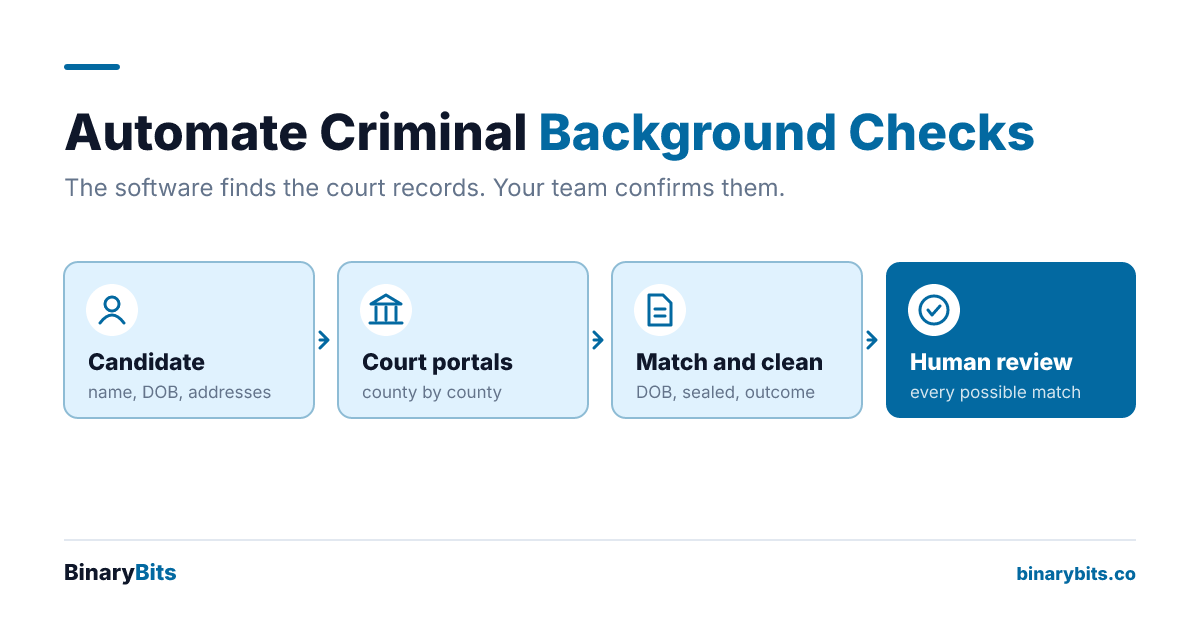
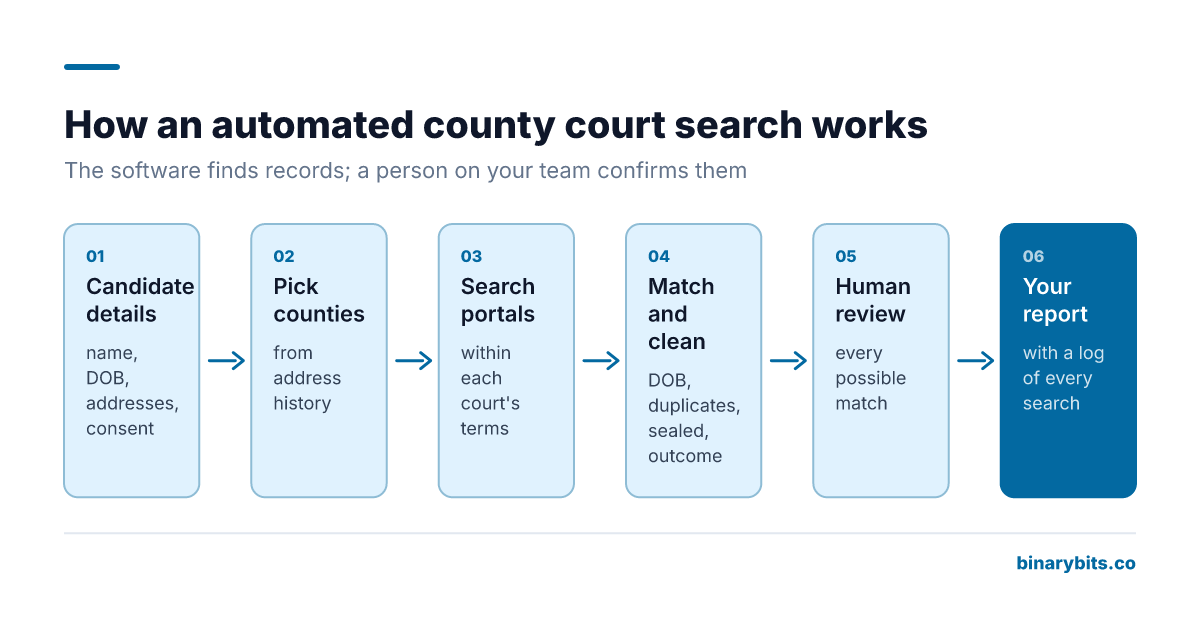
It takes the candidate's details, works out which counties to search, searches each court's public portal, and passes anything that looks like a match to a person to check. Here's the flow we build:
- Take the candidate's details and the signed consent from your existing order form.
- Pick the counties from their address history and your package rules.
- Search each court's public portal, within that court's terms and at a pace it allows.
- Match and clean: compare dates of birth, merge duplicate entries, drop sealed records, attach each case outcome.
- Send every possible match to a reviewer on your team.
- Hand the confirmed results to your report, with a record of every search made.
What details do you need from the candidate?
You need four things, and your order form probably collects them already:
- Full legal name, plus any former names
- Date of birth
- Address history, usually the last seven years, which decides the counties
- The candidate's signed disclosure and authorisation, which the FTC requires before a report is ordered
How does it match a record to the right person?
It matches on name and date of birth, and flags anything that doesn't line up. In 2021 the Consumer Financial Protection Bureau, the federal agency that enforces much of the FCRA, said matching on name alone isn't a reasonable procedure. Many court portals show only part of a birth date, so a partial match goes to a reviewer rather than straight into the report.
What happens when a county court isn't online?
A person still has to search it. Some courts only allow searches at the courthouse or through the clerk, so those counties stay with your court researchers. The software's job there is smaller: send the request, track it, and load the result when it comes back.
Which FCRA accuracy rules should the software enforce?
The Fair Credit Reporting Act (FCRA) is the US law that governs background reports. It requires a consumer reporting agency, meaning a business that assembles information on people for others' hiring decisions, to follow reasonable procedures to assure maximum possible accuracy. Good software turns those duties into checks that run on every search.
Which records must it leave out?
The CFPB's 2024 guidance and the FCRA itself give a clear list:
- Duplicates. One case found in two places must show once.
- Sealed or expunged records, which a court has closed to the public.
- Charges without their outcome. If a case was dismissed, the report must say so.
- Arrests and dismissed charges older than seven years, unless the job pays $75,000 a year or more. Convictions have no federal time limit.
State laws can be stricter, so the rules need to be settings you can change per state, not fixed in code.
Who is responsible when the software gets it wrong?
You are, as the company issuing the report. In 2012 HireRight paid a $2.6 million penalty after the FTC found reports with expunged records, the same offence listed more than once, and convictions belonging to people with a different date of birth. That's why we build a human review step for every possible match and keep a log of every search.
⚠️ Note: This is general information, not legal advice. FCRA duties, state rules and fair chance hiring laws vary, so have your compliance counsel review how your process uses any tool.
How long does a criminal background check take?
A county search takes anywhere from less than a day to 10 business days or more, depending on the court. Automation changes the online counties most. Here's where the time goes:
- Online courts: searched as soon as the order arrives, instead of waiting in a researcher's list.
- Possible matches: wait for a reviewer, which is now the main delay.
- Offline courts: unchanged. They take as long as the clerk takes.
Should you build your own tool or keep paying per check?
It depends on volume and how concentrated your counties are. As a price point, Checkr lists employer reports at $29.99 to $94.99 each, with court access fees passed through on top. Owning a tool turns much of that per-check cost into a build cost and upkeep.
| Per-check vendor | Your own tool | |
|---|---|---|
| Upfront cost | None | A one-off build, sized by how many counties you start with |
| Cost per search | Per report, plus court fees | Court fees, plus running and upkeep |
| Time to start | Days | Weeks, starting with your busiest counties |
| Matching and review rules | The vendor's | Yours |
| When a court site changes | Vendor fixes it | You or your developer fixes it |
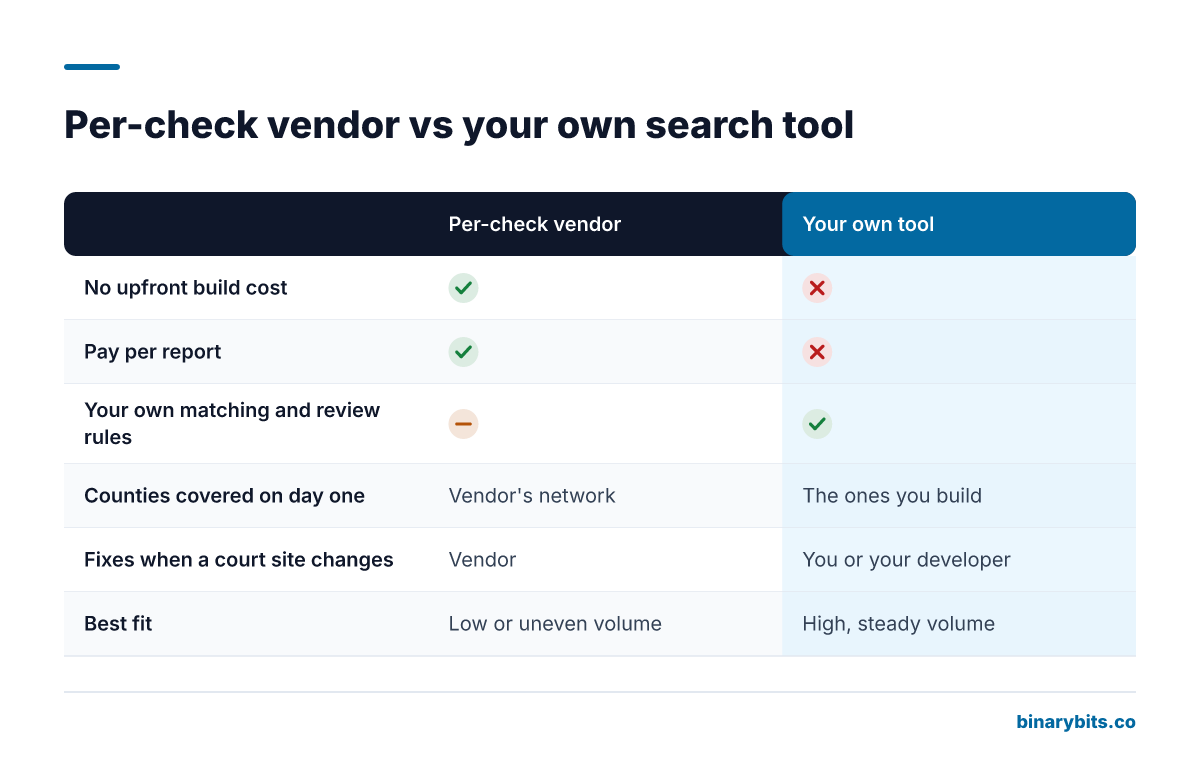
Court portals change their layouts, so a tool needs someone watching it. We've written about why data collection tools keep breaking and what upkeep really looks like.
Want to know which of your counties could be automated? We'll look at your volumes and court list on our web data extraction service page →
When isn't automation worth it?
Don't build it if any of these apply:
- You run a few hundred checks a year. Per-check pricing will almost certainly cost less.
- Your searches are spread thinly across hundreds of counties, so no single court gives enough volume.
- Most of your counties aren't online. The software can't search a court that only answers at the counter.
- You don't yet have FCRA processes: consent, disputes, adverse action notices. Fix that first. Software won't.
What have we learned building these tools?
We've built court search tools for US businesses that run background checks, and the lesson that keeps coming back is to start small. Automate your busiest counties first, prove the matching against your researchers' results, then add courts one at a time.
The pattern is the same as other manual data work we've replaced, like the 40 hours a week of manual data work one client handed over: automate the repeat searches, keep people on the judgement calls.
Two other things we've learned. Run the new tool alongside your current process for a few weeks before you trust it, and compare every result. And make the review screen fast, because once the searching is automated, review is where your team's time goes.
The honest limitation: the tool is only as current as each court's portal, and it can't find records a court doesn't publish. We build it to say clearly which counties it searched and which it couldn't.
We build court search tools you own and run
We build and maintain the software; your team runs the searches, reviews the matches and issues the reports. Tell us your counties and volumes and we'll tell you honestly whether it's worth building. No pitch, just a conversation.
Frequently Asked Questions
How far back do criminal background checks go for employment?
Under the federal FCRA, a screening company can't report arrests or dismissed charges older than seven years, unless the job pays $75,000 a year or more. Convictions have no federal time limit. Some states set limits of their own, so the lookback often depends on where the candidate lives and works. Many county searches cover seven years of records by default.
How long does it take for an employer to do a criminal background check?
It depends on the courts involved. A single county search can take from under a day to 10 business days or more. Courts with online records are the fastest. Courts that only answer requests in person or by post are the slowest, and they hold up the whole report until they reply.
Can an employer do a criminal background check without consent?
Not through a background screening company. Under the FCRA, an employer must give the candidate a written disclosure and get their written permission before ordering a report. That applies to employees, contractors, temps and volunteers. Some states and cities add further rules, including when in the hiring process a check can happen. Check with employment counsel for your state.
How much does a criminal background check cost?
One large screening company lists employer reports at $29.99 to $94.99 each, with court access fees added on top that vary by county. A high-volume screening company that owns its own search software pays mostly court fees and running costs per check, after the upfront cost of building it.
Is there a free criminal background check?
Many county and state courts let anyone search their public records online for free, one person at a time. That's fine for looking up a case. It isn't a complete check: you'd need to know every county to search, match records carefully, and follow the FCRA rules if the result goes into a hiring decision made by someone else.
Does someone get notified when you do a background check?
For employment checks, yes. The candidate signs a disclosure and authorisation before the check runs. If the employer then decides not to hire because of something in the report, the FCRA requires notice before and after that decision, including a copy of the report and a summary of the candidate's rights to dispute it.