You've just bought or built a complex piece of software. The vendor's support team is helpful on calls. The documentation looks fine. But three months in, the system still doesn't quite fit how your team actually works — and neither side seems to know why.
That gap — between how software is designed and how it's actually used — is exactly what a Forward Deployed Engineer (FDE) is built to close.
💡 What you'll get from this post: A plain-English explanation of what a Forward Deployed Engineer does, how they differ from traditional engineers and consultants, which businesses need one, and how BinaryBits deploys FDEs who investigate your operations, observe real workflows, and apply AI directly inside your business.
TL;DR
- A Forward Deployed Engineer is a hybrid engineer embedded directly in a client's organisation — part software builder, part integration specialist, part technical investigator.
- They close the gap between off-the-shelf software and how your business actually operates in the real world.
- FDEs are not consultants. They write code, build integrations, and own outcomes — not PowerPoint decks.
- BinaryBits provides FDEs who observe your workflows, investigate automation opportunities, and implement AI-powered solutions inside your business.
- The right time to bring in an FDE is when you have a complex system that isn't delivering, or when you know AI can help your operations but you don't know where to start.
The Problem With Software That "Almost" Works
Most enterprise software is designed for an idealised version of how businesses run. Clean inputs. Predictable workflows. Rational users. The real world is none of those things.
Your sales team has a process that doesn't map neatly to your CRM's pipeline stages. Your ops team has a workaround for a data issue that's been running for two years. Your AI tool produces outputs that your staff don't trust because nobody explained how it was trained.
The result? Software that's paid for but underused. Automations that were built once and forgotten. Data that flows in but never gets actioned. We've seen this pattern across dozens of client engagements — a company invests in the right technology, but nobody bridges the gap between the technology and the team actually using it.
A Forward Deployed Engineer is that bridge.
What Is a Forward Deployed Engineer?
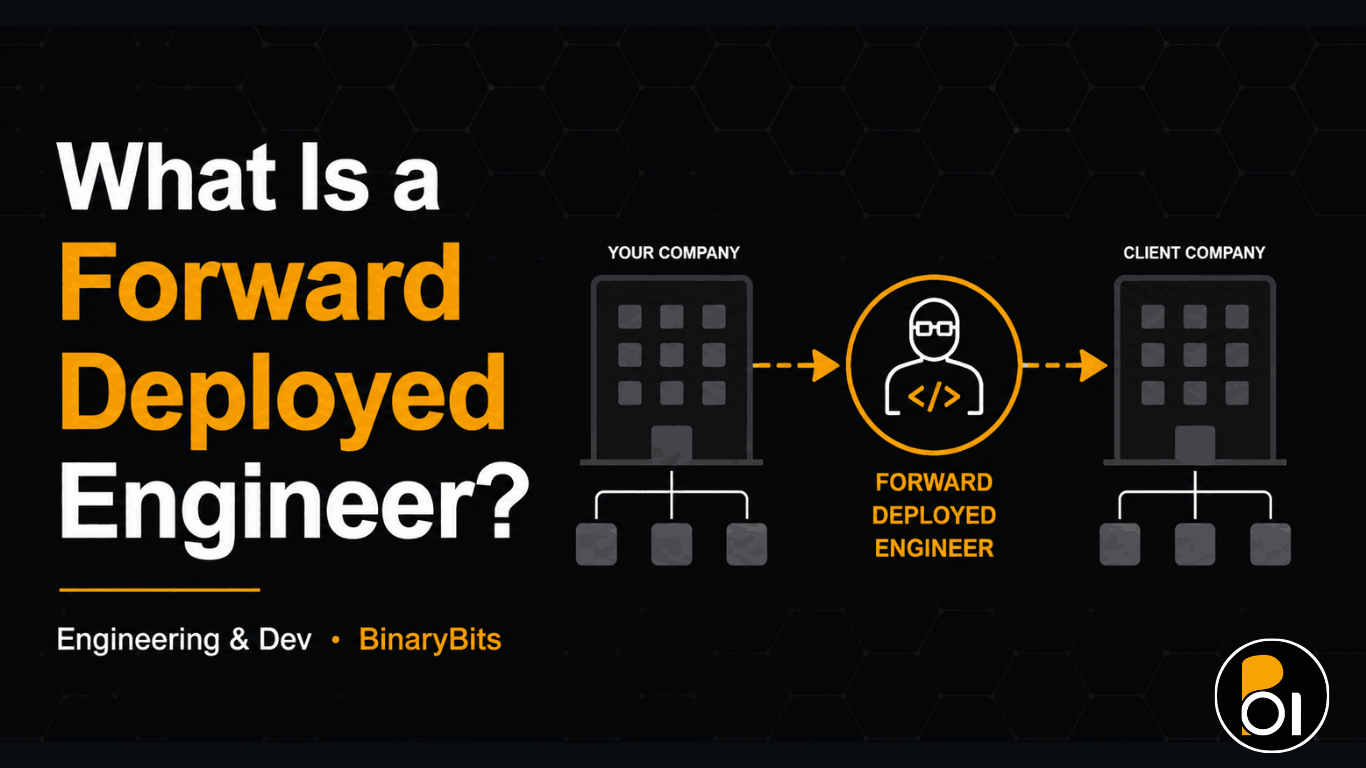
A Forward Deployed Engineer is a software engineer who works directly inside a client organisation — not from a remote vendor office. They sit at the intersection of product development and client operations. Their job is to make complex technical systems work in the messy, specific context of your actual business.
The term comes from the military concept of "forward deployment" — putting resources where they're most needed, close to the action. In a business context, that means embedding an engineer inside your organisation instead of leaving them at arm's length behind a support ticket queue.
An FDE does things a typical remote developer or support engineer won't:
- Investigate before building. They spend time understanding how your workflows actually run — not how the documentation says they should run.
- Observe and identify gaps. They sit with your team, watch how people use (and avoid) existing systems, and identify where friction is costing you time and money.
- Build and deploy in context. They don't hand off specifications to a remote team. They write code, test integrations, and ship solutions directly inside your environment.
- Translate between business and technical. They speak your language with your leadership and the engineer's language with your technical team — without needing an interpreter.
That last point matters more than it sounds. Most technical problems in client organisations aren't purely technical. They're miscommunications between what a business needs and what an engineering team understood the business to need.
FDE vs. Consultant vs. Traditional Developer: What's Actually Different
| Role | Where they work | What they deliver | Relationship to outcomes |
|---|---|---|---|
| Consultant | Their office / remote | Recommendations, reports, roadmaps | Advisory — no delivery obligation |
| Traditional Developer | Remote / their team | Code against a defined spec | Spec delivery — real-world fit not guaranteed |
| Forward Deployed Engineer | Embedded in your organisation | Working integrations, automations, AI implementations | Owns the outcome in your actual environment |
The critical difference is accountability for real-world fit. A consultant tells you what to do and leaves. A remote developer builds what they're told. An FDE is in the room when the system doesn't work the way anyone expected — and they fix it on the spot.
This is also why FDEs are not a good fit for simple development projects with clear specifications. If you know exactly what you need built and the scope is well-defined, a dedicated engineering team will deliver faster and at lower cost. FDEs are for the situations where you don't fully know what you need — because the problem is embedded in the complexity of your existing environment.
What a Forward Deployed Engineer Actually Does Day-to-Day
The workflow of an FDE is investigative before it is technical. Here's how it typically runs in practice:
- Immersion and observation. The first phase isn't writing code — it's watching. The FDE sits in on your team's daily workflows, reviews your current systems, talks to the people doing the actual work, and maps the real process. Not the process on paper. The process that happens every day.
- Problem identification and prioritisation. After observing, the FDE identifies where the biggest friction points are. Which manual steps are costing the most time? Where is data getting stuck or corrupted between systems? Where are people working around the software instead of with it?
- Technical investigation. This is where the engineering depth matters. The FDE digs into your existing tech stack, APIs, data structures, and integration points. They're not designing from scratch — they're understanding what's already there and what's missing.
- Build, integrate, and test in your environment. Unlike a remote team shipping a product you then have to install and configure yourself, the FDE builds inside your environment. They see the real edge cases. They test against your actual data. They adjust in real time when something doesn't behave as expected.
- Handover with institutional knowledge. When the engagement ends, the FDE doesn't just leave documentation. They leave your team with a genuine understanding of how the systems work — because they've been working alongside them throughout.
Where AI Changes What FDEs Can Do
The rise of practical AI — large language models, AI agents, workflow automation — has dramatically expanded what an FDE can do inside a client organisation. Work that previously required months of custom software development can now be deployed in days, if someone with the right expertise is there to apply it correctly.
This is the part most businesses are missing. AI tools have become genuinely powerful. But applying them correctly to a specific business context requires the same investigative, embedded approach that defines a good FDE.
Without investigation, you get AI automations that don't map to how your team actually works. Without observation, you get tools that technically function but that nobody trusts or uses. Without implementation in context, you get pilots that succeed in isolation and fail in production.
An FDE who understands AI doesn't just deploy tools. They identify where AI creates genuine value in your specific operation — and equally importantly, where it doesn't. Our AI process automation work consistently shows that the highest-ROI automations are almost never the obvious ones. They're found in the workflows that nobody has looked at carefully in years.
💡 What we've found: The most valuable AI opportunities in most businesses are not in the areas leadership first suggests. They're in the manual, repetitive, well-understood workflows that a junior team member has been doing for three years without anyone asking whether it could be automated.
How BinaryBits Deploys Forward Deployed Engineers
At BinaryBits, our FDE model is built around three phases: investigate, observe, and apply. We don't parachute in with a predetermined solution. We start from your current reality.
Investigate
We begin by going deep on your existing systems and workflows. What tools do you use? What data do you generate? Where does it go? Where does it get stuck? We review your tech stack, interview the people doing the actual work (not just leadership), and map the real state of your operations — not the idealised version.
For AI engagements, this investigation phase also identifies which parts of your operation involve repetitive pattern recognition, structured data processing, or communication that follows consistent templates — all strong candidates for AI automation.
Observe
Our FDEs spend time inside your workflows before touching anything. They watch how your team uses (and misuses) existing tools. They look for workarounds — manual steps your team has developed because the official process doesn't quite work. Workarounds are the most reliable signal that there's a genuine problem worth solving.
This observation phase is what separates the solutions we build from solutions that look good in a demo but fail in production. By the time we write the first line of code, we've already seen the edge cases.
Apply AI in Your Business
Once we understand your environment, we apply AI and automation where it creates real, measurable value. This could mean:
- AI agents that handle structured, repetitive tasks — customer query triage, document processing, data extraction and enrichment — without human intervention.
- Workflow automations that connect your existing tools and eliminate the manual steps between them using platforms like n8n or custom-built pipelines.
- Data intelligence layers that turn raw operational data into signals your team can actually act on.
- LLM-powered interfaces that let your team interact with complex data or internal systems in plain language instead of navigating dashboards.
Our AI agents service and our dedicated engineering teams both feed into FDE engagements depending on scope and duration. For some clients, the FDE works with a broader BinaryBits team behind them. For others, a single senior FDE embedded for 2–4 months is exactly what's needed.
When You Need a Forward Deployed Engineer (And When You Don't)
FDEs are a specific solution to a specific type of problem. They're not the right answer to every engineering challenge.
Strong FDE signals
- You've invested in software or AI tools that aren't delivering the expected value — and you're not sure why.
- You know your operations could be more efficient but you don't know where to start or what's actually causing the friction.
- You're deploying a complex integration or system change that touches multiple teams and tools simultaneously.
- You want to apply AI to your business but you need someone to investigate the opportunity before committing to a build.
- You've had a failed technology implementation in the past and need someone who will be accountable for real-world fit, not just code delivery.
When an FDE is not what you need
- You have a well-defined spec and need a team to build it — a dedicated engineering team or project-based engagement is faster and cheaper.
- Your primary need is ongoing software maintenance or feature development — a retainer or dedicated team model fits better.
- You're at the very early idea stage and need product strategy, not implementation — we'd point you toward a discovery sprint first.
- Your budget is under £5,000 / $6,000 — FDE engagements need enough time to observe, investigate, and deliver meaningful outcomes; short engagements rarely get there.
Honest answer: not every business needs an FDE. But if you're in a situation where the technology exists, the intent is there, and something is still not working — that's usually the right time to call.
What to Expect from a BinaryBits FDE Engagement
We've completed 200+ projects across 10+ countries, many of them involving embedded engineering work inside client organisations. A typical FDE engagement with BinaryBits runs 4–12 weeks. Here's how it breaks down:
- Week 1–2 — Discovery. We map your current systems, workflows, and pain points. No assumptions. We talk to the people doing the actual work, not just leadership.
- Week 2–4 — Investigation and prioritisation. We identify the highest-value opportunities and agree on which problems to solve first. We produce a technical brief that's validated against your real environment — not a theoretical spec.
- Week 4–10 — Build and deploy in context. We build, test, and iterate inside your environment. Daily standups. Visible progress. No big-reveal moments where you first see the output three weeks after briefing.
- Week 10–12 — Handover and enablement. We document what was built, train your team to use and maintain it, and hand over with full institutional knowledge transfer.
If the engagement reveals more opportunity than was originally scoped — which it often does — we discuss a follow-on phase with full transparency about scope and cost before any work begins.
Need an Engineer Embedded in Your Business?
BinaryBits provides Forward Deployed Engineers who investigate your operations, observe your real workflows, and apply AI and automation directly inside your environment — not from a remote office.
Frequently Asked Questions
What is a Forward Deployed Engineer?
A Forward Deployed Engineer (FDE) is a hybrid software engineer who works directly inside a client organisation — not remotely from a vendor office. They investigate your real workflows, observe how your team uses existing systems, and build integrations, automations, and AI implementations that fit your actual environment. Unlike consultants, FDEs write code and own delivery outcomes, not just recommendations.
How is a Forward Deployed Engineer different from a consultant?
Consultants deliver advice, reports, and roadmaps — they are not accountable for whether their recommendations actually work in your environment. A Forward Deployed Engineer is embedded in your operations, writes working software, and is directly responsible for whether the solution functions in your specific real-world context. The deliverable is a working system, not a slide deck.
What kinds of businesses benefit most from a Forward Deployed Engineer?
Businesses that benefit most are those who have invested in software or AI tools that are underperforming, those deploying complex multi-system integrations, or those who want to apply AI to their operations but need someone to identify the right opportunities before committing to a build. FDEs are particularly valuable when the problem is poorly defined and the solution requires investigation before it requires engineering.
How does BinaryBits approach Forward Deployed Engineering?
BinaryBits FDEs follow a three-phase model: investigate (deep review of your current systems and data flows), observe (time spent watching how your team actually works, identifying friction points and workarounds), and apply (building and deploying AI agents, automations, and integrations directly in your environment). We build in context — not against a spec written in isolation from your real operations.
Can a Forward Deployed Engineer help with AI implementation?
Yes — and this is one of the highest-value FDE applications. Most AI implementations fail not because the technology doesn't work, but because it's applied to the wrong workflows or deployed without understanding how a team actually operates. A BinaryBits FDE investigates your operation to identify where AI creates genuine ROI, then implements and tests it in your real environment. You can explore our AI agents service to see the types of workflows we typically automate.
How long does a Forward Deployed Engineer engagement take?
A typical BinaryBits FDE engagement runs 4–12 weeks, depending on complexity. The first 1–2 weeks are always discovery and observation — we don't start building until we understand your environment. This upfront investment consistently reduces rework later and results in solutions that your team actually adopts. Shorter engagements of under 4 weeks rarely allow enough time to investigate properly and deliver meaningful outcomes.