If you've read three articles about AI agents and still aren't sure what one actually is, that's not a failure of understanding on your part. It's a failure of explanation on the part of whoever wrote those articles.
The AI industry has a habit of wrapping straightforward ideas in enough jargon that the ideas themselves become hard to see. "Autonomous multi-step reasoning systems with tool-calling capabilities" is technically accurate. It is also completely useless to someone trying to decide whether this technology is relevant to their business.
This post is a plain-English guide to AI agents — what they are, how they differ from the chatbots you've already encountered, what they can genuinely do, what they genuinely can't, and how to think about them for your business. No jargon. No hype. Just a clear explanation.
Start Here: What a Chatbot Actually Does
To understand AI agents, it helps to start with what came before them — the chatbot — because the distinction between the two is the key to understanding why agents matter.
A chatbot, in the way most people have encountered it over the past few years, is fundamentally reactive. You give it an input — a question, a request, a prompt — and it generates an output. It answers. Then it stops. It doesn't do anything until you give it the next input.
Think of it like a very knowledgeable colleague who will answer any question you ask but will never take initiative. Ask them "what's the best way to handle a delayed shipment?" and they'll give you a thorough answer. But they won't notice that you have a delayed shipment, go into your system, identify which customers are affected, draft the apology emails, and send them — unless you specifically ask them to do each of those things, one step at a time.
That's a chatbot. Useful. But limited to the conversation you're having.
So What Is an AI Agent?
An AI agent is a system that can perceive a situation, decide what to do about it, and take action — across multiple steps, using multiple tools, without requiring you to guide every individual move.
The same knowledgeable colleague, but now they're proactive. They notice the delayed shipment in your operations system, check which customers are affected by cross-referencing your order database, draft personalised emails for each one, send them, update the internal ticket, and notify your account manager — all because you told them at the start: "Handle delayed shipment communications."
That's the core shift. A chatbot responds to inputs. An agent pursues goals.
The technical definition, stripped of jargon: an AI agent is a system that observes inputs from its environment (data, systems, events), reasons about what actions to take, acts using tools it has access to (APIs, databases, applications, the web), and evaluates whether the outcome matches the goal — repeating the loop until the job is done or it needs to hand off to a human.
A Concrete Example: The Same Task, Two Ways
Abstract explanations only go so far. Here's the same business task handled by a chatbot versus an AI agent.
The task: A potential client fills in a contact form on your website expressing interest in your services.
With a chatbot:
The chatbot on your website might respond to questions the visitor asks during their session. It can't do anything with the form submission itself. Your sales team gets an email notification, someone manually looks up the company, researches the contact, scores the lead, adds it to the CRM, assigns it to a salesperson, and drafts an outreach email. This might happen in two hours if someone's on top of it. It might happen the next morning.
With an AI agent:
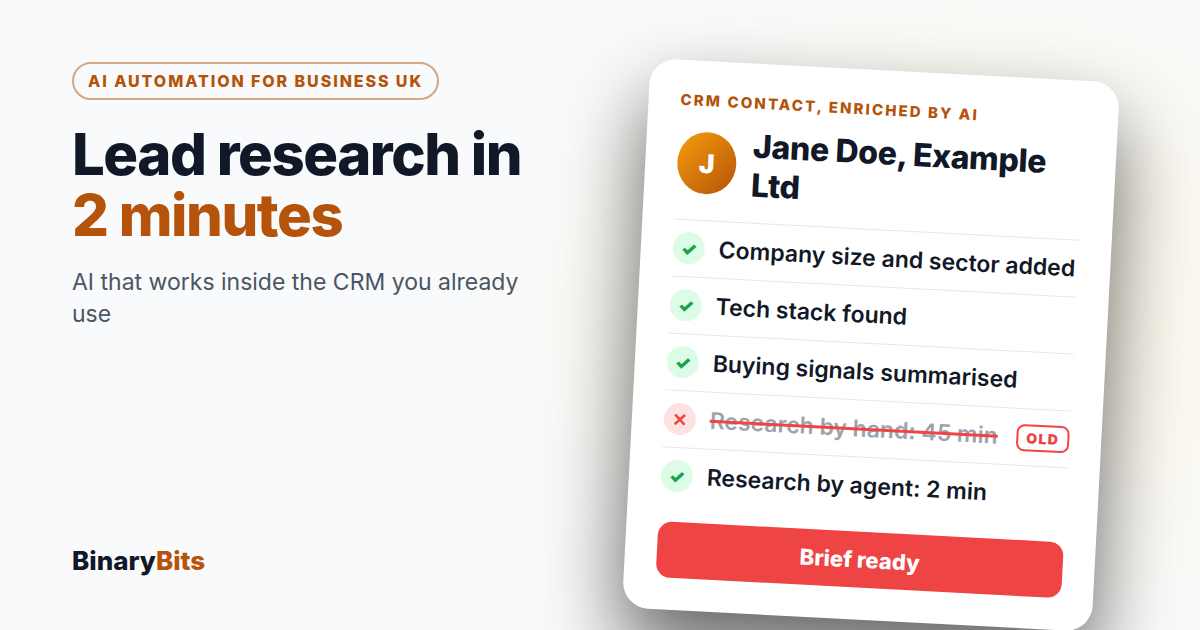
The moment the form submits, the agent triggers. It looks up the company using the email domain — pulling their website, company size, industry, recent news and job postings from public sources. It scores the lead against your ideal customer profile. It creates the CRM record, attaches the research summary, assigns it to the right salesperson based on territory and workload, and drafts a personalised first outreach email referencing something specific about the company. It pings the salesperson with a brief and the draft email ready to review. All of this happens in under two minutes.
The salesperson reviews a pre-researched brief and a ready-to-send email instead of starting from a blank form submission. The difference in first-contact speed and relevance is significant — and speed-to-first-contact is one of the strongest predictors of lead conversion.
The Three Things That Make an Agent an Agent
Not every piece of software that calls itself an "AI agent" actually is one. Three things need to be present.
1. The ability to take actions, not just generate text.
A true AI agent can do things in the world — write to a database, send an email, call an API, update a record, search the web, run a calculation. A system that only produces text responses and requires a human to carry out every action isn't an agent — it's a sophisticated chatbot.
2. Multi-step reasoning.
An agent can break a goal down into steps, execute them in sequence (or in parallel), evaluate the result of each step, and adjust if something doesn't go as expected. It's not a single prompt-response transaction. It's a process.
3. Some degree of autonomy.
The agent decides, within defined boundaries, what to do next. It doesn't wait for a human to approve each step. This is where the "agent" label earns its meaning — and also where the design of appropriate guardrails becomes important, which we'll come back to.
What AI Agents Are Actually Good At
AI agents perform best on tasks that share a specific profile. Understanding this profile helps you identify where agents create genuine value in your business versus where they're the wrong tool.
Agents excel when:
- The goal is clear but the path has multiple steps. "Qualify this lead and prepare a brief" is a clear goal with 6–8 steps. An agent handles this well. "Grow our business" is not a clear goal. An agent cannot handle this.
- The task involves pulling together information from multiple sources. Agents are excellent at connecting things — retrieving data from one system, cross-referencing it against another, synthesising it into a useful output. This is exactly the kind of work humans find tedious and error-prone.
- The task is repetitive and follows a consistent pattern. The more a task follows the same sequence of steps, the more reliable an agent becomes at it. Variability is the enemy of agent reliability.
- Speed matters. An agent doesn't have meetings, doesn't take lunch, and doesn't have a Monday morning backlog. For time-sensitive tasks — lead response, support triage, monitoring and alerting — the always-on nature of agents is a genuine competitive advantage.
- The volume is higher than a human team can comfortably handle. A human can process 20 support tickets an hour. An agent can process 2,000 — at consistent quality, without fatigue.
What AI Agents Are Not Good At
This section is where most AI agent marketing falls short — by omission. Understanding the genuine limitations of agents is just as important as understanding the capabilities, because deploying an agent in the wrong context produces bad outcomes at scale and at speed.
Agents struggle when:
- The goal requires genuine human judgement. Deciding whether to accept a high-risk client, handling a sensitive complaint that requires emotional intelligence, making a strategic trade-off that involves values and priorities — these are not agent territory. Agents can prepare the information; humans need to make the call.
- The task is highly ambiguous or poorly defined. An agent given a vague instruction will either get stuck or make confident mistakes. Clarity of instruction is not optional — it's the foundation of reliable agent behaviour.
- The cost of a mistake is very high. Agents make errors. Not often, but they do. In contexts where an error has serious consequences — sending incorrect financial information to a client, making a compliance-critical decision, communicating in a high-stakes negotiation — the agent should surface information to a human rather than act autonomously.
- The required information isn't available to the agent. An agent can only work with what it can access. If the data it needs is locked in a system with no API, stored in a format it can't read, or simply doesn't exist, the agent can't help — regardless of how sophisticated its reasoning is.
The Question Nobody Asks Enough: What Happens When It Goes Wrong?
One of the most important things to think about before deploying any AI agent isn't "what will it do when it works?" It's "what will happen when it doesn't?"
Well-designed agents have explicit guardrails: boundaries that define what the agent is allowed to do independently, and what it must escalate to a human. These aren't limitations of the technology — they're features of a responsible deployment.
Think of it in three zones:
Zone 1 — Act autonomously: Tasks where the agent has high confidence, the consequences of an error are low, and the action is reversible. Updating a CRM record. Sending a routine notification. Classifying an incoming ticket. The agent handles these without asking.
Zone 2 — Act, but log for review: Tasks where the action is consequential enough that a human should be able to audit it, even if real-time approval isn't needed. Sending a first outreach email to a qualified lead. Updating a price in a system. The agent acts, but the action is logged and surfaced for periodic review.
Zone 3 — Escalate: Tasks where the stakes are too high, the confidence is too low, or the situation is outside the agent's defined scope. Handling a complaint from a high-value client. Any action that affects financial records above a threshold. Anything the agent identifies as ambiguous. The agent prepares and presents; a human decides.
The businesses that get the most value from AI agents are not the ones that give agents the most autonomy. They're the ones that design the right boundaries and trust the agent completely within them.
Types of AI Agents You'll Hear About
The terminology around agents is inconsistent across the industry, but a few terms come up often enough to be worth understanding.
Single-task agents are focused on one workflow — a lead qualification agent, a support triage agent, a reporting agent. These are the most reliable and the best starting point for most businesses.
Multi-agent systems involve several agents working together, each handling a specific part of a larger workflow, with one agent orchestrating the others. More powerful, more complex, and more points of failure. Best approached after you have experience with single-task agents.
Autonomous agents are designed to operate with minimal human oversight, pursuing longer-horizon goals over extended periods. These are the ones generating the most excitement and the most concern. In production business contexts, full autonomy is rarely the right design — supervised autonomy, with clear escalation paths, is almost always the better approach.
Is This Actually Relevant to Your Business Right Now?
The honest answer is: probably yes, but the right scope depends on your stage.
In 2026, 68% of small businesses report using AI tools regularly — a figure that has grown sharply year over year. Businesses that are thoughtfully adopting agents now are building operational advantages that compound over time. Those that wait are narrowing the window in which adoption is a differentiator rather than table stakes.
But "adopting AI agents" doesn't mean deploying a complex multi-agent system across your entire business next quarter. It means identifying one workflow — ideally one that is repetitive, well-defined, and currently consuming meaningful team time — and building something focused and reliable for that workflow first.
The businesses extracting the most value from agents right now aren't the ones that moved fastest. They're the ones that started with a narrow, well-scoped problem and built genuine confidence in the technology before expanding its scope.
Where to Start if You're Evaluating This for Your Business
Three questions help identify whether an AI agent is the right tool for a problem you're trying to solve.
1. Is the task currently consuming meaningful time from people who could be doing more valuable work? If yes, it's worth exploring. If the task takes 30 minutes a week, the cost of building and maintaining an agent probably isn't justified.
2. Does the task follow a consistent enough pattern that you could write down the steps? If you can document the process clearly — even if it has conditional branches — an agent can likely follow it. If the process is so variable that every instance requires fresh judgement, agents will struggle.
3. Is the data the agent needs available and accessible? An agent is only as good as its access to information. Before scoping any agent project, map the data sources it needs and verify they're accessible — either via API, database, or structured file. Surprises here are expensive to discover mid-build.
If you can answer yes to all three, you have a strong candidate for an agent. If you're not sure, a short conversation with someone who builds these systems regularly is usually enough to get a clear picture.
The Takeaway
An AI agent is not magic and it's not science fiction. It's a system that pursues goals by taking actions across multiple steps, using tools it has access to, within boundaries you define.
Chatbots answer questions. Agents get things done. The distinction is real, and the practical implications for how you work are significant — for the businesses that adopt agents thoughtfully, and for the ones that don't.
The businesses thriving in the current moment aren't the ones that adopted every new AI tool the moment it launched. They're the ones that identified where the technology genuinely solves a problem, built something focused and reliable, and expanded from there.
If you're trying to figure out whether AI agents belong in your business — what the right first use case is, what it would take to build it, what it would realistically deliver — that's exactly the kind of conversation we have with clients regularly.