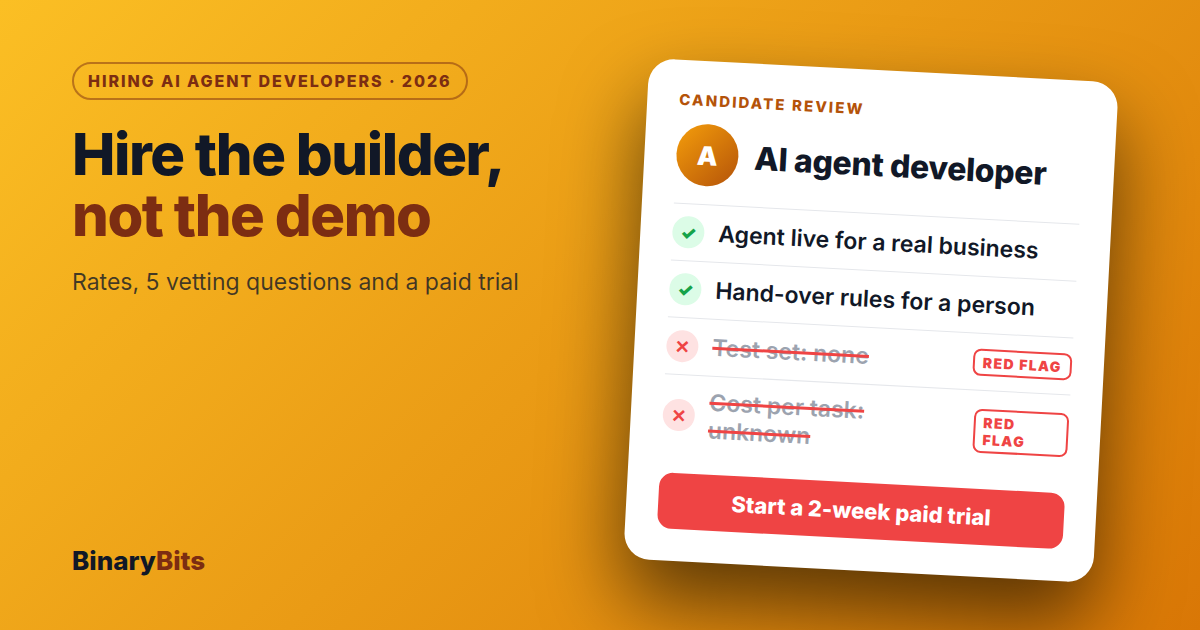
To hire AI agent developers, budget $119-$185 an hour for a mid-level US freelancer or $28-$72 for one in India, then test what they've built, not what they say. Ask five questions about failures, hand-offs, testing and cost per task, and pay for a 1-2 week trial on a real workflow before you commit.
This guide gives you the rates by country, which hiring model fits, the questions that separate agent builders from prompt writers, and the red flags.
💡 What you'll get from this post: a hiring process you can run this month, with the costs and the exact questions to ask.
TL;DR
- Mid-level freelance AI agent developers cost $119-$185 an hour in the US, $74-$115 in the UK and $28-$72 in India.
- Hire a freelancer for one small agent, an agency or dedicated team for anything you'll keep running.
- Ask what happens when a tool call fails, when the agent stops and hands over, and what one finished task costs.
- Pay for a 1-2 week trial on one real workflow, with a pass mark agreed up front.
- Keep the code, the AI accounts and the logs in your name from day one.
How much does it cost to hire AI agent developers?
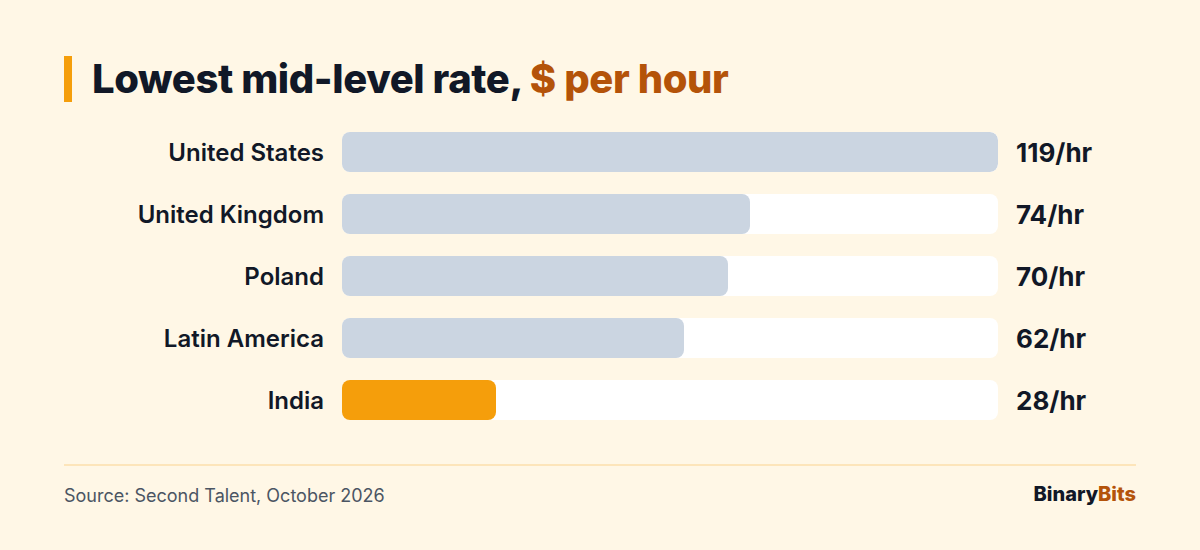
It depends mostly on where the developer lives. Mid-level freelance AI agent developers charge $119-$185 an hour in the US and $28-$72 in India, according to Second Talent's October 2026 rate tables. Here's the spread, with what a full-time month (160 hours) works out to:
| Where the developer is | Hourly rate (mid-level) | Full-time month, 160 hours |
|---|---|---|
| United States | $119-$185 | $19,040-$29,600 |
| United Kingdom | $74-$115 | $11,840-$18,400 |
| Poland (Eastern Europe) | $70-$109 | $11,200-$17,440 |
| Latin America | $62-$96 | $9,920-$15,360 |
| India | $28-$72 | $4,480-$11,520 |
| BinaryBits developer (India) | $15-$30 | $2,400-$4,800 |
The monthly column is our arithmetic on those hourly rates. The last row is our own rate, not market data. Platform fees and taxes sit on top of freelance rates.
What does a salaried AI agent developer cost in the US and UK?
The median US software developer earned $135,980 a year in May 2025, according to the US Bureau of Labor Statistics. That's about $65 an hour over 2,080 hours, before benefits, recruiting and the months to hire. In the UK, the median advertised salary for AI agent jobs is £95,000, per IT Jobs Watch.
Agent work is a newer skill than general software, so expect to pay above the developer median for someone who has shipped agents. If you're comparing Indian costs in detail, including salaries and time-zone overlap, see our guide to hiring AI developers in India.
Who should you hire to build AI agents: a freelancer, an agency or a dedicated team?
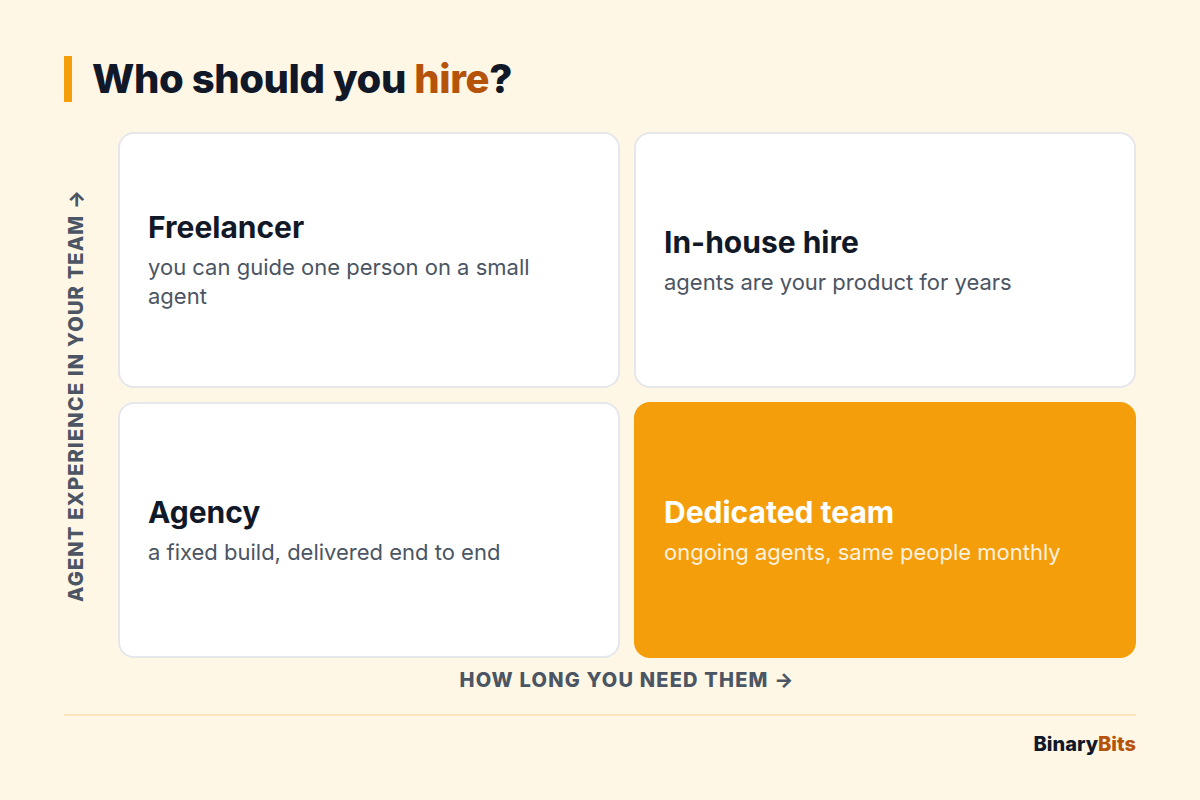
Hire a freelancer for one small, self-contained agent. Hire an agency for a fixed project you want delivered end to end. Hire a dedicated team when the agents will keep changing and you want the same people on them every month.
| Model | Best for | Watch out for |
|---|---|---|
| Freelancer | A single agent, a prototype, a few weeks of work | One person: no cover when they're ill or move on |
| Agency (fixed project) | A defined build with a deadline | Who maintains it after handover |
| Dedicated team | Several agents, ongoing changes, months of work | Needs someone on your side to set priorities |
| In-house hire | Agents are your product, for years | Months to hire, full salary from day one |
If you're choosing between agent companies rather than individual developers, our checklist for choosing a custom AI agent development company covers that side.
Do you need a developer at all?
Maybe not. If the workflow is short and uses popular apps, a no-code tool may be enough, and we cover those in how to build a custom AI agent without code. You need a developer when the agent touches your own systems, private data, or tasks where a mistake costs money.
What skills should an AI agent developer have?
An AI agent is software that reads a request, decides what to do and then acts in your systems: it updates the CRM, replies to the ticket, files the document. Building one well is mostly normal software engineering with a model in the middle.
- Tool calling: letting the model use your APIs (the way software reads and writes data in another system), and handling it when those calls fail.
- Guardrails: rules for what the agent may do alone and what needs a person's approval.
- Evaluation: a test set of real past cases with the right answers, run on every change.
- Monitoring: a log of every run, its cost and every human correction.
- Security basics: prompt injection, where text in an email or web page tricks the agent, is number one in the OWASP Top 10 for LLM applications. OWASP's advice is to restrict the model's access to the minimum it needs.
Does the developer need to know a specific framework?
Less than you'd think. Frameworks like LangGraph or CrewAI come and go. Anthropic's own guide to building effective agents recommends "finding the simplest solution possible", and says plain workflows suit well-defined tasks better than agents. A developer who reaches for a multi-agent framework for a simple job is a warning sign, not a strength.
How do you vet AI agent developers? 5 questions to ask
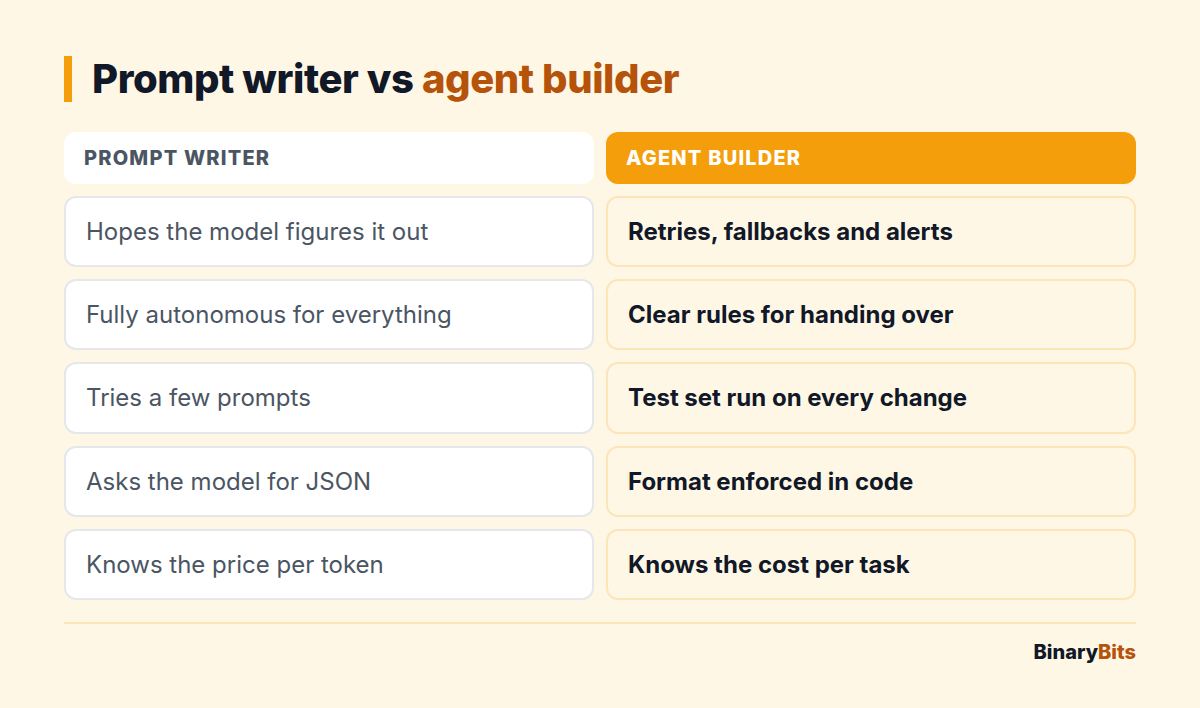
Ask about things that only go wrong in production. Someone who has run agents for real customers answers these with stories; someone who hasn't answers with tools and buzzwords.
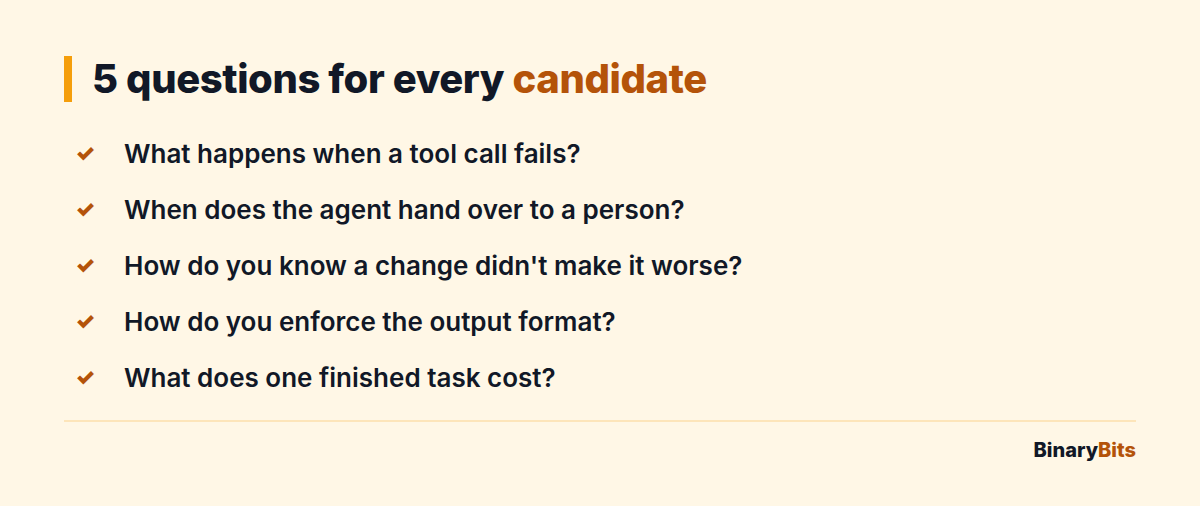
1. What happens when a tool call fails?
Good answer: retries with a limit, a fallback (a safe default action, or a hand-over to a person), and an alert. Weak answer: "the model will figure it out", or no idea that APIs time out.
2. When does the agent stop and hand over to a person?
Good answer: named triggers, such as low confidence, money above a set amount, an angry customer, or a request outside its list of tasks. Weak answer: "it's fully autonomous".
3. How do you know a change didn't make it worse?
Good answer: a test set of real cases, scored on every change, with the score tracked over time. Weak answer: "we try a few prompts and check".
4. How do you make sure the output is in the right format?
Good answer: the format is enforced in code (a schema the output must pass, rejected and retried if not). Weak answer: "I tell the model to always reply in JSON".
5. What does one finished task cost?
Good answer: a number per task, including model fees, retries and the human review time, plus how they'd cut it. Weak answer: only the price per token (the unit AI providers bill in), or no idea.
Then ask for one agent they've built that's still running, and for a failure they caused and what they changed afterwards. People who've shipped have both.
How should a paid trial work?
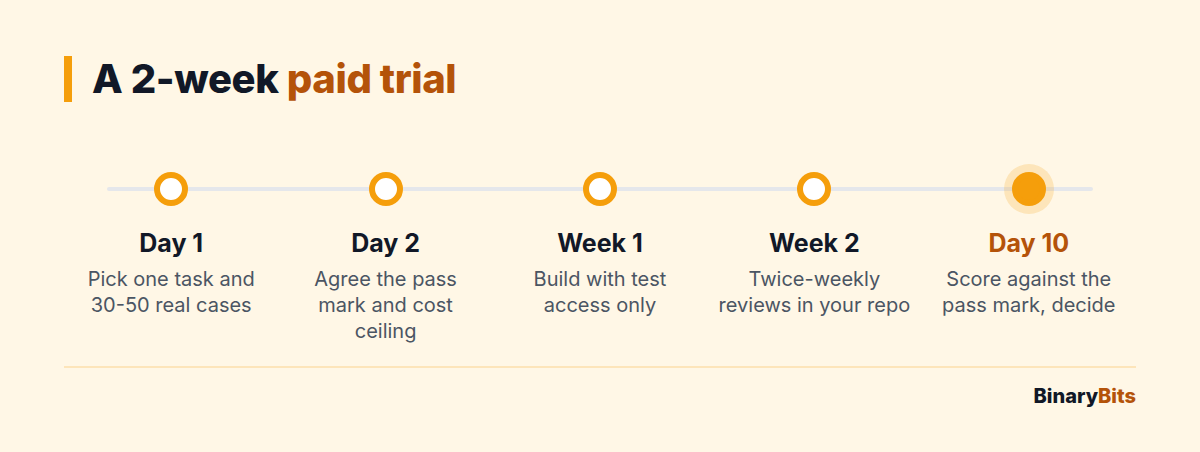
Pay for one to two weeks on one real workflow, with a pass mark you agree before it starts. Toptal, for example, starts AI agent engagements with a trial of up to two weeks. A trial on your own data tells you more than any interview.
- Pick one task the agent should take over, with 30-50 real past cases and the right answers.
- Agree the pass mark: for example, the share of cases handled without a person, and a cost per task ceiling.
- Give limited access: a test account, sample data, no production keys.
- Review twice a week: short calls, the code in your repository, not a demo video.
- Score it at the end against the pass mark, then decide.
What it costs: 40 hours at mid-level rates is $4,760-$7,400 with a US freelancer, $1,120-$2,880 with one in India, and $600-$1,200 at our rate. That's our arithmetic on the rates above.
Want to run a paid trial with developers who've shipped agents? See how our dedicated developer teams work →
What are the red flags when hiring AI agent developers?
Most of them come down to having built demos but never run an agent for real users. Gartner expects over 40% of agentic AI projects to be canceled by the end of 2027 because of rising costs and unclear value, as Reuters reported. Hiring well is how you avoid being one of them.
- Only demos. No agent running for a real business that they can show or describe in detail.
- "Fully autonomous" for everything. No hand-over rules, no approval step for costly actions.
- No test set. Quality is judged by trying a few prompts.
- No cost estimate per task. You find out the model bill after launch.
- Accounts in their name. They want to host the agent or hold the API keys themselves.
- Can't name a failure. Everyone who has run agents has broken one.
What should the contract and access setup cover?
Sort this out before anyone touches your systems. It protects you whichever hiring model you pick.
- IP assignment: the code, prompts and test sets belong to you.
- Your accounts: the code repository, cloud, and AI provider accounts are in your company's name, and the developer gets access.
- Least access: only the systems and data the task needs, separate keys for testing.
- Data terms: an NDA, plus a data processing agreement if personal data is involved.
- Exit terms: notice period, handover notes, and access removed on the last day.
⚠️ Note: This is general information, not legal advice. Have a lawyer review contracts that cover IP and personal data.
What should the first 30 days look like?
One agent, one workflow, measured weekly. Resist adding a second agent until the first one hits its target.
- Week 1: access set up, the workflow mapped step by step, the test set agreed.
- Week 2: a working version on test data, with logs for every run.
- Week 3: live on a small share of real cases, a person approving each action.
- Week 4: the first weekly report: tasks handled, how often a person stepped in, cost per task.
This is how our own agents went live. Our lead enrichment agent took one task, researching each inbound lead in HubSpot, and cut it from 45 minutes to 2 minutes per lead. A support agent we built answers from the product docs and past tickets and handles 70% of support queries. Those are past results, not a promise for your project.
When shouldn't you hire an AI agent developer?
When nobody on your team can write down how the decision is made today. An agent can't automate a process your people can't explain, and a developer will spend your budget discovering that. Also wait if the process changes every week, or if the task happens a few times a month: a custom agent isn't worth it there, because the build won't pay back.
Fix the process first, then hire. If you're not sure which of your tasks are worth automating, our AI agent development page lists the ones we see pay back fastest.
Hire AI agent developers who've shipped agents
Book a free 30-minute call. We'll look at the workflow you want to automate, tell you if a developer is worth it, and set up a short paid trial if it is. No pitch, just a conversation.
Frequently asked questions
How much does it cost to hire AI agent developers?
Mid-level freelance AI agent developers charge about $119-$185 an hour in the US, $74-$115 in the UK, $70-$109 in Poland and $28-$72 in India, based on Second Talent's October 2026 rates. A full-time month of 160 hours ranges from about $4,480 in India to $29,600 in the US. Salaried US software developers had a median pay of $135,980 in May 2025.
Who should I hire to build AI agents for my business?
Hire someone who has an agent running for a real business today, not only demos. For one small agent, a freelancer can work. For agents you'll keep changing, a dedicated team or agency gives you cover and continuity. Whoever you pick, test them with a paid 1-2 week trial on one of your own workflows, scored against a pass mark agreed in advance.
How do I vet an offshore developer?
The same way as a local one, with more weight on proof. Ask for a system they built that's still running, and a failure they caused. Ask how they handle failed tool calls, hand-overs to people, testing and cost per task. Then run a short paid trial in your own repository with limited access, and hold twice-weekly calls in overlapping hours.
Should I hire a freelancer or an agency to build an AI agent?
A freelancer suits a single, small agent you need in a few weeks, at the lowest cost. An agency or dedicated team suits work that will run for months: you get cover when someone is away, a second pair of eyes on the code, and someone to maintain the agent after launch. The risk with a freelancer is that everything depends on one person.
Can I hire AI agent developers in India?
Yes. India has a large pool of developers building with AI models, and mid-level freelance AI agent developers there charge about $28-$72 an hour, per Second Talent's October 2026 data. Plan for the time difference by agreeing a few overlapping hours each day. Vet them on shipped agents and a paid trial, exactly as you would anyone else.
How long does it take to build an AI agent?
A single-workflow agent usually takes a few weeks once the developer has access to your systems: about a week to map the task and build the test set, one to two weeks to build, then live on a small share of real cases. Agents that touch several older in-house systems take longer, because the integrations take most of the time.