A good custom AI agent development company proves its agents work in production, writes the integrations into your systems itself, measures how often a person has to step in, and tells you up front what the agent costs to run each month. Start with a 2-week paid pilot on your real data before you sign a full build.
This post gives you a 10-point checklist, the questions to ask on the first call, real prices and the numbers from agents we've delivered.
💡 What you'll get from this post: a way to tell a team that ships working agents from one that ships demos, in one or two calls.
TL;DR
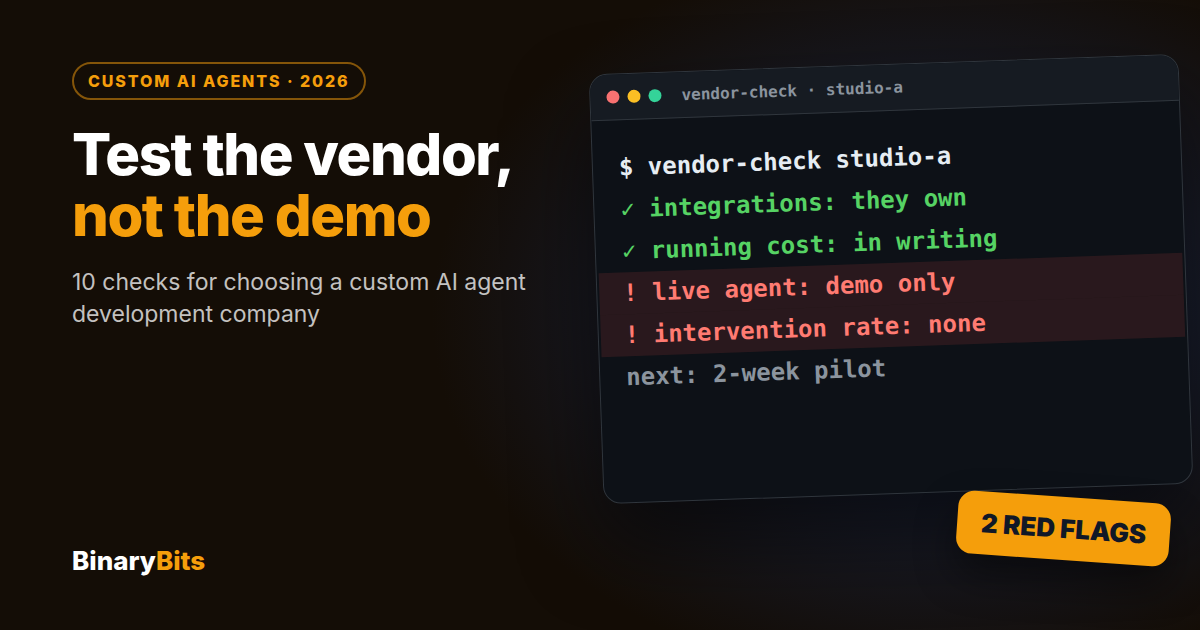
- Ask to see an agent that's been running in production for months, not a demo.
- Ask who writes and maintains the integrations with your CRM, helpdesk or database. That's where most agent projects stall.
- Ask how they measure the intervention rate: how often a person has to correct, approve or redo the agent's work.
- Pay for a 2-week pilot on your own data first. At $15-$30 an hour per developer, that's $1,200-$2,400 for one developer.
- Get the monthly running cost in writing: model usage, hosting, monitoring and fixes.
What does a custom AI agent development company deliver?
An AI agent is software that reads a request, decides what to do and then takes the action in your systems: it updates the CRM, replies to the ticket, files the document. A custom AI agent development company builds one around your workflow and your tools, rather than selling you a fixed product.
What you should receive is more than the agent itself:
| Deliverable | What it is | Why it matters |
|---|---|---|
| Workflow map | The steps the agent takes over, and the ones it doesn't | Stops the scope from drifting |
| Integrations | Code that connects the agent to your CRM, helpdesk, email or database | The agent is useless if it can't act |
| Guardrails | Rules on what the agent may do alone and what needs a person's approval | Limits the damage when it's wrong |
| Test set | Real past cases with the right answers, run on every change | Shows whether an update made it worse |
| Monitoring | A log of every run, its cost and every human correction | How you measure the intervention rate |
| Handover | Code in your repository, setup notes, credentials in your accounts | You can change vendors later |
When does a custom AI agent make sense, and when is no-code enough?
Building custom AI agents for a business makes sense when the work is repeated many times a week, follows rules a person could write down, and touches systems that have an API (a way for software to read and write data). Lead research, support replies and document routing fit well.
No-code tools are enough when the workflow is short, uses popular apps and doesn't handle sensitive data. If you want an operations team to triage incoming requests without writing code, start there. We cover those tools in how to build a custom AI agent for your business without code.
When should you hire a company to build a custom AI product instead?
- Your systems are old or in-house. No-code connectors don't exist for them.
- The data can't leave your control. You need the agent on your own servers or cloud account.
- The volume is high. Per-task pricing on no-code platforms grows faster than a custom build's running cost.
- A mistake is expensive. You need approval steps, test sets and logs you can audit.
Should you build in-house or hire an AI agent development company?
Build in-house if AI agents are your product and you'll keep improving them for years. Hire a company if the agent supports your business and you need it working this quarter.
Cost is part of it. The median US software developer earned $135,980 a year in May 2025, according to the US Bureau of Labor Statistics. Over 2,080 working hours that's about $65 an hour before benefits, hiring time and the months it takes to learn agent work. Our developers bill $15-$30 an hour, and you pay only for the weeks the build needs.
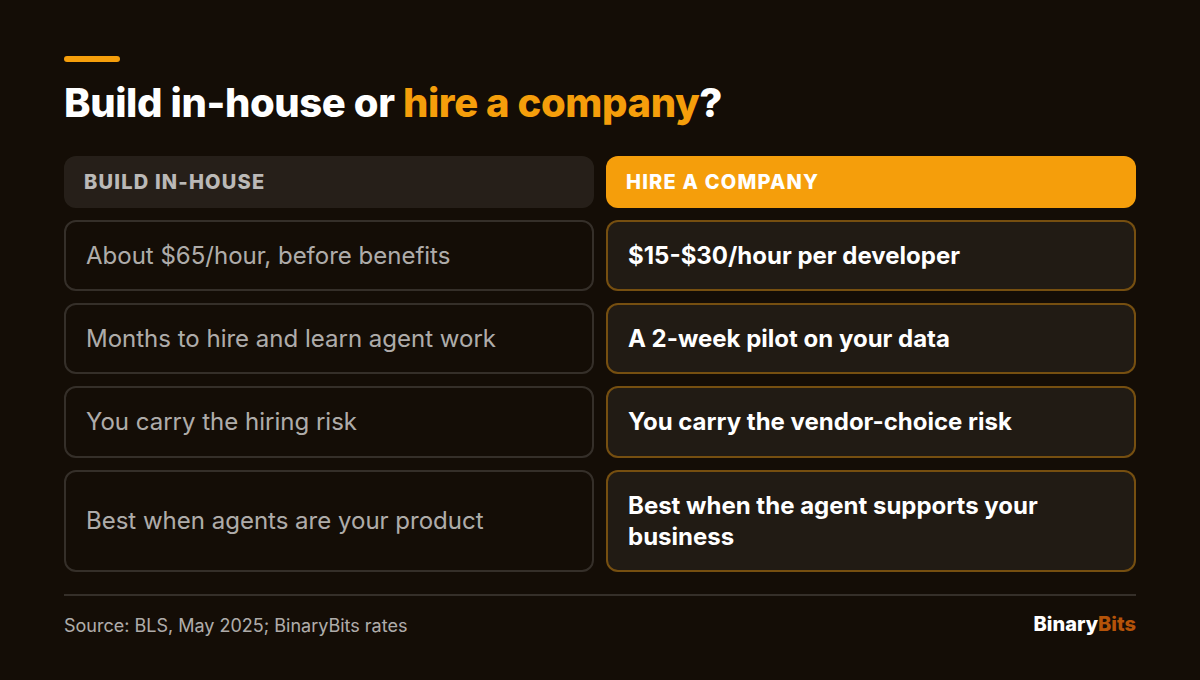
The risk sits in different places. In-house, you carry the hiring risk and the learning curve. With a vendor, you carry the risk of picking the wrong one, which is what the checklist below is for.
How do you evaluate a custom AI agent development company?
Judge them on what they've shipped and how they run it, not on the demo. Gartner expects over 40% of agentic AI projects to be canceled by the end of 2027, and estimates that only about 130 of the thousands of vendors selling "agentic AI" are the real thing, as Reuters reported. The rest relabel chatbots, which Gartner calls "agent washing".
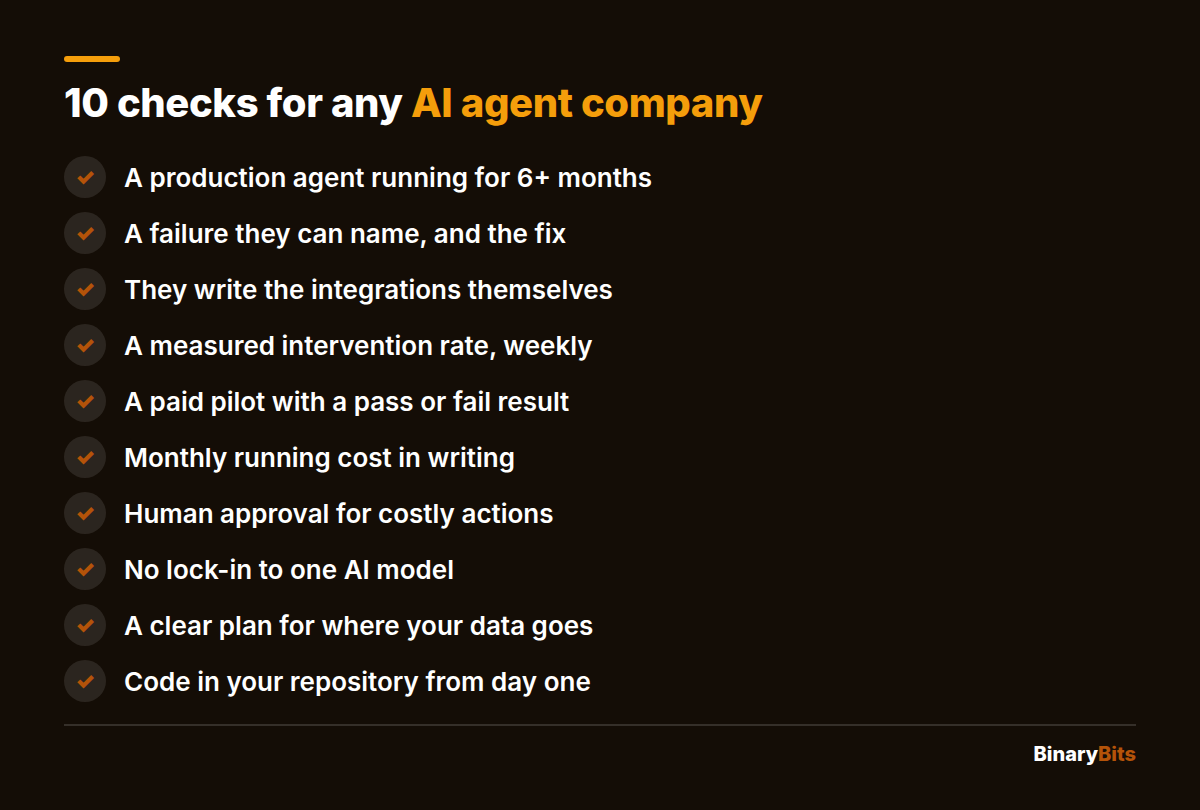
- A production agent you can see. Live, and running for at least six months, as this list of questions for AI agencies suggests.
- A failure they can name, and what they changed after it.
- They write the integrations into your tools themselves.
- A measured intervention rate, reported every week.
- A paid pilot with a clear pass or fail result.
- A monthly running cost in writing.
- Guardrails: human approval for costly or customer-facing actions.
- No lock-in to one model provider.
- A clear data plan: where your data goes and who can see it.
- You own the code, in your repository, from day one.
Who owns the integrations?
Ask who writes the code that connects the agent to your CRM, helpdesk or database, and who fixes it when one of those tools changes. Integration is where agent projects stall, as &above's buyer guide also points out. A vendor that hands it back to your team is selling half a project.
How do they measure the intervention rate?
The intervention rate is the share of the agent's runs where a person had to step in: correct the answer, approve it, or do the task again. It's the clearest single number for whether an agent is actually saving work.
- Every run is logged, and so is every human correction.
- The rate is reported each week, per task type.
- You agree a target before the build, and the pilot reports against it.
If a vendor can't say how they'd count it, they don't know how often their agents fail.
What does a 2-week pilot deliver?
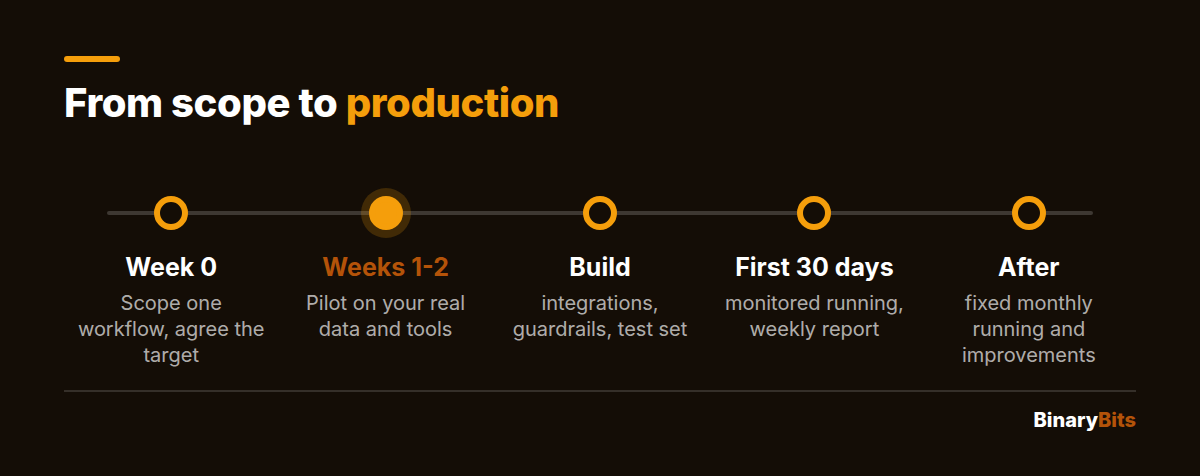
A good pilot runs one workflow on your real data, inside your real tools, and ends with a number: how many cases the agent handled, how many needed a person, and what each run cost. It shouldn't end with a slide deck.
What will it cost to run each month?
The build is a one-off. Running the agent costs money every month: the AI model's usage fees (charged per amount of text processed), hosting, a vector database if it searches your documents, and the hours to fix and improve it. Ask for each line separately.
What happens when the agent is wrong?
Strong answers name specific checks: output validation, a test set run on every change, human approval for costly actions, and the agent saying "I don't know" instead of guessing. "Better prompts" is a weak answer. The NIST AI Risk Management Framework is a useful free reference if you want a structured list of risks to ask about.
Is the agent tied to one AI model?
Models get retired and repriced. The agent should let you switch the model behind it (say, from one provider to another, or to one running on your own servers) without a rebuild.
What do you own at the end?
The code, the prompts, the test set and the logs, in your accounts. If the vendor disappears, another team should be able to pick it up from the setup notes.
Want to run this checklist against a real workflow of yours? See how we scope and build AI agents →
What did our delivered agents measure?
Here are three agents we've built, with the results the clients measured. They're past results, not a promise for your project.
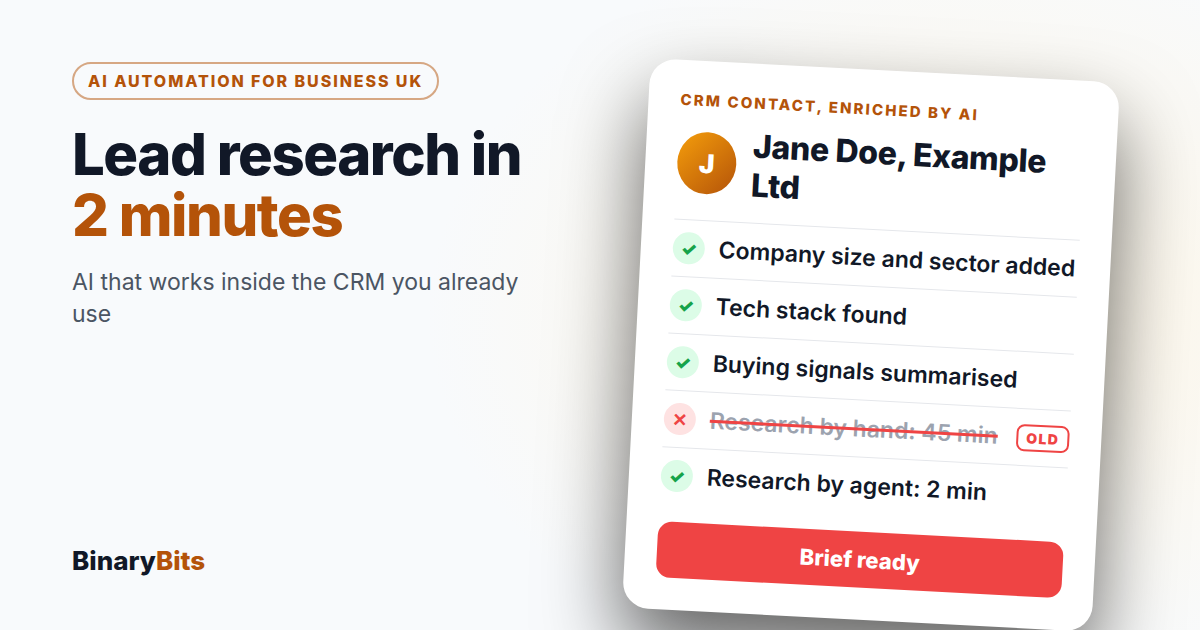
- Lead enrichment agent in HubSpot. It adds company data, tech stack and buying signals to every inbound lead. Research time went from 45 minutes to 2 minutes per lead, 95% less. See the lead enrichment agent case study.
- Customer support agent. It uses RAG, meaning it looks up the product docs and past tickets before it answers. It automated 70% of support queries and made replies 70% faster. See the AI customer support case study.
- Operations agents. Document processing, lead routing and approvals across sales, operations and support. In our project, they removed 80% of the manual operations work and tripled the team's output.
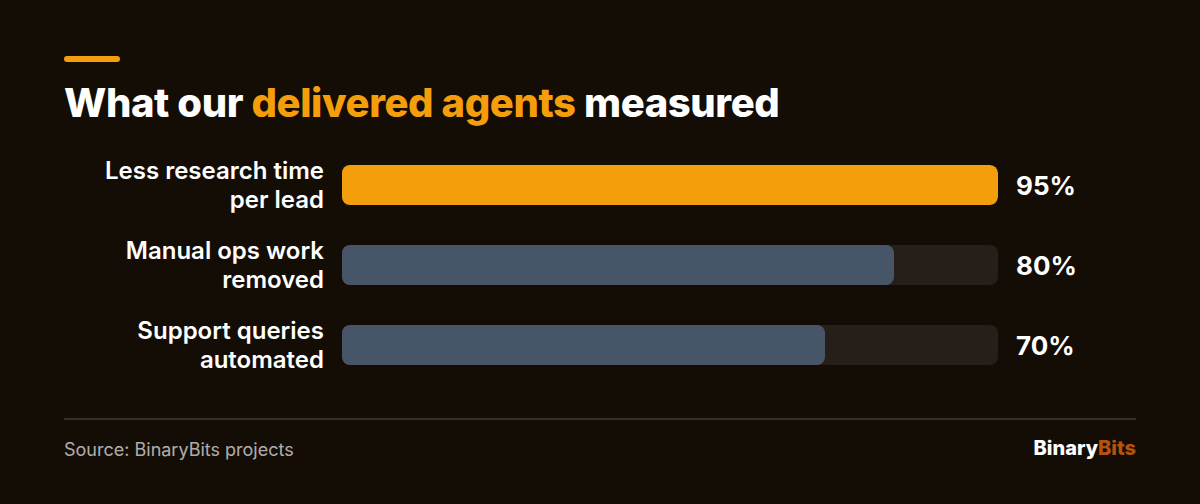
What they had in common: each took over one clear, repeated task, inside a tool the team already used.
How much does custom AI agent development cost, and how long does it take?
The cost of custom AI agent development is mostly developer time, plus a monthly running cost. Our developers bill $15-$30 an hour each, and we set a fixed monthly cost per project once the scope is clear. Here's how the hours add up:
| Stage | Example team and time | Hours | At $15-$30/hour |
|---|---|---|---|
| Pilot | 1 developer, 2 weeks | 80 | $1,200-$2,400 |
| One-workflow agent | 1 developer, 4 weeks | 160 | $2,400-$4,800 |
| Multi-step agent with several integrations | 2 developers, 8 weeks | 640 | $9,600-$19,200 |
| Running and improving | Set per project | - | Fixed monthly cost |
The examples are arithmetic on our rate, not quotes. The real length depends on how many systems the agent touches and how clean their APIs are. If you're an early-stage team, our guide to deploying AI agents in a startup without failing covers what to build first.
Can you work in US hours?
Our team in India covers US morning hours, so calls, reviews and fixes happen while your day is starting. If you need a team for longer, we also run dedicated developer teams.
Which questions should you ask before you sign?
Ask these on the first call and write down the answers. The weak answers are as telling as the strong ones.
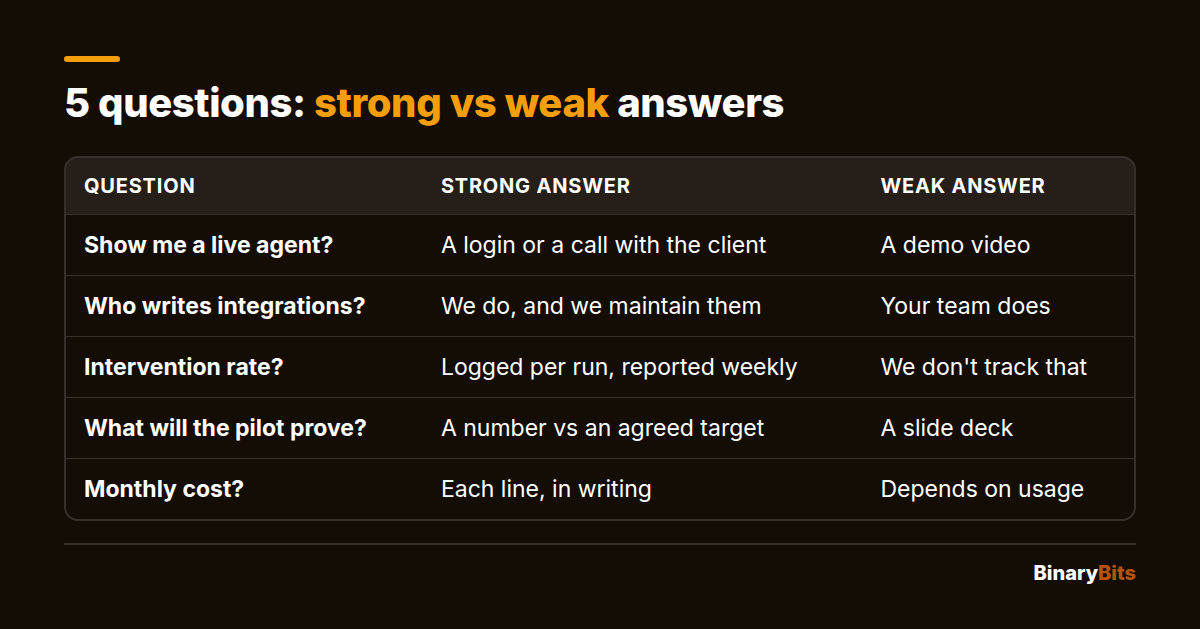
- Can you show me an agent of yours that's in production today?
- Who writes and maintains the integrations with our tools?
- How will you measure the intervention rate, and what's the target?
- What will the pilot prove, and what happens if it fails?
- What will this cost us each month once it's live?
What are the red flags?
- Only demos. No agent you can see working in a real business.
- "Our platform". The agent only runs on their software, so you can't leave.
- No running-cost estimate. You find out the monthly bill after launch.
- An agent for everything. A good partner tells you which tasks aren't worth automating.
And one honest limit: if your process changes every week, or nobody can write down how a person decides, don't hire anyone yet. An agent can't automate a decision your team can't explain. Fix the process first.
Talk through your workflow with us
Book a free 30-minute call. We'll tell you which tasks are worth automating, what a pilot would prove, and what it would cost to run. No pitch, just a conversation.
Frequently asked questions
What does a custom AI agent development company do?
It builds AI agents around your own workflow and tools. That means mapping which steps the agent takes over, writing the integrations into your CRM, helpdesk or database, setting rules on what needs a person's approval, testing on real past cases, and monitoring every run once it's live. A good one also hands over the code and tells you which tasks aren't worth automating.
How much does custom AI agent development cost?
It's mostly developer time plus a monthly running cost. At our rate of $15-$30 an hour per developer, a 2-week pilot with one developer is $1,200-$2,400, and a 4-week single-workflow build is $2,400-$4,800. Larger agents with several integrations cost more. Running costs cover the AI model's usage fees, hosting, monitoring and fixes, and we set them per project.
Should I build AI agents in-house or outsource them?
Build in-house if agents are your core product and you'll improve them for years. Outsource if the agent supports your business and you need it working soon. The median US software developer earns $135,980 a year (BLS, May 2025), and hiring takes months. A vendor lets you test the idea with a short pilot before you commit to a team.
Who should I hire to build custom AI agents for my SaaS product?
Hire a team that has shipped agents inside other software products, not only standalone chatbots. Ask to see one running in production, check that they'll write the integrations with your app's API themselves, and make sure the code lives in your repository. For a SaaS product, also ask how the agent keeps each customer's data separate.
We can't send customer data to third-party services. How do we build agents?
You have three common options. Run an open-weight model (one you can download and host) on your own servers. Use an AI model through your existing cloud account, in your chosen region, under its data terms. Or strip names, emails and other personal details before any text leaves your systems. A good vendor will help you pick one and document where data goes.
Can a studio build a custom AI agent within a 3-month launch window?
Usually yes for one well-defined workflow, if the systems it touches have APIs. Spend the first two weeks on a pilot with your real data, then build for production, then leave a month of monitored running before the launch date. Three months gets tight when the agent needs several integrations with older in-house systems, so scope those first.