Simple questions, answers spread across many screens
Answers are spread across many screens and tables.
Asking someone, or opening five pages, takes too long for simple questions like "how did last week's posts do?"
We wanted to ask in plain English and get a short, correct answer, without giving an AI the power to change anything.
A chat that can look, but never touch
Ask AI is a chat inside our own apps. It was built for our own companies, BinaryBits and TheDataHQ, and it is used every day.
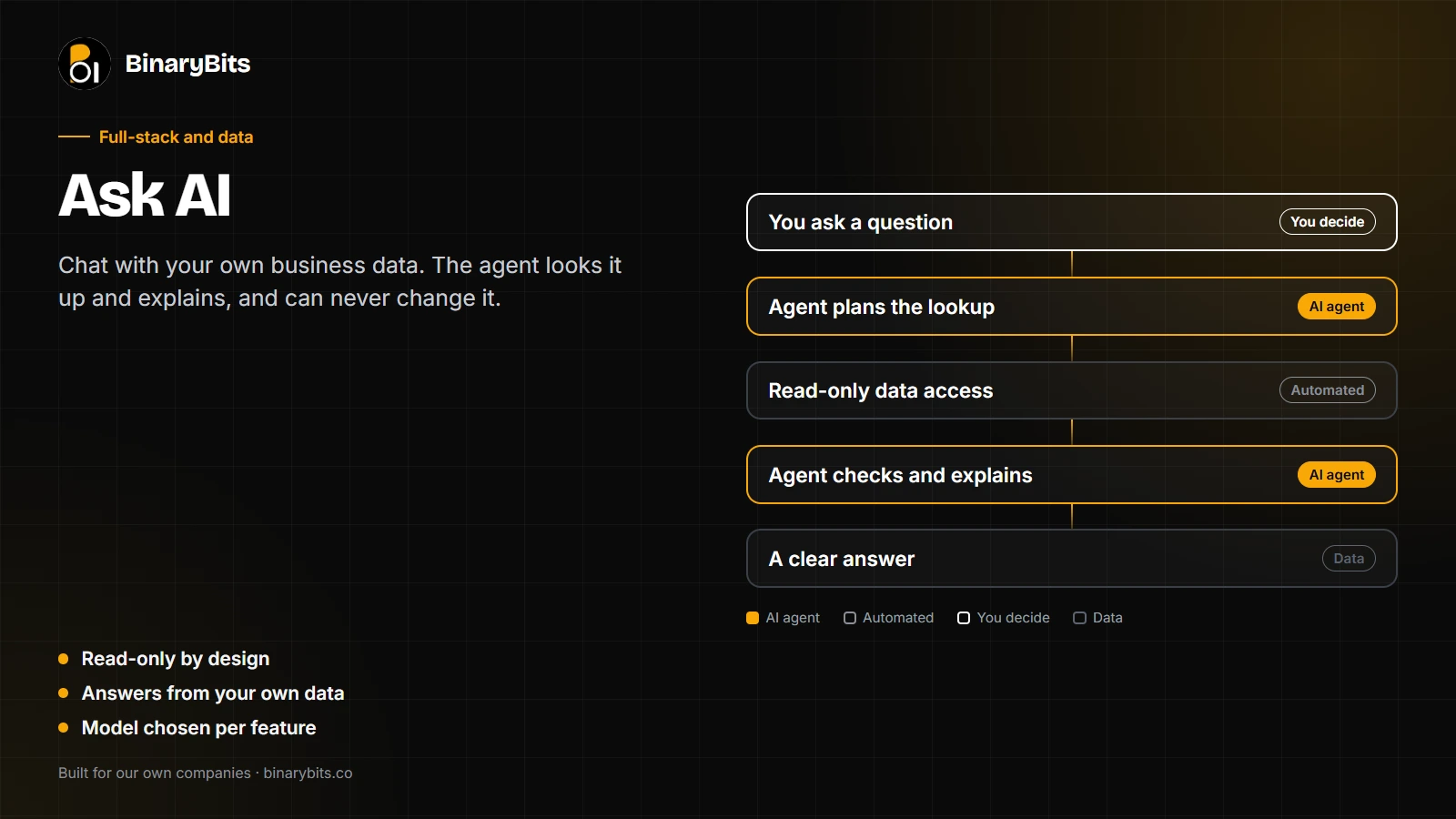
From question to grounded answer
Safe by design, grounded in data
Safety comes from the design, not from instructions: the agent simply cannot change data. The agents run on Anthropic's Claude, through Claude Code skills.
| Who | What it does |
|---|---|
| Planner (AI) | Works out what to look up to answer the question. |
| Read-only access (automated) | Returns the data the agent asks for. It cannot change anything. |
| Explainer (AI) | Checks what was found and writes a short answer grounded in it. |
| The owner (person) | Asks the questions and chooses which Claude model each feature uses. |
Read-only access by design. There is no possibility of changes.
Short answers grounded in what was looked up, so they don't wander.
The owner chooses the right model per feature, balancing quality and cost.
Conversations continue where they left off.
Technologies used
Our own Python code, a relational SQL database, and Anthropic's Claude.
Challenges and how we solved them
Answers without opening five screens
Ask AI is in daily use. Business results: not applicable for this internal tool.
Last updated: November 2026
What this means for you
The same safe pattern works over any data your team needs answers from.
- Chat with your company data. Plain-English questions over your own databases and reports.
- Internal AI assistants for operations. Answers for the team without waiting for an analyst.
- Analytics questions answered without a dashboard. Ask the question instead of building another report.
For a client we would connect it read-only to your PostgreSQL, data warehouse or BI layer, with access rules. See our AI agent development services.
Frequently asked questions
Can the AI change our data?
No. Its access is read-only by design.
Which data can it use?
Whatever it's connected to read-only, such as databases, a warehouse or reports.
How do you control cost?
By choosing the right model per feature.