Two websites, very little time
Two company websites, each with its own audience, and very little time.
Picking blog topics by gut feeling wastes posts on topics nobody searches. The data that would help sits in different places: Search Console, analytics, competitors' sites and what people ask in different countries.
Bringing it together by hand every week isn't realistic.
A topic engine, audits and a roadmap
The strategist decides what our two company websites should write next. It was built for our own companies, BinaryBits and TheDataHQ, and it is used every day.
From scattered data to a content brief
Live research, not fixed formulas
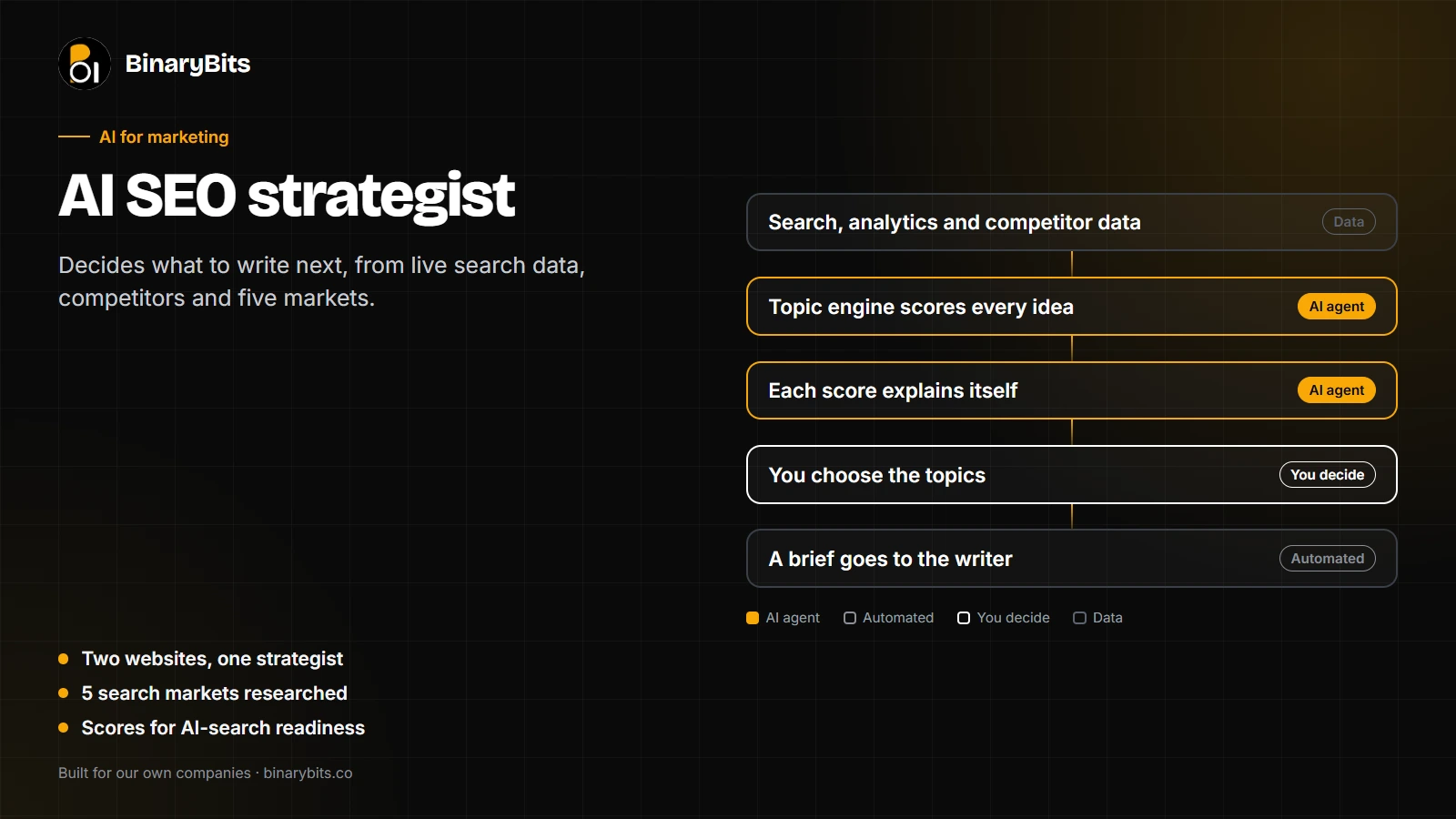
The AI researches from live data each time; there are no fixed keyword lists or templates. Code gathers and scores the data; the agent reasons and explains; a person decides. The agents run on Anthropic's Claude, through Claude Code skills.
| Who | What it does |
|---|---|
| Topic engine (automated) | Collects the data sources and scores topic candidates on comparable signals. |
| Researcher (AI) | Researches the best candidates from live data and explains each one. |
| Site audits (automated) | Crawl our sites for on-page SEO issues and AI-search readiness, and produce the scores. |
| A person | Picks the topics. Nothing is written without that choice. |
Every score explains itself, so a person can trust it or challenge it.
Titles and topics are researched from live data each time, never from fixed formulas.
An AI-search readiness score checks how easily assistants can find, understand and cite a page.
The strategist recommends; a person decides what gets written.
Technologies used
Official Google APIs, website crawling, our own Python code, and AI agents built on Anthropic's Claude.
Challenges and how we solved them
Two sites, one strategist
The strategist is in daily use for two company websites, and it feeds the blog workflow. Business results will be added here once they are measured.
Last updated: November 2026
What this means for you
The same engine works for any site that wants to publish what people actually search for.
- A content strategy engine for a SaaS or e-commerce site. Topics ranked and explained from your own data.
- An AI-search readiness audit. How well your pages can be found and cited by AI assistants, alongside classic SEO.
- A research dashboard that merges your analytics. Search Console, analytics and competitors in one place.
For a client we would connect your own analytics and search tools, and host on your cloud with PostgreSQL. For client systems we build on PostgreSQL, MySQL, MongoDB or Redis, and cloud data warehouses where needed, chosen for the project's scale and team. See our AI agent development services.
Frequently asked questions
Does it replace an SEO specialist?
No. It does the research and explains its reasoning; a person decides. It makes one person much faster.
Which data does it use?
Search Console, Google Analytics 4, competitors' public sitemaps, search autocomplete in several markets, news and public discussions, and optionally a keyword tool.
What is AI-search readiness?
How easily AI assistants can find, understand and cite a page. We score it alongside classic SEO.
Can it work for one site?
Yes. It handles each site separately, with its own audience and markets.